Using the Edmonton obesity staging system to predict mortality in a population-representative cohort of people with overweight and obesity
- PMID: 21844111
- PMCID: PMC3185097
- DOI: 10.1503/cmaj.110387
Using the Edmonton obesity staging system to predict mortality in a population-representative cohort of people with overweight and obesity
Abstract
Background: Anthropometric-based classification schemes for excess adiposity do not include direct assessment of obesity-related comorbidity and functional status and thus have limited clinical utility. We examined the ability of the Edmonton obesity staging system, a 5-point ordinal classification system that considers comorbidity and functional status, in predicting mortality in a nationally representative US sample.
Methods: We analyzed data from the National Health and Human Nutrition Examination Surveys (NHANES) III (1988-1994) and the NHANES 1999-2004, with mortality follow-up through to the end of 2006. Adults (age ≥ 20 yr) with overweight or obesity who had been randomized to the morning session at the mobile examination centre were scored according to the Edmonton obesity staging system. We examined the relationship between staging system scores and mortality, and Cox proportional hazards models were adjusted for the presence of the metabolic syndrome or hypertriglyceridemic waist.
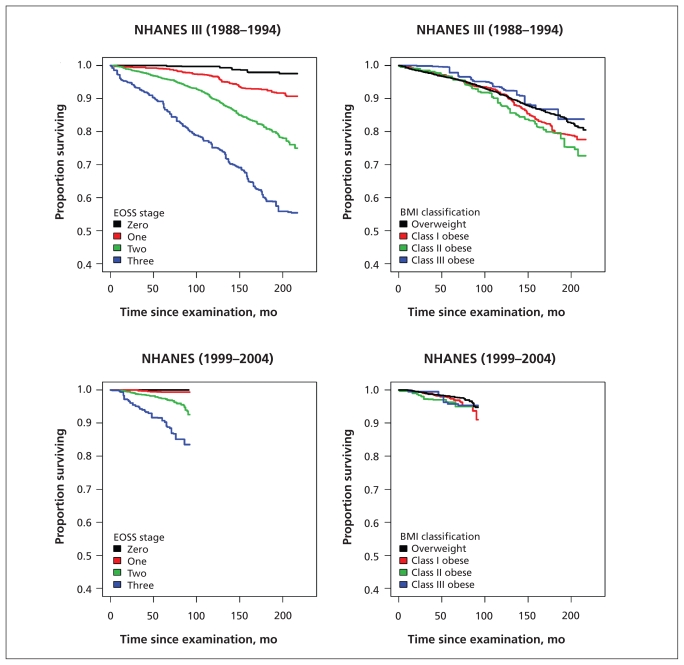
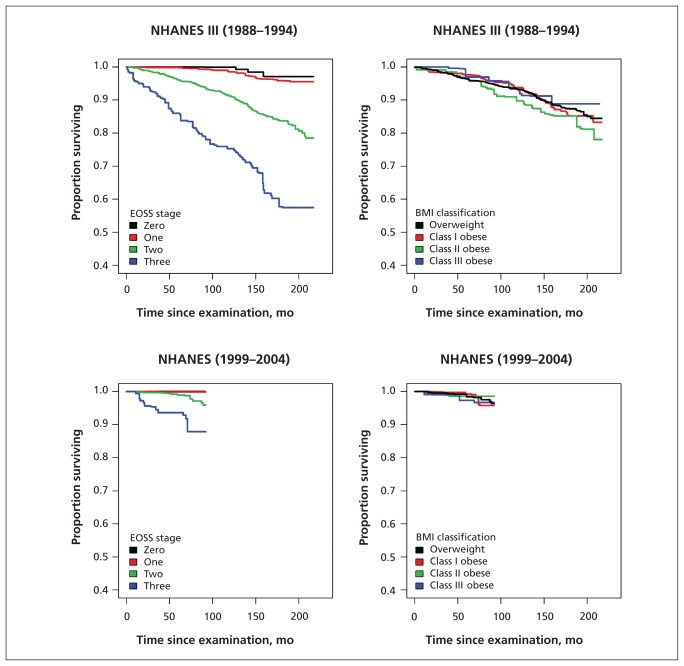
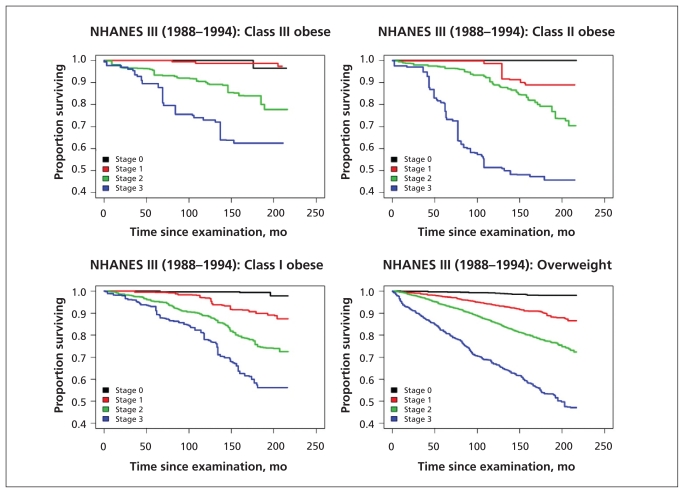
Results: Over 75% of the cohort with overweight or obesity were given scores of 1 or 2. Scores of 4 could not be reliably assigned because specific data elements were lacking. Survival curves clearly diverged when stratified by scores of 0-3, but not when stratified by obesity class alone. Within the data from the NHANES 1988-1994, scores of 2 (hazard ratio [HR] 1.57; 95% confidence interval [CI] 1.16 to 2.13) and 3 (HR 2.69; 95% CI 1.98 to 3.67) were associated with increased mortality compared with scores of 0 or 1, even after adjustment for body mass index and the metabolic syndrome. We found similar results after adjusting for hypertriglyceridemic waist (i.e., waist circumference ≥ 90 cm and a triglyceride level ≥ 2 mmol/L for men; the corresponding values for women were ≥ 85 cm and ≥ 1.5 mmol/L), as well as in a cohort eligible for bariatric surgery.
Interpretation: The Edmonton obesity staging system independently predicted increased mortality even after adjustment for contemporary methods of classifying adiposity. The Edmonton obesity staging system may offer improved clinical utility in assessing obesity-related risk and prioritizing treatment.
Figures
References
-
- Hu FB. Obesity and mortality: watch your waist, not just your weight. Arch Intern Med 2007;167:875–6 - PubMed
-
- Yusuf S, Hawken S, Ounpuu S, et al. Unknown. Obesity and the risk of myocardial infarction in 27,000 participants from 52 countries: a case-control study. Lancet 2005;366:1640–9 - PubMed
-
- National Heart, Lung, and Blood Institute, National Institutes of Health Clinical guidelines on the identification, evaluation, and treatment of overweight and obesity in adults: the evidence report. Bethesda (MD): National Institutes of Health; 1998
Publication types
MeSH terms
Substances
Grants and funding
LinkOut - more resources
Full Text Sources
Other Literature Sources
Medical