


Large-scale navigational map in a mammal
- PMID: 21844350
- PMCID: PMC3174628
- DOI: 10.1073/pnas.1107365108
Large-scale navigational map in a mammal
Abstract
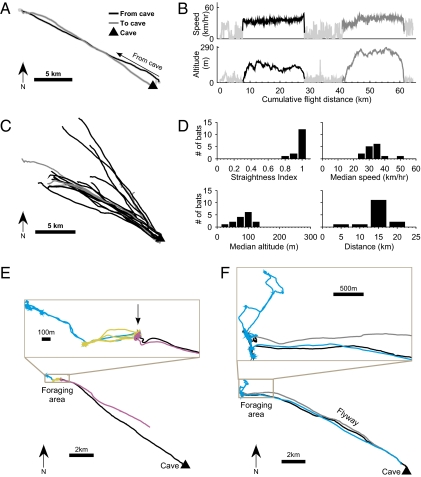
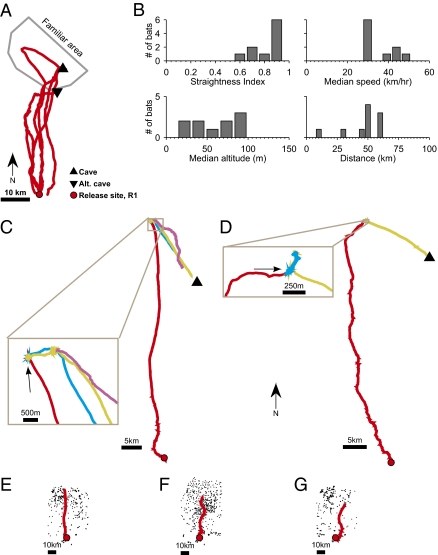
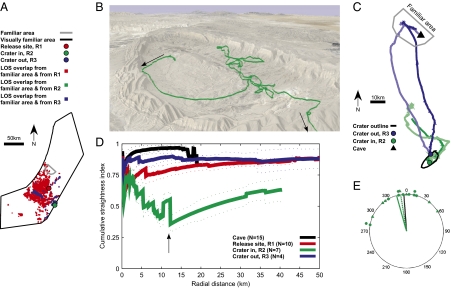
Navigation, the ability to reach desired goal locations, is critical for animals and humans. Animal navigation has been studied extensively in birds, insects, and some marine vertebrates and invertebrates, yet we are still far from elucidating the underlying mechanisms in other taxonomic groups, especially mammals. Here we report a systematic study of the mechanisms of long-range mammalian navigation. High-resolution global positioning system tracking of bats was conducted here, which revealed high, fast, and very straight commuting flights of Egyptian fruit bats (Rousettus aegyptiacus) from their cave to remote fruit trees. Bats returned to the same individual trees night after night. When displaced 44 km south, bats homed directly to one of two goal locations--familiar fruit tree or cave--ruling out beaconing, route-following, or path-integration mechanisms. Bats released 84 km south, within a deep natural crater, were initially disoriented (but eventually left the crater toward the home direction and homed successfully), whereas bats released at the crater-edge top homed directly, suggesting navigation guided primarily by distal visual landmarks. Taken together, these results provide evidence for a large-scale "cognitive map" that enables navigation of a mammal within its visually familiar area, and they also demonstrate the ability to home back when translocated outside the visually familiar area.
Conflict of interest statement
The authors declare no conflict of interest.
Figures
Comment in
-
A bat's perspective on navigation.Proc Natl Acad Sci U S A. 2011 Sep 20;108(38):15665-6. doi: 10.1073/pnas.1112843108. Epub 2011 Sep 8. Proc Natl Acad Sci U S A. 2011. PMID: 21903921 Free PMC article. No abstract available.
References
-
- Wallraff HG. Avian Navigation: Pigeon Homing as a Paradigm. New York: Springer; 2005.
-
- Gallistel CR. The Organization of Learning. Cambridge, MA: MIT Press; 1990.
-
- Lohmann KJ, Lohmann CM, Ehrhart LM, Bagley DA, Swing T. Animal behaviour: geomagnetic map used in sea-turtle navigation. Nature. 2004;428:909–910. - PubMed
-
- Cochran WW, Mouritsen H, Wikelski M. Migrating songbirds recalibrate their magnetic compass daily from twilight cues. Science. 2004;304:405–408. - PubMed
Publication types
MeSH terms
LinkOut - more resources
Full Text Sources
