. 2011 Aug 30;108(35):14411-5.
doi: 10.1073/pnas.1109059108. Epub 2011 Aug 15.

Innate C-H trifluoromethylation of heterocycles

Affiliations

Innate C-H trifluoromethylation of heterocycles

Yining Ji et al. Proc Natl Acad Sci U S A. .

Abstract

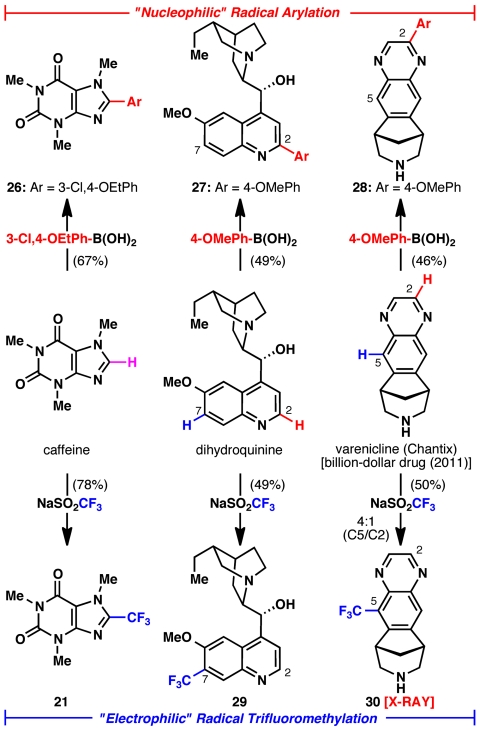
Direct methods for the trifluoromethylation of heteroaromatic systems are in extremely high demand in nearly every sector of chemical industry. Here we report the discovery of a general procedure using a benchtop stable trifluoromethyl radical source that functions broadly on a variety of electron deficient and rich heteroaromatic systems and demonstrates high functional group tolerance. This C-H trifluoromethylation protocol is operationally simple (avoids gaseous CF(3)I), scalable, proceeds at ambient temperature, can be used directly on unprotected molecules, and is demonstrated to proceed at the innately reactive positions of the substrate. The unique and orthogonal reactivity of the trifluoromethyl radical relative to aryl radicals has also been investigated on both a complex natural product and a pharmaceutical agent. Finally, preliminary data suggest that the regioselectivity of C-H trifluoromethylation can be fine-tuned simply by judicious solvent choice.


Conflict of interest statement

The authors declare no conflict of interest.

Figures
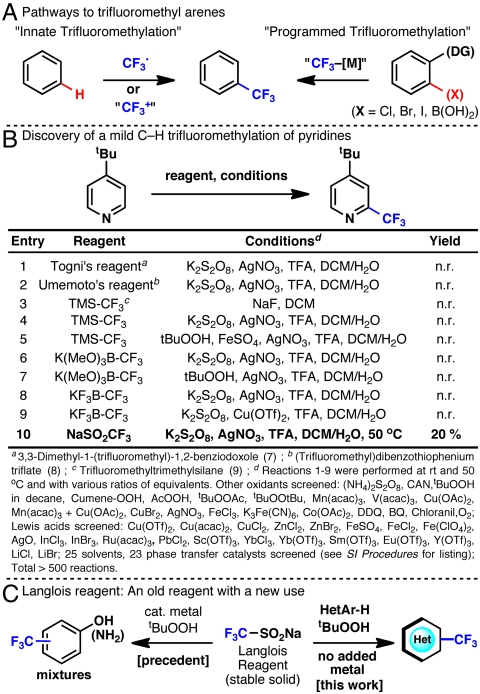
Fig. 1.
Fig. 1.
Discovery of a mild method for C-H trifluoromethylation (–9).
Fig. 2.
Fig. 2.
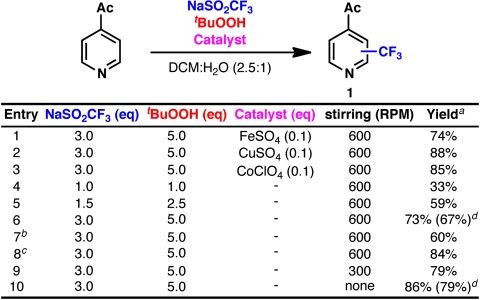
Initial investigations into reaction parameters: a GC yield with tetradecane as an internal standard. b tBuOOH added as a single portion. c 0.25 μL/s syringe drive addition of tBuOOH. d Isolated yield.
Fig. 3.
Fig. 3.
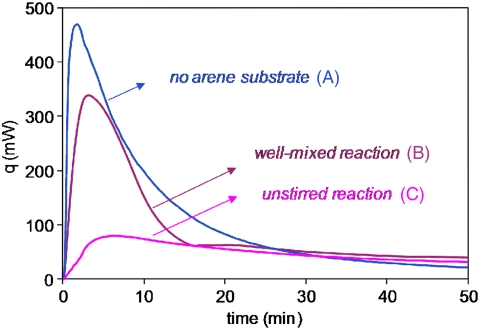
Observed heat flow in the two-phase system: DCM∶H2O 2.5∶1, with 0.18 M arene, 5 equiv. tBuOOH, 3 equiv. CF3SO2Na, (B) stirred at 600 rpm; (A) in the absence of arene, stirred at 600 rpm; (C) with arene, unstirred with separate organic and aqueous layers.
Fig. 4.
Fig. 4.
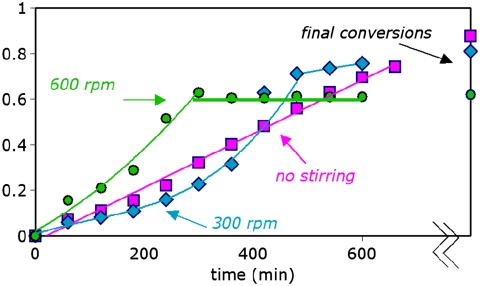
Fraction conversion to product over time as a function of stirring speed in the two-phase reaction shown in Fig. 2 using 0.18 M arene, 5.0 equiv. tBuOOH, 3.0 equiv. CF3SO2Na in (DCM∶H2O 2.5∶1). Final reaction conversions were measured at 1,500 min.
Fig. 5.
Fig. 5.
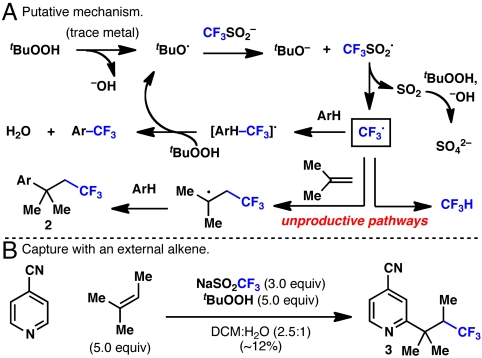
Putative mechanism and radical alkene capture.
Fig. 6.
Fig. 6.
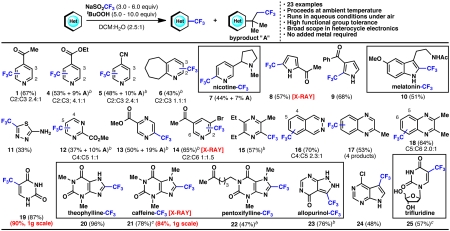
Scope of heterocycle trifluoromethylation. a Heterocycle (1.0 equiv), sodium trifluoromethanesulfinate (3.0 equiv), tButyl-hydroperoxide (5.0 equiv), 23 ºC, 3–24 h; isolated yields of chromatographically and spectroscopically pure products yields displayed, unless otherwise noted. b Reaction showed incomplete conversion after 24 h, and a second addition of sodium trifluoromethanesulfinate (3.0 equiv) and tButyl-hydroperoxide (5.0 equiv) was added. c Reaction run without organic solvent.
Fig. 7.
Fig. 7.
Diverging regioselectivity of reactive radicals on complex substrates: “Nucleophilic” versus “electrophilic” radical regioselectivity. Isolated yields of purified products after silica gel chromatography (21 and 26) or preparative HPLC (2730).
Fig. 8.
Fig. 8.
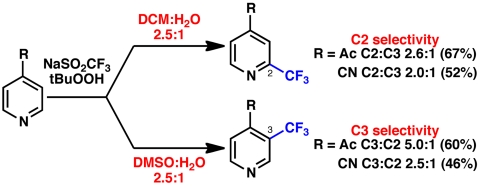
Preliminary results on the effect of solvent on regioselectivity in the trifluoromethylation of 4-acetylpyridine. (Top arrow) DCM∶H2O 2.5∶1, with 0.18 M arene, 5 equiv. tBuOOH, 3 equiv. CF3SO2Na. (Bottom arrow) DMSO∶H2O 2.5∶1, with 0.18 M arene, 5 equiv. tBuOOH, 3 equiv. CF3SO2Na. GC yield with tetradecane as an internal standard. Both products are volatile and are lost upon rotary evaporation (see SI Appendix for details).

References

    1. Smart BE. Introduction: Fluorine chemistry. Chem Rev. 1996;96:1555–1556. - PubMed
    1. Filler R, Kobayashi Y, Yagupolskii LM, editors. Organofluorine Compounds in Medicinal Chemistry and Biomedical Applications. Amsterdam: Elsevier; 1993.
    1. Welch JT. Advances in the preparation of biologically-active organofluorine compounds. Tetrahedron. 1987;43:3123–3197.
    1. Ma JA, Cahard D. Strategies for nucleophilic, electrophilic, and radical trifluoromethylations. J Fluorine Chem. 2007;128:975–996.
    1. Meanwell NA. Synopsis of some recent tactical application of bioisosteres in drug design. J Med Chem. 2011;54:2529–2591. - PubMed

Publication types

MeSH terms

LinkOut - more resources