. 2011 Aug 16:8:30.
doi: 10.1186/1742-6405-8-30.

Chronic alcohol ingestion exacerbates skeletal muscle myopathy in HIV-1 transgenic rats

Affiliations

Chronic alcohol ingestion exacerbates skeletal muscle myopathy in HIV-1 transgenic rats

Caroline R Clary et al. AIDS Res Ther. .

Abstract

Background: Separately, chronic alcohol ingestion and HIV-1 infection are associated with severe skeletal muscle derangements, including atrophy and wasting, weakness, and fatigue. One prospective cohort study reported that 41% of HIV-infected patients met the criteria for alcoholism, however; few reports exist on the co-morbid effects of these two disease processes on skeletal muscle homeostasis. Thus, we analyzed the atrophic effects of chronic alcohol ingestion in HIV-1 transgenic rats and identified alterations to several catabolic and anabolic factors.

Findings: Relative plantaris mass, total protein content, and fiber cross-sectional area were reduced in each experimental group compared to healthy, control-fed rats. Alcohol abuse further reduced plantaris fiber area in HIV-1 transgenic rats. Consistent with previous reports, gene levels of myostatin and its receptor activin IIB were not increased in HIV-1 transgenic rat muscle. However, myostatin and activin IIB were induced in healthy and HIV-1 transgenic rats fed alcohol for 12 weeks. Catabolic signaling factors such as TGFβ1, TNFα, and phospho-p38/total-p38 were increased in all groups compared to controls. There was no effect on IL-6, leukemia inhibitory factor (LIF), cardiotrophin-1 (CT-1), or ciliary neurotrophic factor (CNTF) in control-fed, transgenic rats. However, the co-morbidity of chronic alcohol abuse and HIV-1-related protein expression decreased expression of the two anabolic factors, CT-1 and CNTF.

Conclusions: Consistent with previous reports, alcohol abuse accentuated skeletal muscle atrophy in an animal model of HIV/AIDS. While some catabolic pathways known to drive alcoholic or HIV-1-associated myopathies were also elevated in this co-morbid model (e.g., TGFβ1), consistent expression patterns were not apparent. Thus, specific alterations to signaling mechanisms such as the induction of the myostatin/activin IIB system or reductions in growth factor signaling via CT-1- and CNTF-dependent mechanisms may play larger roles in the regulation of muscle mass in alcoholic, HIV-1 models.


Figures
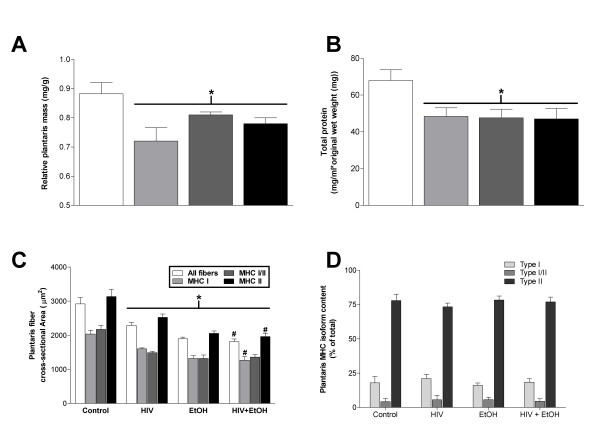
Figure 1
Figure 1
Chronic alcohol ingestion exacerbates plantaris fiber area in HIV-1 transgenic rats. (A) Relative plantaris mass, (B) total protein content, and (C) fiber area were reduced in each disease state. Myosin heavy chain isoform (MHC) content was unchanged in any group (D). Twelve weeks of chronic alcohol ingestion further reduced plantaris fiber area in HIV-1 transgenic rats compared to control-fed transgenic rats (C). A portion of this figure has been previously published [15]. Values are expressed as means + SEM (n = 6-7 rats/group). Significance was accepted at p ≤ 0.05. *, compared to control-fed, otherwise-healthy rat group. #, compared to control-fed, HIV-1 transgenic rat group.
Figure 2
Figure 2
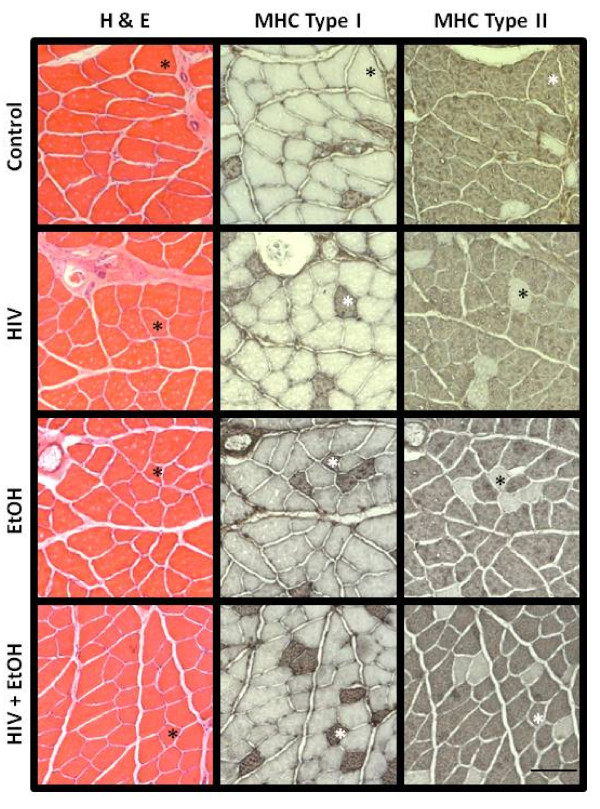
Representative (immuno)histological staining in alcoholic plantaris muscles from HIV-1 transgenic rats. Measurements of fiber area (quantified in Figure 1C) were made from hematoxylin and eosin (H&E-stained) sections. Serial sections were also processed for immunohistochemical detection of MHC type I and/or MHC type II (IIa, IIx, and IIb) expression. Hybrid fibers - those that stain positively for both MHC type I and any one of the three fast MHC isoforms in rat muscle - are identified by the asterisks in the HIV + EtOH panels. For convenience, asterisks have been provided within each group to track fibers in series.
Figure 3
Figure 3
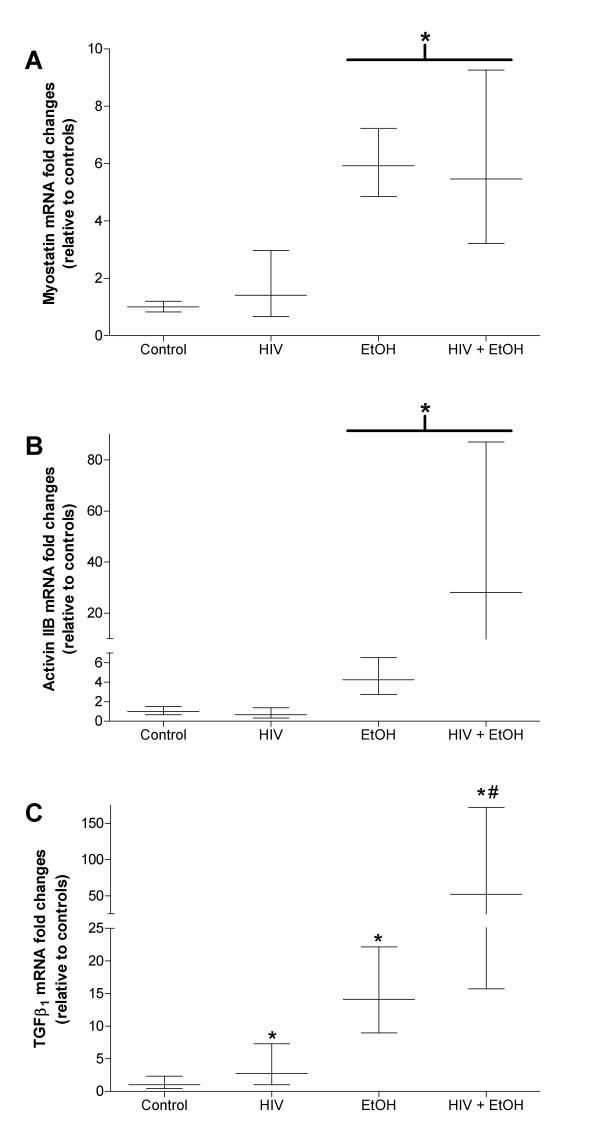
Gene levels of TGFβ super family members are differentially regulated in diseased plantaris muscles. Gene expression of myostatin (A) and its receptor activin IIB (B) were up-regulated in alcoholic plantaris muscles regardless of HIV-1-related protein expression. In contrast, TGFβ1 was up-regulated in each disease state (C). Unlike myostatin and activin IIB, TGFβ1 gene levels were higher in the co-morbid model compared to plantaris muscles from control-fed, HIV-1 transgenic rats. Data are represented as means ± range of potential values based on the 2-ΔΔCT method [15,16] and expressed as fold changes relative to controls (n = 6-7 rats/group). Significance was accepted at p ≤ 0.05. *, compared to control-fed, otherwise-healthy rat group. #, compared to control-fed, HIV-1 transgenic rat group.
Figure 4
Figure 4
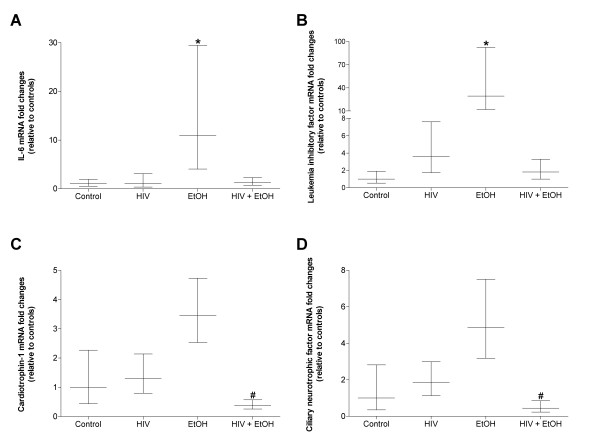
Gene levels of IL-6 super family members are differentially regulated in diseased plantaris muscles. As previously described [16], chronic alcohol ingestion induced expression of IL-6 (A) and LIF (B). The co-morbidity of twelve weeks of daily alcohol ingestion and HIV-1-related protein expression reduced gene expression of CT-1 (C) and CNTF (D). Data are represented as means ± range of potential values based on the 2-ΔΔCT method [15,16] and expressed as fold changes relative to controls (n = 6-7 rats/group). Significance was accepted at p ≤ 0.05. *, compared to control-fed, otherwise-healthy rats. #, compared to control-fed, HIV-1 transgenic rats.
Figure 5
Figure 5
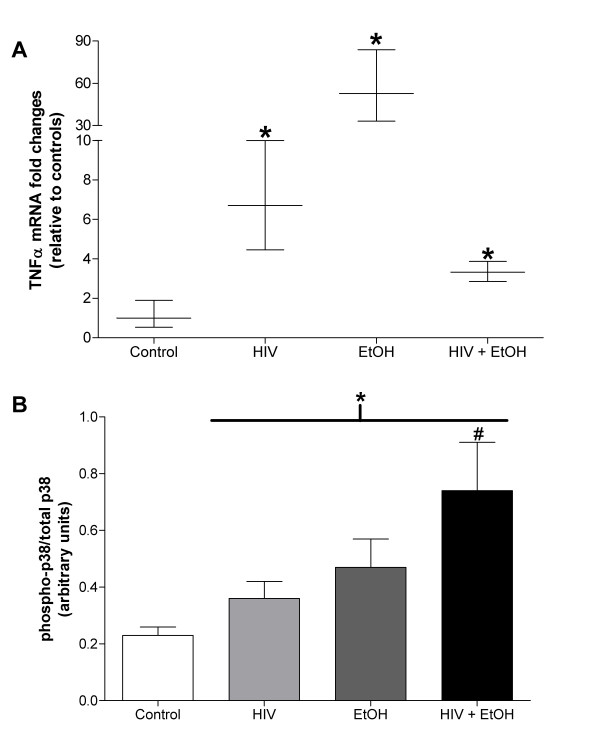
TNFα mRNA levels and phosphorylated p38 are elevated in diseased plantaris muscles. (A) HIV-1-related protein expression increased TNFα mRNA levels. Likewise, twelve weeks of chronic alcohol ingestion increased TNFα levels in otherwise healthy and in HIV-1 transgenic rat plantaris muscles. (B) Twelve weeks of chronic alcohol abuse increased the ratio of phospho-p38/total-p38 in each disease and co-morbid state. Chronic alcohol abuse further increased this ratio in HIV-1 transgenic rat muscle. Total p38 was unchanged in any group (data not shown). Significance was accepted at p ≤ 0.05. *, compared to control-fed, otherwise-healthy rats. #, compared to control-fed, HIV-1 transgenic rat group.

References

    1. Kresina TF, Flexner CW, Sinclair J, Correia MA, Stapleton JT, Adeniyi-Jones S, Cargill V, Cheever LW. Alcohol use and HIV pharmacotherapy. AIDS Res Hum Retroviruses. 2002;18(11):757–770. doi: 10.1089/08892220260139495. - DOI - PubMed
    1. Moss M, Burnham EL. Chronic alcohol abuse, acute respiratory distress syndrome, and multiple organ dysfunction. Crit Care Med. 2003;31(4 Suppl):S207–212. - PubMed
    1. Reid W, Sadowska M, Denaro F, Rao S, Foulke J Jr, Hayes N, Jones O, Doodnauth D, Davis H, Sill A. et al. An HIV-1 transgenic rat that develops HIV-related pathology and immunologic dysfunction. Proc Natl Acad Sci USA. 2001;98(16):9271–9276. doi: 10.1073/pnas.161290298. - DOI - PMC - PubMed
    1. Franchi S, Sacerdote P, Moretti S, Gerra G, Leccese V, Tallone MV, Panerai AE, Somaini L. The effects of alcoholism pharmacotherapy on immune responses in alcohol-dependent patients. Int J Immunopathol Pharmacol. pp. 847–855. - PubMed
    1. Naicker S, Fabian J. Risk factors for the development of chronic kidney disease with HIV/AIDS. Clin Nephrol. pp. S51–56. - PubMed

LinkOut - more resources