


Childhood acute leukemias are frequent in Mexico City: descriptive epidemiology
- PMID: 21846410
- PMCID: PMC3171387
- DOI: 10.1186/1471-2407-11-355
Childhood acute leukemias are frequent in Mexico City: descriptive epidemiology
Abstract
Background: Worldwide, acute leukemia is the most common type of childhood cancer. It is particularly common in the Hispanic populations residing in the United States, Costa Rica, and Mexico City. The objective of this study was to determine the incidence of acute leukemia in children who were diagnosed and treated in public hospitals in Mexico City.
Methods: Included in this study were those children, under 15 years of age and residents of Mexico City, who were diagnosed in 2006 and 2007 with leukemia, as determined by using the International Classification of Childhood Cancer. The average annual incidence rates (AAIR), and the standardized average annual incidence rates (SAAIR) per million children were calculated. We calculated crude, age- and sex-specific incidence rates and adjusted for age by the direct method with the world population as standard. We determined if there were a correlation between the incidence of acute leukemias in the various boroughs of Mexico City and either the number of agricultural hectares, the average number of persons per household, or the municipal human development index for Mexico (used as a reference of socio-economic level).
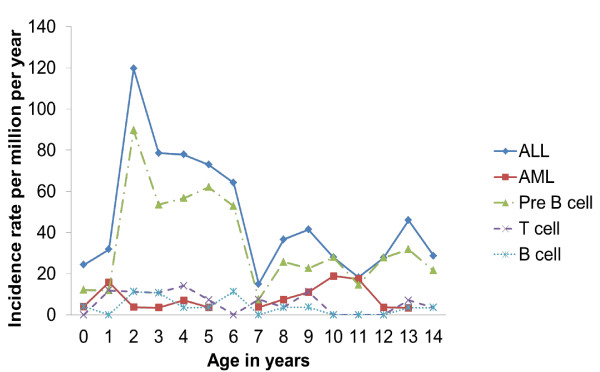
Results: Although a total of 610 new cases of leukemia were registered during 2006-2007, only 228 fit the criteria for inclusion in this study. The overall SAAIR was 57.6 per million children (95% CI, 46.9-68.3); acute lymphoblastic leukemia (ALL) was the most frequent type of leukemia, constituting 85.1% of the cases (SAAIR: 49.5 per million), followed by acute myeloblastic leukemia at 12.3% (SAAIR: 6.9 per million), and chronic myeloid leukemia at 1.7% (SAAIR: 0.9 per million). The 1-4 years age group had the highest SAAIR for ALL (77.7 per million). For cases of ALL, 73.2% had precursor B-cell immunophenotype (SAAIR: 35.8 per million) and 12.4% had T-cell immunophenotype (SAAIR 6.3 per million). The peak ages for ALL were 2-6 years and 8-10 years. More than half the children (58.8%) were classified as high risk. There was a positive correlation between the average number of persons per household and the incidence of the pre-B immunophenotype (Pearson's r, 0.789; P = 0.02).
Conclusions: The frequency of ALL in Mexico City is among the highest in the world, similar to those found for Hispanics in the United States and in Costa Rica.
Figures

References
-
- American Cancer Society. Cancer in children and adolescents. Cancer acts & Figures for Hispanics/Latinos 2009-2011. http://www.cancer.org/acs/groups/content/@nho/documents/document/ffhispa...
-
- Parkin DW, Stiller CA. Childhood cancer in developing countries: environmental factors. Int J Pediatr Hematol Oncol. 1995;2:411–417.
Publication types
MeSH terms
LinkOut - more resources
Full Text Sources
Medical
