


doi: 10.1161/CIRCEP.110.957662.
Advances in cardiac ATP-sensitive K+ channelopathies from molecules to populations
Affiliations
- PMID: 21846889
- PMCID: PMC3158387
- DOI: 10.1161/CIRCEP.110.957662
Item in Clipboard
Advances in cardiac ATP-sensitive K+ channelopathies from molecules to populations
Circ Arrhythm Electrophysiol.
2011 Aug.
No abstract available
Figures
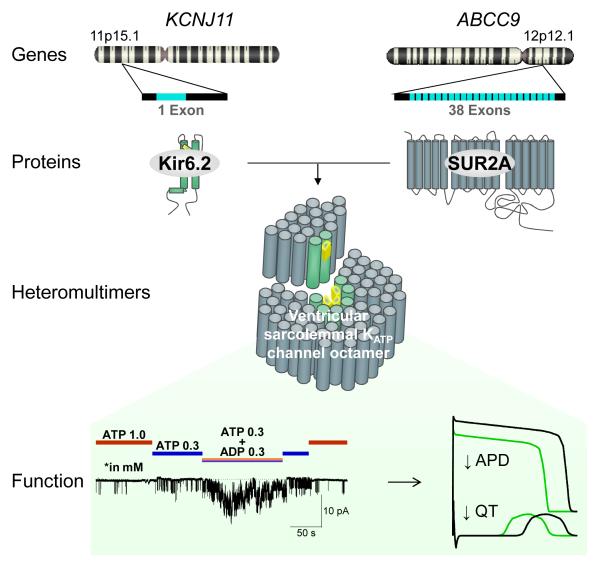
The pore-forming KCNJ11-encoded Kir6.2 subunit assembles with the regulatory ABCC9-encoded SUR2A protein to form heteromultimeric KATP channels abundantly expressed in the ventricular sarcolemma. The defining feature of KATP channel operation is adenine nucleotide-dependent gating, ensuring high-fidelity coupling between the cellular energetic state and membrane electrical activity. Intracellular ATP keeps KATP channels closed under normal conditions, while ADP promotes channel opening in response to metabolic challenge. KATP channel opening under stress translates into shortening of the cardiac action potential (↓APD) and accelerated repolarization (↓QT).
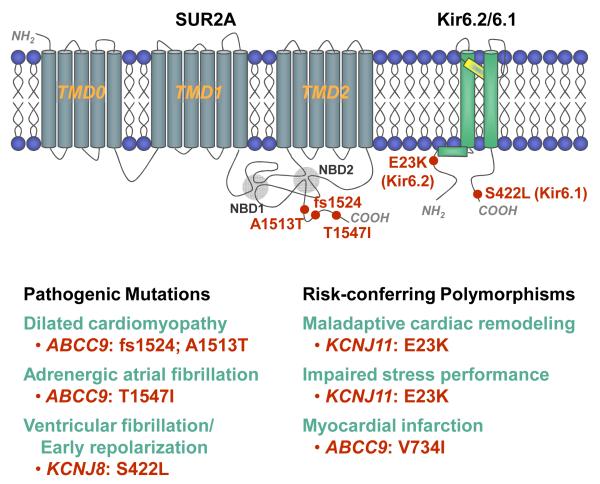
Topology of Kir6.2/Kir6.1 and SUR2A (with nucleotide binding domain NBD1/NBD2 and transmembrane domains TMD0-TMD1-TMD2) subunits, with mapped locations of variant sites underlying KATP channelopathies.
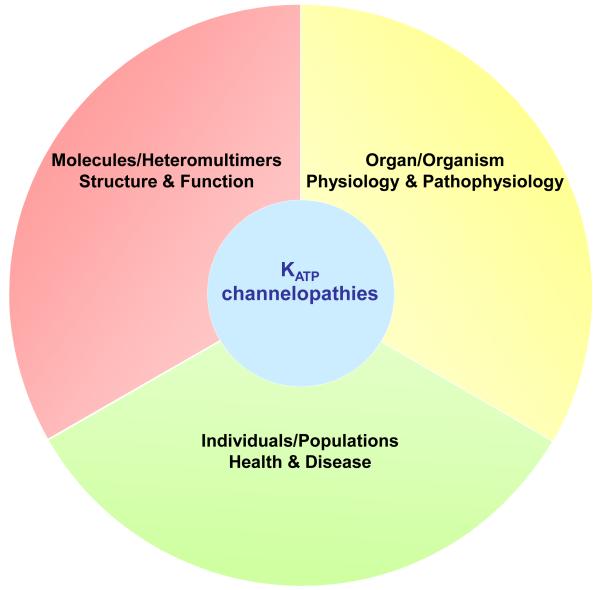
Over the last three decades, science has increasingly defined KATP channel structure and function at molecular, cellular, organ and organism levels. Today, new knowledge in KATP channelopathies informs the practice of cardiovascular medicine expanding the understanding of cardioprotection in health and disease.
References
-
- Miki T, Seino S. Roles of KATP channels as metabolic sensors in acute metabolic changes. J Mol Cell Cardiol. 2005;38:917–925. - PubMed
-
- Nichols CG. KATP channels as molecular sensors of cellular metabolism. Nature. 2006;440:470–476. - PubMed
-
- Ashcroft FM. ATP-sensitive K+ channels and disease: from molecule to malady. Am J Physiol Endocrinol Metab. 2007;293:E880–E889. - PubMed
Publication types
MeSH terms
Substances
Grants and funding
LinkOut - more resources
Full Text Sources
