Multi-observation PET image analysis for patient follow-up quantitation and therapy assessment
- PMID: 21846937
- PMCID: PMC3511249
- DOI: 10.1088/0031-9155/56/18/001
Multi-observation PET image analysis for patient follow-up quantitation and therapy assessment
Abstract
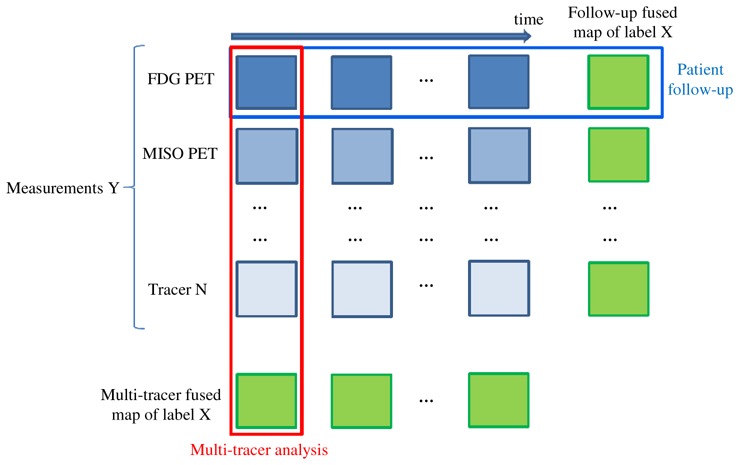
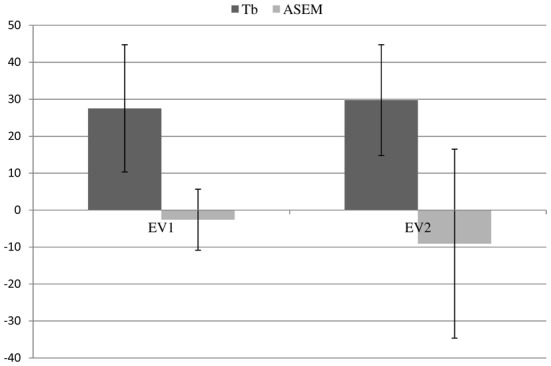
In positron emission tomography (PET) imaging, an early therapeutic response is usually characterized by variations of semi-quantitative parameters restricted to maximum SUV measured in PET scans during the treatment. Such measurements do not reflect overall tumor volume and radiotracer uptake variations. The proposed approach is based on multi-observation image analysis for merging several PET acquisitions to assess tumor metabolic volume and uptake variations. The fusion algorithm is based on iterative estimation using a stochastic expectation maximization (SEM) algorithm. The proposed method was applied to simulated and clinical follow-up PET images. We compared the multi-observation fusion performance to threshold-based methods, proposed for the assessment of the therapeutic response based on functional volumes. On simulated datasets the adaptive threshold applied independently on both images led to higher errors than the ASEM fusion and on clinical datasets it failed to provide coherent measurements for four patients out of seven due to aberrant delineations. The ASEM method demonstrated improved and more robust estimation of the evaluation leading to more pertinent measurements. Future work will consist in extending the methodology and applying it to clinical multi-tracer datasets in order to evaluate its potential impact on the biological tumor volume definition for radiotherapy applications.
Figures
References
-
- Bentzen SM. Theragnostic imaging for radiation oncology: dose-painting by numbers. Lancet Oncol. 2005;6:112–117. - PubMed
-
- Boussion N, Cheze Le Rest C, Hatt M, Visvikis D. Incorporation of wavelet based denoising in iterative deconvolution for partial volume correction in whole body PET imaging. European Journal of Nuclear Medicine and Molecular Imaging. 2008;36(7):1064–75. - PubMed
-
- Celeux G, Diebolt J. L’algorithme SEM : un algorithme d’apprentissage probabiliste pour la reconnaissance de mélanges de densités. Revue de statistique appliquée. 1986;34(2)
-
- Delignon Y, Marzouki A, Pieczynski W. Estimation of Generalized Mixtures and Its Application in Image Segmentation. IEEE Transactions on Image Processing. 1997;6(10) - PubMed