


Differences between perception and eye movements during complex motions
- PMID: 21846952
- PMCID: PMC3668572
- DOI: 10.3233/VES-2011-0416
Differences between perception and eye movements during complex motions
Abstract
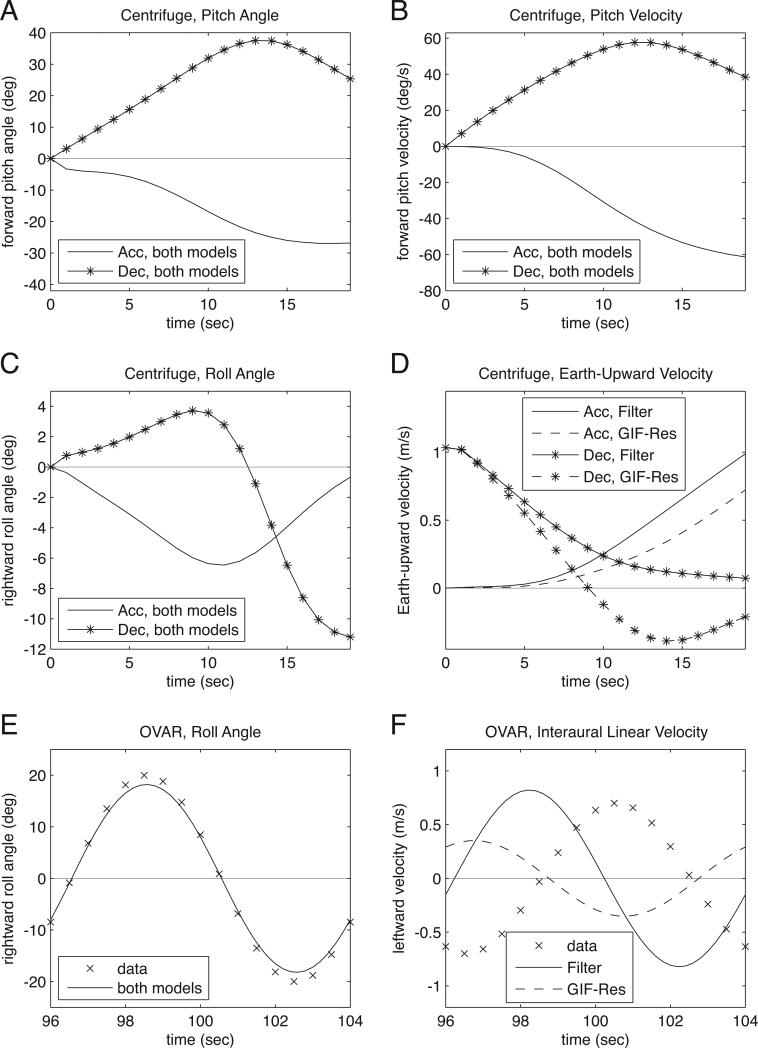
During passive whole-body motion in the dark, the motion perceived by subjects may or may not be veridical. Either way, reflexive eye movements are typically compensatory for the perceived motion. However, studies are discovering that for certain motions, the perceived motion and eye movements are incompatible. The incompatibility has not been explained by basic differences in gain or time constants of decay. This paper uses three-dimensional modeling to investigate gondola centrifugation (with a tilting carriage) and off-vertical axis rotation. The first goal was to determine whether known differences between perceived motions and eye movements are true differences when all three-dimensional combinations of angular and linear components are considered. The second goal was to identify the likely areas of processing in which perceived motions match or differ from eye movements, whether in angular components, linear components and/or dynamics. The results were that perceived motions are more compatible with eye movements in three dimensions than the one-dimensional components indicate, and that they differ more in their linear than their angular components. In addition, while eye movements are consistent with linear filtering processes, perceived motion has dynamics that cannot be explained by basic differences in time constants, filtering, or standard GIF-resolution processes.
Figures


References
-
- Angelaki DE, Shaikh AG, Green AM, Dickman JD. Neurons compute internal models of the physical laws of motion. Nature. 2004;430:560–564. - PubMed
-
- Bles W, de Graaf B. Postural consequences of long duration centrifugation. Journal of Vestibular Research. 1993;3:87–95. - PubMed
-
- Bockisch CJ, Straumann D, Haslwanter T. Eye movements during multiaxis whole-body rotations. Journal of Neurophysiology. 2003;89:355–366. - PubMed
-
- Borah J, Young LR, Curry RE. Optimal estimator model for human spatial orientation. Annals of the New York Academy of Sciences. 1988;545:51–73. - PubMed
-
- Boring EG, Langfeld HS, Weld HP. Foundations of Psychology. John Wiley and Sons, Inc.; New York: 1948.
Publication types
MeSH terms
Grants and funding
LinkOut - more resources
Full Text Sources
