


Comparison of Goldmann and Pascal tonometry in relation to corneal hysteresis and central corneal thickness in nonglaucomatous eyes
- PMID: 21847339
- PMCID: PMC3155272
- DOI: 10.2147/OPTH.S23086
Comparison of Goldmann and Pascal tonometry in relation to corneal hysteresis and central corneal thickness in nonglaucomatous eyes
Abstract
Objective: To compare measurements obtained by Goldmann applanation tonometry (GAT) and Pascal dynamic contour tonometry (DCT), and to study their relationship to corneal thickness and biomechanical properties in nonglaucomatous eyes.
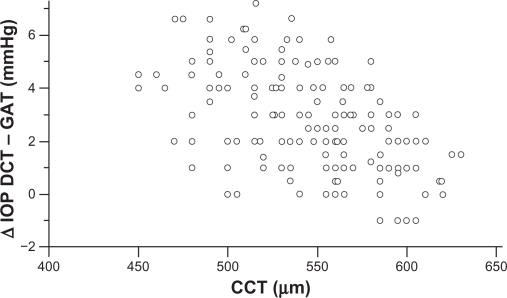
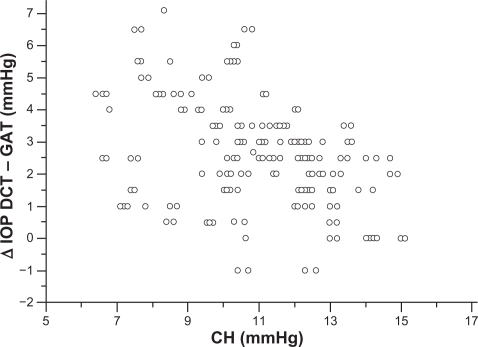
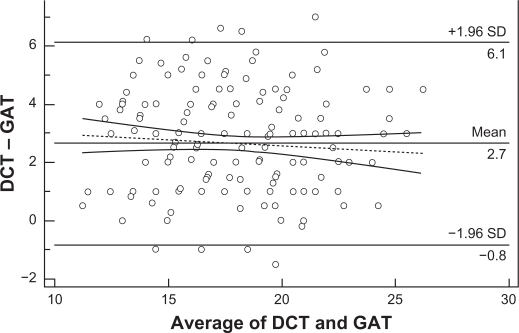
Methods: This is a prospective and randomized study of 200 eyes from 200 non-glaucomatous subjects who underwent intraocular pressure (IOP) measurements by GAT and DCT. The two methods were compared and assessed for agreement by means of the Bland-Altman plot. Central corneal thickness (CCT) and corneal hysteresis (CH) were obtained by ultrasound pachymeter and Ocular Response Analyzer, respectively. The effect of CH and CCT was correlated with the DCT/GAT IOP differences.
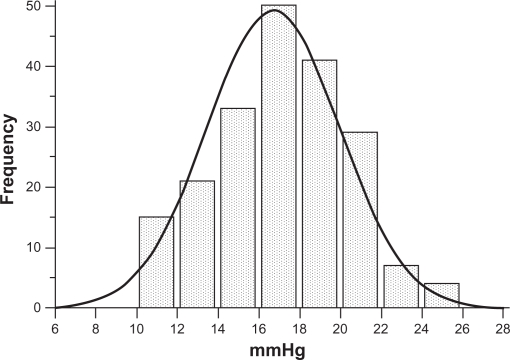
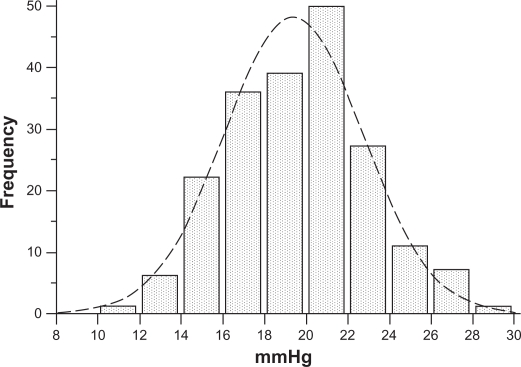
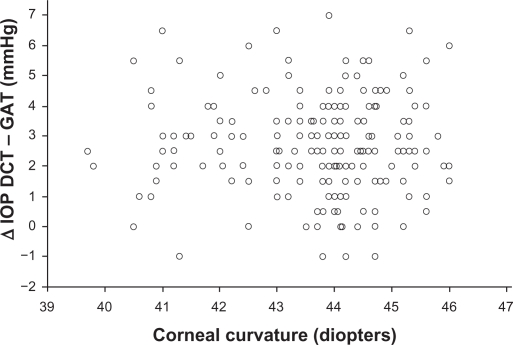
Results: Mean age was 57.4 ± 14.7 years (range 24-82 years). Mean IOP measurements obtained were 16.7 ± 3.2 mmHg by GAT and 19.4 ± 3.3 mmHg by DCT. DCT showed a statistically significant higher mean IOP (2.7 ± 1.9 mmHg, P < 0.001) compared with GAT. Mean CCT and CH were 546.5 ± 40 μm and 10.85 ± 2.0 mmHg, respectively. The differences in IOP (DCT - GAT) were significantly correlated with CCT and CH (Pearson's correlation coefficient r = -0.517 and -0.355, P < 0.0001, respectively). The difference between the two correlation coefficients was statistically significant (P < 0.05, Z-statistic). According to the Bland-Altman plot, the results of the two methods were clinically different.
Conclusion: Significantly higher IOP readings were obtained by DCT than by GAT in nonglaucomatous subjects. The IOP differences between the two methods were associated with CCT and CH, suggesting that DCT was less dependent on corneal parameters. Each method provides clinically different IOP values, indicating that DCT and GAT should not be used interchangeably.
Keywords: Goldmann applanation tonometry; Pascal dynamic contour tonometry; central corneal thickness; corneal hysteresis; glaucoma.
Figures
References
-
- Kass MA, Heur DK, Higginbotham EJ, et al. The ocular hypertension treatment study: a randomised trial determines that topical ocular hypotensive medication delays or prevents the onset of primary open-angle glaucoma. Arch Ophthalmol. 2002;1209(6):701–713. - PubMed
-
- Leske MC, Heijl A, Hussein M, Bengtsson B, Hyman L, Komaroff E. Early Manifest Glaucoma Trail Group. Factors for glaucoma progression and the effect of treatment: the early manifest glaucoma trial. Arch Ophthalmol. 2003;121(1):48–56. - PubMed
-
- Goldmann H, Schmidt T. Applanation tonometry. Ophthalmologica. 1957;134(4):221–242. - PubMed
-
- Ehlers N, Bramsen T, Sperling S. Applanation tonometry and central corneal thickness. Acta Ophthalmol (Copenh) 1975;53(1):34–43. - PubMed
-
- Wessels IF, Oh Y. Tonometer utilization, accuracy, and calibration under field conditions. Arch Ophthalmol. 1990;108(12):1709–1712. - PubMed
LinkOut - more resources
Full Text Sources
Other Literature Sources
