. 2011 Aug 17:4:24.
doi: 10.1186/1754-6834-4-24.

Functional characterization of cellulases identified from the cow rumen fungus Neocallimastix patriciarum W5 by transcriptomic and secretomic analyses

Affiliations

Functional characterization of cellulases identified from the cow rumen fungus Neocallimastix patriciarum W5 by transcriptomic and secretomic analyses

Tzi-Yuan Wang et al. Biotechnol Biofuels. .

Abstract

Background: Neocallimastix patriciarum is one of the common anaerobic fungi in the digestive tracts of ruminants that can actively digest cellulosic materials, and its cellulases have great potential for hydrolyzing cellulosic feedstocks. Due to the difficulty in culture and lack of a genome database, it is not easy to gain a global understanding of the glycosyl hydrolases (GHs) produced by this anaerobic fungus.

Results: We have developed an efficient platform that uses a combination of transcriptomic and proteomic approaches to N. patriciarum to accelerate gene identification, enzyme classification and application in rice straw degradation. By conducting complementary studies of transcriptome (Roche 454 GS and Illumina GA IIx) and secretome (ESI-Trap LC-MS/MS), we identified 219 putative GH contigs and classified them into 25 GH families. The secretome analysis identified four major enzymes involved in rice straw degradation: β-glucosidase, endo-1,4-β-xylanase, xylanase B and Cel48A exoglucanase. From the sequences of assembled contigs, we cloned 19 putative cellulase genes, including the GH1, GH3, GH5, GH6, GH9, GH18, GH43 and GH48 gene families, which were highly expressed in N. patriciarum cultures grown on different feedstocks.

Conclusions: These GH genes were expressed in Pichia pastoris and/or Saccharomyces cerevisiae for functional characterization. At least five novel cellulases displayed cellulytic activity for glucose production. One β-glucosidase (W5-16143) and one exocellulase (W5-CAT26) showed strong activities and could potentially be developed into commercial enzymes.


Figures
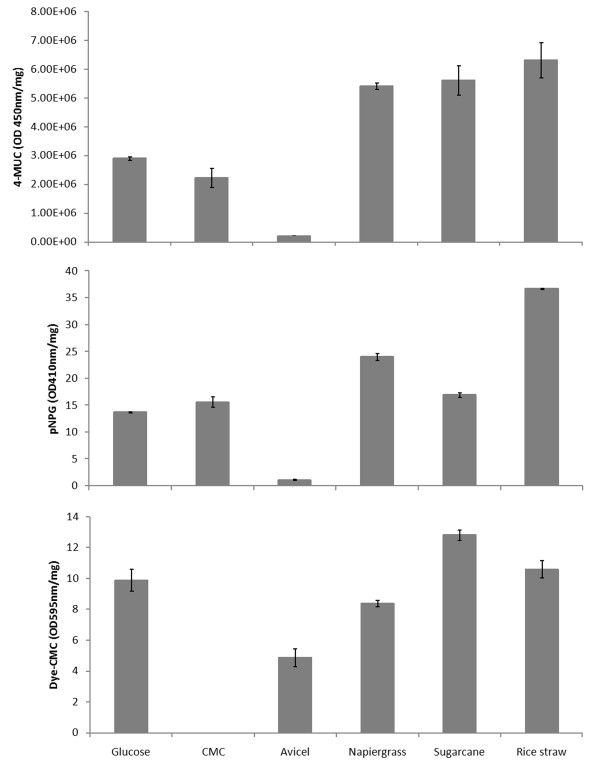
Figure 1
Figure 1
Total cellulase activity of four-day culture of W5 strain in response to glucose, two artificial celluloses (CMC and avicel) and three feedstocks (napiergrass, sugarcane and rice straw).
Figure 2
Figure 2
Sample fractions (in milliliters) and relative cellulase activity (%) after QFF P2-Superdex 200 purification.
Figure 3
Figure 3
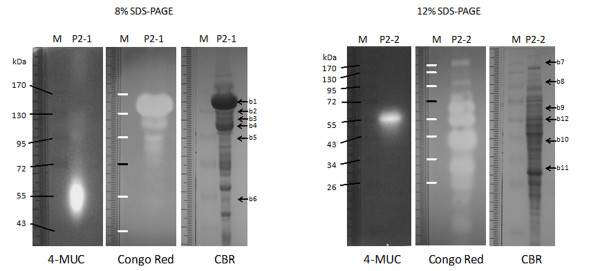
Zymogram assay of the second batch culture. Fractions P2-1 and P2-2 in Figure 2 corresponding to 52 to 61 mL and 64 to 73 mL were pooled and then separated on 8% and 12% SDS-PAGE-based zymogram assays, respectively. Twelve bands were recovered and analyzed for possible glucanase sequences using ESI-Trap LC-MS/MS.
Figure 4
Figure 4
Flowchart showing the transcriptome and secretome analysis pipeline.
Figure 5
Figure 5
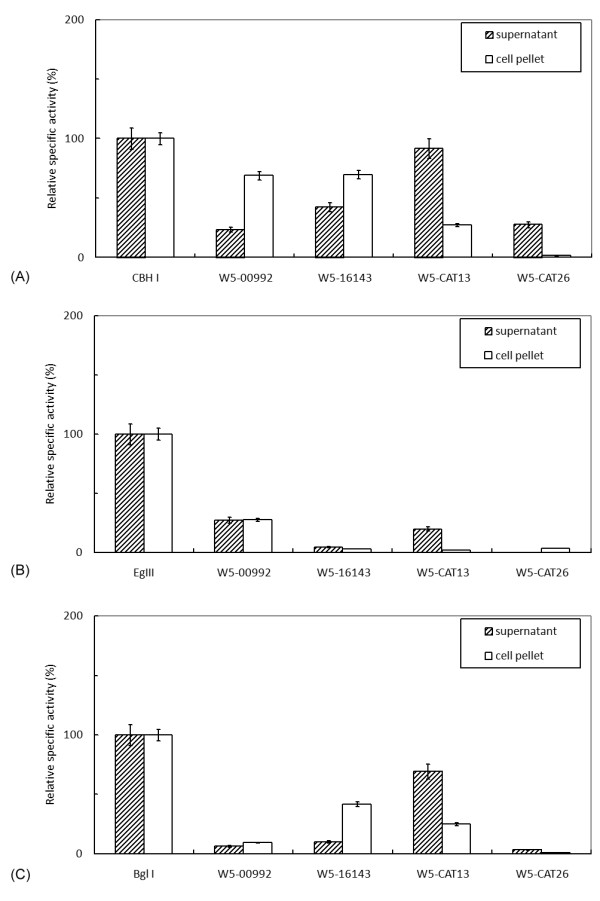
Recombinant cellulase activities of W5 clones expressed in Pichia pastoris. (A) 4-methylumbelliferyl-β-cellobiose (4-MUC assay) for exoglucanase activity and CbhI as relative specific activity marker (100%). (B) Dye CM-cellulose (dye-CMC) assay for endoglucanase activity and EgIII as relative specific activity marker (100%). (C) p-nitrophenyl-β-D-glucopyranoside (pNPG) assay for β-glucosidase activity and BglI as relative specific activity marker (100%).

References

    1. Paul SS, Kamra DN, Sastry VR, Sahu NP, Agarwal N. Effect of anaerobic fungi on in vitro feed digestion by mixed rumen microflora of buffalo. Reprod Nutr Dev. 2004;4:313–319. doi: 10.1051/rnd:2004036. - DOI - PubMed
    1. Teunissen MJ, de Kort GV, Op den Camp HJ, Vogels GD. Production of cellulolytic and xylanolytic enzymes during growth of anaerobic fungi from ruminant and nonruminant herbivores on different substrates. Appl Biochem Biotechnol. 1993;4:177–189. doi: 10.1007/BF02918988. - DOI - PubMed
    1. Thareja A, Puniya AK, Goel G, Nagpal R, Sehgal JP, Singh PK, Singh K. In vitro degradation of wheat straw by anaerobic fungi from small ruminants. Arch Anim Nutr. 2006;4:412–417. doi: 10.1080/17450390600884443. - DOI - PubMed
    1. Tripathi VK, Sehgal JP, Puniya AK, Singh K. Hydrolytic activities of anaerobic fungi from wild blue bull (Boselaphus tragocamelus) Anaerobe. 2007;4:36–39. doi: 10.1016/j.anaerobe.2006.11.001. - DOI - PubMed
    1. Teunissen MJ, Smits AA, Op den Camp HJ, Huis in 't Veld JH, Vogels GD. Fermentation of cellulose and production of cellulolytic and xylanolytic enzymes by anaerobic fungi from ruminant and non-ruminant herbivores. Arch Microbiol. 1991;4:290–296. doi: 10.1007/BF00263000. - DOI - PubMed

LinkOut - more resources