


Magnetic resonance imaging/ultrasound fusion guided prostate biopsy improves cancer detection following transrectal ultrasound biopsy and correlates with multiparametric magnetic resonance imaging
- PMID: 21849184
- PMCID: PMC3193933
- DOI: 10.1016/j.juro.2011.05.078
Magnetic resonance imaging/ultrasound fusion guided prostate biopsy improves cancer detection following transrectal ultrasound biopsy and correlates with multiparametric magnetic resonance imaging
Abstract
Purpose: A novel platform was developed that fuses pre-biopsy magnetic resonance imaging with real-time transrectal ultrasound imaging to identify and biopsy lesions suspicious for prostate cancer. The cancer detection rates for the first 101 patients are reported.
Materials and methods: This prospective, single institution study was approved by the institutional review board. Patients underwent 3.0 T multiparametric magnetic resonance imaging with endorectal coil, which included T2-weighted, spectroscopic, dynamic contrast enhanced and diffusion weighted magnetic resonance imaging sequences. Lesions suspicious for cancer were graded according to the number of sequences suspicious for cancer as low (2 or less), moderate (3) and high (4) suspicion. Patients underwent standard 12-core transrectal ultrasound biopsy and magnetic resonance imaging/ultrasound fusion guided biopsy with electromagnetic tracking of magnetic resonance imaging lesions. Chi-square and within cluster resampling analyses were used to correlate suspicion on magnetic resonance imaging and the incidence of cancer detected on biopsy.
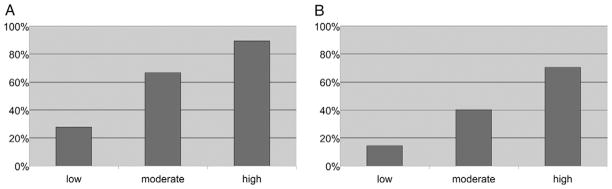
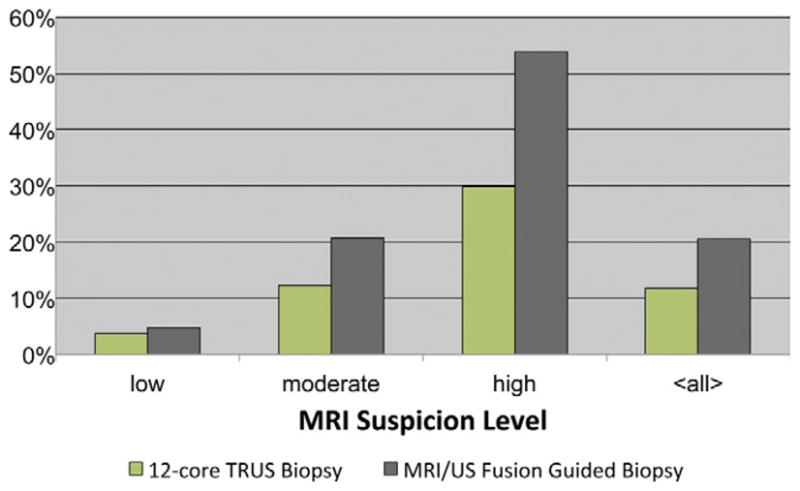
Results: Mean patient age was 63 years old. Median prostate specific antigen at biopsy was 5.8 ng/ml and 90.1% of patients had a negative digital rectal examination. Of patients with low, moderate and high suspicion on magnetic resonance imaging 27.9%, 66.7% and 89.5% were diagnosed with cancer, respectively (p <0.0001). Magnetic resonance imaging/ultrasound fusion guided biopsy detected more cancer per core than standard 12-core transrectal ultrasound biopsy for all levels of suspicion on magnetic resonance imaging.
Conclusions: Prostate cancer localized on magnetic resonance imaging may be targeted using this novel magnetic resonance imaging/ultrasound fusion guided biopsy platform. Further research is needed to determine the role of this platform in cancer detection, active surveillance and focal therapy, and to determine which patients may benefit.
Copyright © 2011 American Urological Association Education and Research, Inc. Published by Elsevier Inc. All rights reserved.
Figures
Comment in
-
The role of magnetic resonance imaging in the detection of prostate cancer.J Urol. 2011 Oct;186(4):1181-2. doi: 10.1016/j.juro.2011.07.046. Epub 2011 Aug 17. J Urol. 2011. PMID: 21849178 No abstract available.
-
Re: Magnetic resonance imaging/ultrasound fusion guided prostate biopsy improves cancer detection following transrectal ultrasound biopsy and correlates with multiparametric magnetic resonance imaging: P. A. Pinto, P. H. Chung, A. R. Rastinehad, A. A. Baccala, Jr., J. Kruecker, C. J. Benjamin, S. Xu, P. Yan, S. Kadoury, C. Chua, J. K. Locklin, B. Turkbey, J. H. Shih, S. P. Gates, C. Buckner, G. Bratslavsky, W. M. Linehan, N. D. Glossop, P. L. Choyke and B. J. Wood J Urol 2011; 186: 1281-1285.J Urol. 2012 Apr;187(4):1511-2. doi: 10.1016/j.juro.2011.12.007. Epub 2012 Feb 17. J Urol. 2012. PMID: 22341821 No abstract available.
References
-
- Jemal A, Siegel R, Ward E, et al. Cancer statistics, 2009. CA Cancer J Clin. 2009;59:225. - PubMed
-
- Patel AR, Jones JS. Optimal biopsy strategies for the diagnosis and staging of prostate cancer. Curr Opin Urol. 2009;19:232. - PubMed
-
- Presti JC, Jr, O’Dowd GJ, Miller MC, et al. Extended peripheral zone biopsy schemes increase cancer detection rates and minimize variance in prostate specific antigen and age related cancer rates: results of a community multi-practice study. J Urol. 2003;169:125. - PubMed
-
- Babaian RJ, Toi A, Kamoi K, et al. A comparative analysis of sextant and an extended 11-core multi-site directed biopsy strategy. J Urol. 2000;163:152. - PubMed
-
- Eskew LA, Bare RL, McCullough DL. Systematic 5 region prostate biopsy is superior to sextant method for diagnosing carcinoma of the prostate. J Urol. 1997;157:199. - PubMed
Publication types
MeSH terms
Grants and funding
LinkOut - more resources
Full Text Sources
Other Literature Sources
Medical
