


Novel reassortment of Eurasian avian-like and pandemic/2009 influenza viruses in swine: infectious potential for humans
- PMID: 21849442
- PMCID: PMC3187487
- DOI: 10.1128/JVI.05352-11
Novel reassortment of Eurasian avian-like and pandemic/2009 influenza viruses in swine: infectious potential for humans
Abstract
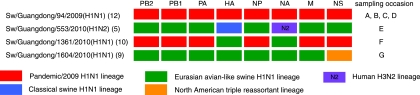
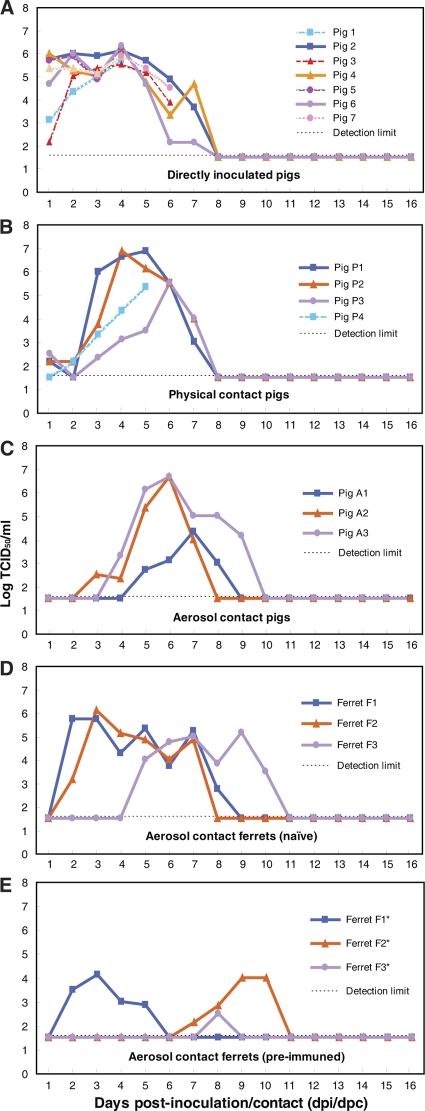
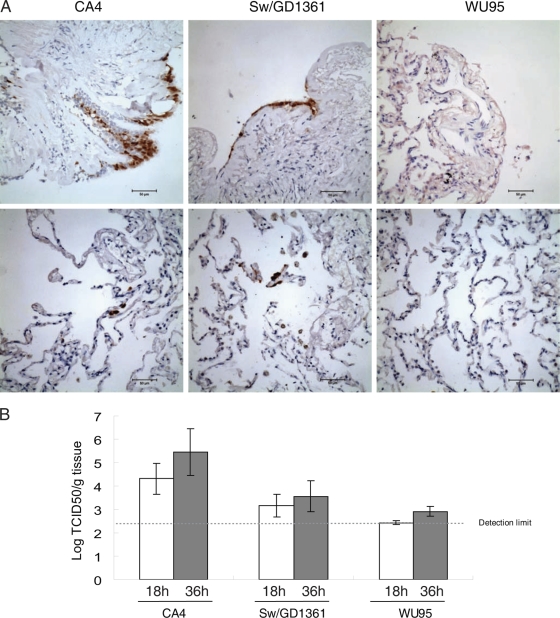
Pigs are considered to be intermediate hosts and "mixing vessels," facilitating the genesis of pandemic influenza viruses, as demonstrated by the emergence of the 2009 H1N1 pandemic (pdm/09) virus. The prevalence and repeated introduction of the pdm/09 virus into pigs raises the possibility of generating novel swine influenza viruses with the potential to infect humans. To address this, an active influenza surveillance program was conducted with slaughtered pigs in abattoirs in southern China. Over 50% of the pigs tested were found to be seropositive for one or more H1 influenza viruses, most commonly pdm/09-like viruses. Out of 36 virus isolates detected, one group of novel reassortants had Eurasian avian-like swine H1N1 surface genes and pdm/09 internal genes. Animal experiments showed that this virus transmitted effectively from pig to pig and from pig to ferret, and it could also replicate in ex vivo human lung tissue. Immunization against the 2009 pandemic virus gave only partial protection to ferrets. The continuing prevalence of the pdm/09 virus in pigs could lead to the genesis of novel swine reassortant viruses with the potential to infect humans.
Figures
References
-
- Adiego Sancho B., et al. 2009. Human case of swine influenza A (H1N1), Aragon, Spain, November 2008. Euro Surveill. 14:pii=19120. - PubMed
-
- Brown I. H. 2000. The epidemiology and evolution of influenza viruses in pigs. Vet. Microbiol. 74:29–46 - PubMed
-
- Claas E. C., Kawaoka Y., de Jong J. C., Masurel N., Webster R. G. 1994. Infection of children with avian-human reassortant influenza virus from pigs in Europe. Virology 204:453–457 - PubMed
-
- Dawood F. S., et al. 2009. Emergence of a novel swine-origin influenza A (H1N1) virus in humans. N. Engl. J. Med. 360:2605–2615 - PubMed
Publication types
MeSH terms
Substances
Associated data
- Actions
- Actions
- Actions
- Actions
- Actions
- Actions
- Actions
- Actions
- Actions
- Actions
- Actions
- Actions
- Actions
- Actions
- Actions
- Actions
- Actions
- Actions
- Actions
- Actions
- Actions
- Actions
- Actions
- Actions
- Actions
- Actions
- Actions
- Actions
- Actions
- Actions
- Actions
- Actions
- Actions
- Actions
- Actions
- Actions
- Actions
- Actions
- Actions
- Actions
- Actions
- Actions
- Actions
- Actions
- Actions
- Actions
- Actions
- Actions
- Actions
- Actions
- Actions
- Actions
- Actions
- Actions
- Actions
- Actions
- Actions
- Actions
- Actions
- Actions
- Actions
- Actions
- Actions
- Actions
- Actions
- Actions
- Actions
- Actions
- Actions
- Actions
- Actions
- Actions
- Actions
- Actions
- Actions
- Actions
- Actions
- Actions
- Actions
- Actions
- Actions
- Actions
- Actions
- Actions
- Actions
- Actions
- Actions
- Actions
- Actions
- Actions
- Actions
- Actions
- Actions
- Actions
- Actions
- Actions
- Actions
- Actions
- Actions
- Actions
- Actions
- Actions
- Actions
- Actions
- Actions
- Actions
- Actions
- Actions
- Actions
- Actions
- Actions
- Actions
- Actions
- Actions
- Actions
- Actions
- Actions
- Actions
- Actions
- Actions
- Actions
- Actions
- Actions
- Actions
- Actions
- Actions
- Actions
- Actions
- Actions
- Actions
- Actions
- Actions
- Actions
- Actions
- Actions
- Actions
- Actions
- Actions
- Actions
- Actions
- Actions
- Actions
- Actions
- Actions
- Actions
- Actions
- Actions
- Actions
- Actions
- Actions
- Actions
- Actions
- Actions
- Actions
- Actions
- Actions
- Actions
- Actions
- Actions
- Actions
- Actions
- Actions
- Actions
- Actions
- Actions
- Actions
- Actions
- Actions
- Actions
- Actions
- Actions
- Actions
- Actions
- Actions
- Actions
- Actions
- Actions
- Actions
- Actions
- Actions
- Actions
- Actions
- Actions
- Actions
- Actions
- Actions
- Actions
- Actions
- Actions
- Actions
- Actions
- Actions
- Actions
- Actions
- Actions
- Actions
- Actions
- Actions
- Actions
- Actions
- Actions
- Actions
- Actions
- Actions
- Actions
- Actions
- Actions
- Actions
- Actions
- Actions
- Actions
- Actions
- Actions
- Actions
- Actions
- Actions
- Actions
- Actions
- Actions
- Actions
- Actions
- Actions
- Actions
- Actions
- Actions
- Actions
- Actions
- Actions
- Actions
- Actions
- Actions
- Actions
- Actions
- Actions
- Actions
- Actions
- Actions
- Actions
- Actions
- Actions
- Actions
- Actions
- Actions
- Actions
- Actions
- Actions
- Actions
- Actions
- Actions
- Actions
- Actions
- Actions
- Actions
- Actions
- Actions
- Actions
- Actions
- Actions
- Actions
- Actions
- Actions
- Actions
- Actions
- Actions
- Actions
- Actions
- Actions
- Actions
- Actions
- Actions
- Actions
- Actions
- Actions
- Actions
- Actions
- Actions
- Actions
- Actions
- Actions
- Actions
- Actions
- Actions
- Actions
- Actions
- Actions
- Actions
- Actions
- Actions
Grants and funding
LinkOut - more resources
Full Text Sources
