Consumption of fructose and high fructose corn syrup increase postprandial triglycerides, LDL-cholesterol, and apolipoprotein-B in young men and women
- PMID: 21849529
- PMCID: PMC3200248
- DOI: 10.1210/jc.2011-1251
Consumption of fructose and high fructose corn syrup increase postprandial triglycerides, LDL-cholesterol, and apolipoprotein-B in young men and women
Abstract
Context: The American Heart Association Nutrition Committee recommends women and men consume no more than 100 and 150 kcal of added sugar per day, respectively, whereas the Dietary Guidelines for Americans, 2010, suggests a maximal added sugar intake of 25% or less of total energy.
Objective: To address this discrepancy, we compared the effects of consuming glucose, fructose, or high-fructose corn syrup (HFCS) at 25% of energy requirements (E) on risk factors for cardiovascular disease. PARTICIPANTS, DESIGN AND SETTING, AND INTERVENTION: Forty-eight adults (aged 18-40 yr; body mass index 18-35 kg/m(2)) resided at the Clinical Research Center for 3.5 d of baseline testing while consuming energy-balanced diets containing 55% E complex carbohydrate. For 12 outpatient days, they consumed usual ad libitum diets along with three servings per day of glucose, fructose, or HFCS-sweetened beverages (n = 16/group), which provided 25% E requirements. Subjects then consumed energy-balanced diets containing 25% E sugar-sweetened beverages/30% E complex carbohydrate during 3.5 d of inpatient intervention testing.
Main outcome measures: Twenty-four-hour triglyceride area under the curve, fasting plasma low-density lipoprotein (LDL), and apolipoprotein B (apoB) concentrations were measured.
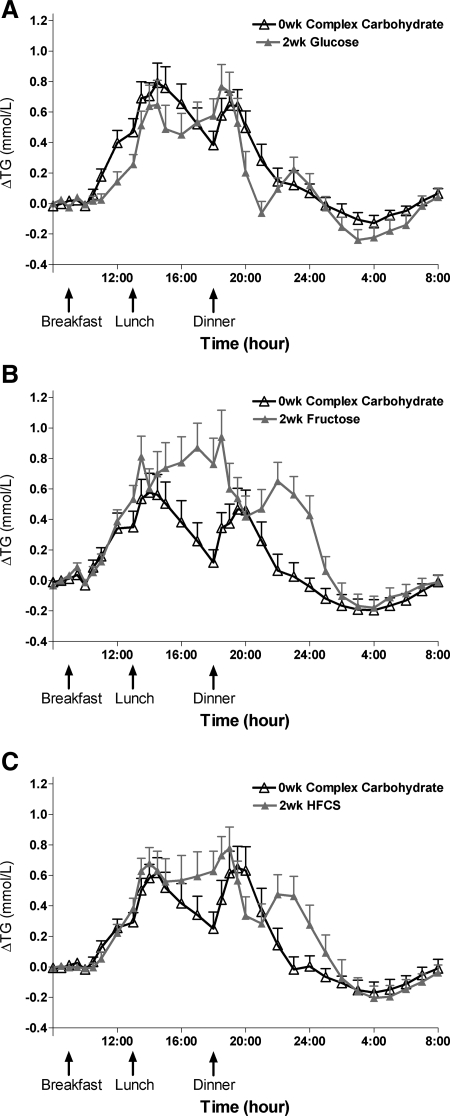
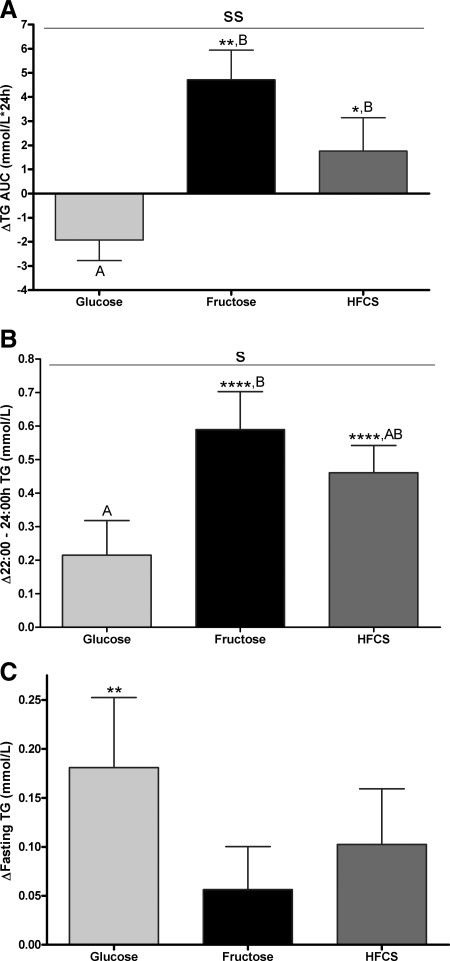
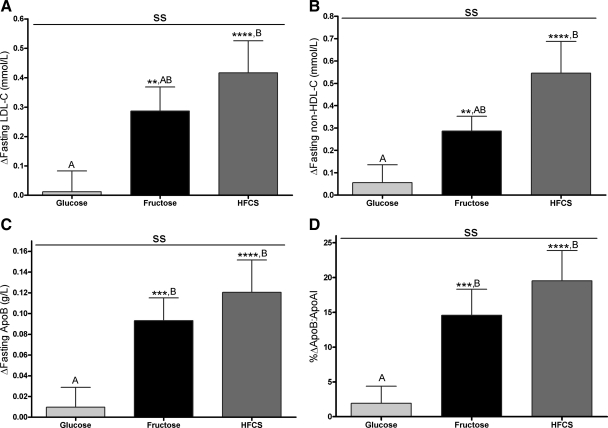
Results: Twenty-four-hour triglyceride area under the curve was increased compared with baseline during consumption of fructose (+4.7 ± 1.2 mmol/liter × 24 h, P = 0.0032) and HFCS (+1.8 ± 1.4 mmol/liter × 24 h, P = 0.035) but not glucose (-1.9 ± 0.9 mmol/liter × 24 h, P = 0.14). Fasting LDL and apoB concentrations were increased during consumption of fructose (LDL: +0.29 ± 0.082 mmol/liter, P = 0.0023; apoB: +0.093 ± 0.022 g/liter, P = 0.0005) and HFCS (LDL: +0.42 ± 0.11 mmol/liter, P < 0.0001; apoB: +0.12 ± 0.031 g/liter, P < 0.0001) but not glucose (LDL: +0.012 ± 0.071 mmol/liter, P = 0.86; apoB: +0.0097 ± 0.019 g/liter, P = 0.90).
Conclusions: Consumption of HFCS-sweetened beverages for 2 wk at 25% E increased risk factors for cardiovascular disease comparably with fructose and more than glucose in young adults.
Figures
References
-
- Aeberli I, Zimmermann MB, Molinari L, Lehmann R, l'Allemand D, Spinas GA, Berneis K. 2007. Fructose intake is a predictor of LDL particle size in overweight schoolchildren. Am J Clin Nutr 86:1174–1178 - PubMed
-
- Bortsov AV, Liese AD, Bell RA, Dabelea D, D'Agostino RB, Jr, Hamman RF, Klingensmith GJ, Lawrence JM, Maahs DM, McKeown R, Marcovina SM, Thomas J, Williams DE, Mayer-Davis EJ. 20 January 2011. Sugar-sweetened and diet beverage consumption is associated with cardiovascular risk factor profile in youth with type 1 diabetes. Acta Diabetol 10.1007/s00592-010-0246-9 - DOI - PMC - PubMed