


A low-cost reinforcement procedure improves short-term weight loss outcomes
- PMID: 21851917
- PMCID: PMC3200484
- DOI: 10.1016/j.amjmed.2011.04.016
A low-cost reinforcement procedure improves short-term weight loss outcomes
Abstract
Objective: Reinforcement-based treatments, based on behavioral economics models, can improve outcomes of medical conditions with behavioral components. This study evaluated the efficacy of a low-cost reinforcement intervention to produce initial weight loss.
Methods: Overweight individuals (n=56) were randomized to one of two 12-week treatments: Lifestyle, Exercise, Attitudes, Relationships, Nutrition manual with supportive counseling or that same treatment with opportunities to win $1 to $100 prizes for losing weight and completing weight-loss activities.
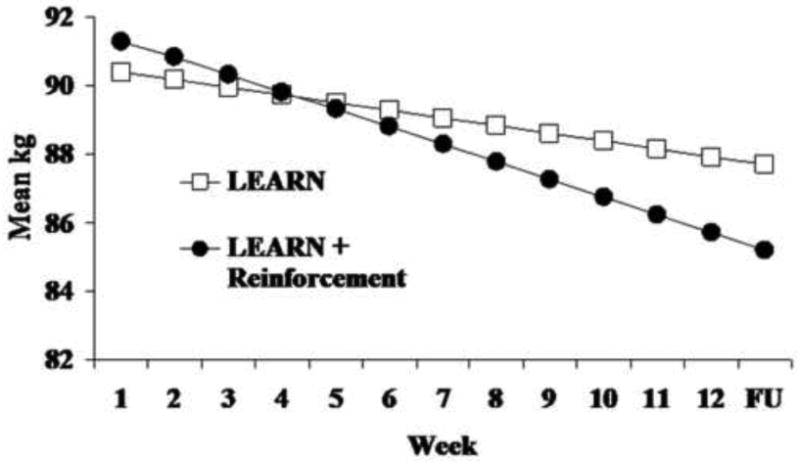
Results: Patients receiving reinforcement lost significantly more weight (6.0% ± 4.9% baseline bodyweight) than patients in the non-reinforcement condition (3.5% ± 4.1%; P=.04). Moreover, 64.3% of patients receiving reinforcement achieved weight loss of ≥ 5% baseline bodyweight versus 25.0% of those in the non-reinforcement condition (P=.003). Proportional weight loss was significantly related to reductions in total cholesterol and 24-hour ambulatory heart rate.
Conclusion: This reinforcement-based intervention substantially enhances short-term weight loss, and reductions in weight are associated with important changes in clinical biomarkers. Larger-scale evaluation of reinforcement-based treatments for weight loss is warranted.
Copyright © 2011 Elsevier Inc. All rights reserved.
Conflict of interest statement
Conflict of interest: No authors report a conflict of interest. All authors had access to data and a role in writing the manuscript.
Figures
References
-
- Jeffery RW, Bjornson-Benson WM, Rosenthal BS, et al. Behavioral treatment of obesity with monetary contracting: two-year follow-up. Addict Behav. 1984;9:311–313. - PubMed
-
- Jeffery RW, Wing RR, Thorson C, et al. Strengthening behavioral interventions for weight loss: a randomized trial of food provision and monetary incentives. J Consult Clin Psychol. 1993;61:1038–1045. - PubMed
-
- Petry NM. A comprehensive guide to the application of contingency management procedures in clinical settings. Drug Alcohol Depend. 2000;58:9–25. - PubMed
Publication types
MeSH terms
Grants and funding
LinkOut - more resources
Full Text Sources
Medical
Miscellaneous
