Review
. 2011 Oct;34(10):536-47.
doi: 10.1016/j.tins.2011.07.006. Epub 2011 Aug 17.

A neoHebbian framework for episodic memory; role of dopamine-dependent late LTP

Affiliations
Review

A neoHebbian framework for episodic memory; role of dopamine-dependent late LTP

John Lisman et al. Trends Neurosci. 2011 Oct.

Abstract

According to the Hebb rule, the change in the strength of a synapse depends only on the local interaction of presynaptic and postsynaptic events. Studies at many types of synapses indicate that the early phase of long-term potentiation (LTP) has Hebbian properties. However, it is now clear that the Hebb rule does not account for late LTP; this requires an additional signal that is non-local. For novel information and motivational events such as rewards this signal at hippocampal CA1 synapses is mediated by the neuromodulator, dopamine. In this Review we discuss recent experimental findings that support the view that this 'neoHebbian' framework can account for memory behavior in a variety of learning situations.


Figures

Box 2 Figure I
Box 2 Figure I
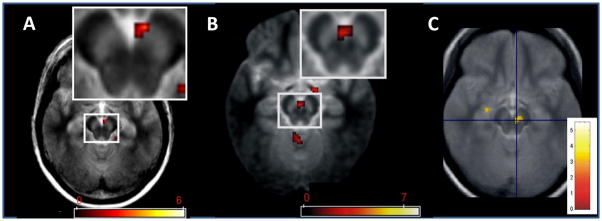
Activation of SN/VTA by different types of stimuli. A Stimulus novelty: Activation was induced in the right medial SN/VTA by rarely appearing novel scenes (novel oddballs) compared with rarely appearing familiar scenes (familiar oddballs). The data were obtained from healthy older adults (Reprinted with permission from [109]). B Incidental stimulus encoding. FMRI responses in bilateral medial SN/VTA were elicited during the incidental encoding of images of scenes that correlate with scene recognition memory after a 24 hour retention interval. (Reprinted with permission from [110]). C Cues that predict novelty. fMRI response in right SN/VTA was elicited by symbolic cues that predict images of novel scenes as compared to cues predicting familiar scenes (Reprinted with permission from [64]. The SN/VTA is visible as a bilaterally bright area in the midbrain. Colour bars depict t-values.
Box 3 Figure I
Box 3 Figure I
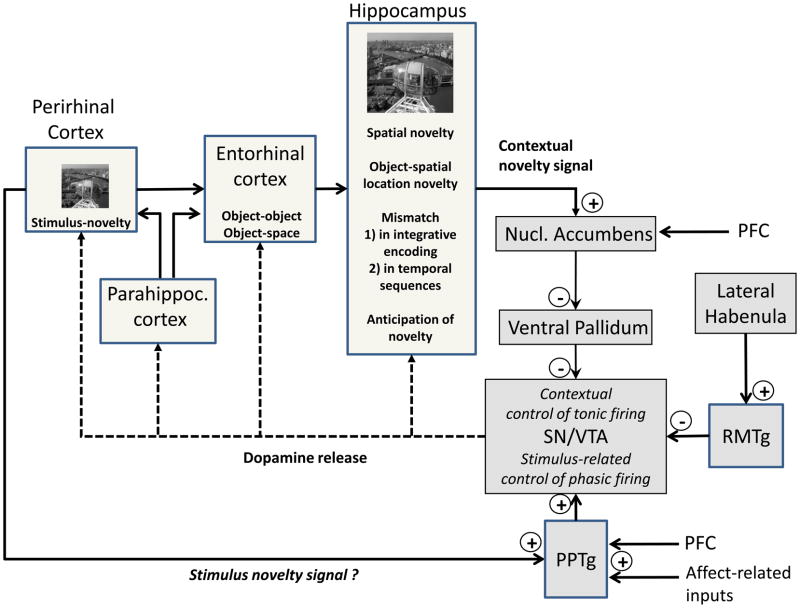
Connectivity within the MTL and the hippocampus-VTA loop. Information about objects and their spatial location converges in the entorhinal cortex via the perirhinal and parahippocampal cortices. These inputs can be integrated in the hippocampus towards ‘object-in-context’ information. Contextual representations in the hippocampus are not limited to spatial information, but may also include the temporal sequence of occurrence and anticipatory states associated with current goals and expectations. Hippocampal contextual novelty signals generated on the basis of such representations can increase the pool of tonically active dopamine neurons in the SN/VTA. This could allow perirhinal cortical information about stimulus-novelty to generate phasic dopamine responses (italics in the figure indicates that this possibility needs experimental testing). The loop is completed by ascending dopaminergic fibers that innervate the hippocampus and other MTL structures.
Fig. 1
Fig. 1
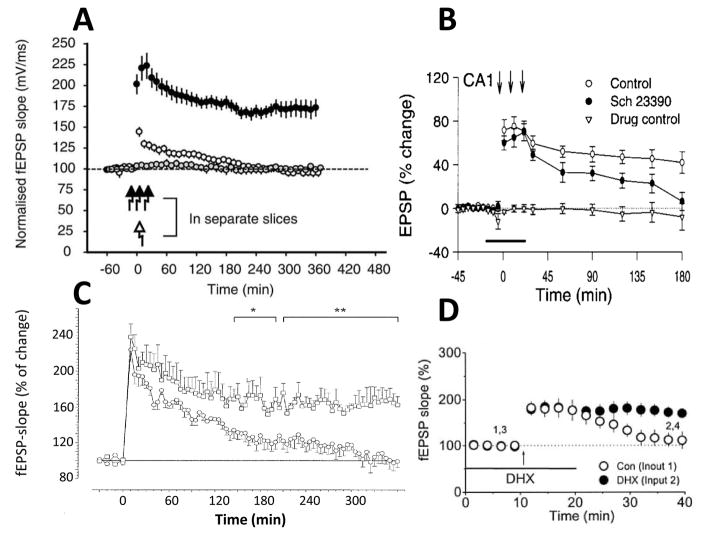
Dopamine is required for late LTP in the CA1 region of the hippocampus in rodents. A. Under control conditions (closed black circles), robust LTP was induced after high frequency stimulation at time 0 min (as indicated by arrows) [14]. A significant reduction in LTP was observed in the presence of a D1 antagonist SCH23390 (open circles), and a complete absence of LTP induction in the presence of the NMDAR antagonist, APV (grey circles) [14]. Experiments were done in the acute slice preparation. B. Effect of SCH23390 on LTP measured in vivo [17]. C. Experiments in acute slice from D1 receptor knockout mouse (circles) and wild type controls (squares)[15]. LTP in the CA1 region of the hippocampus in D1-deficient mutant mice (circles) and wild-type (squares). Asterisks indicate statistically significant deviations (*, p< 0.05; ** p< 0.01) between the two groups at late stages of LTP. D. Block of late LTP by in vivo dopamine/noradrenaline depletion with 6-hyroxydopamine (open circles) is reversed by the addition of the D1 agonist, dihydrexidine (DHX) (black circles) [18]. The duration of potentiation in depleted animals is quite short, but consistent with the short potentiation after protein synthesis inhibition seen in some experiments [84]. Reproduced with permission from [14, 15, 17, 18], respectively.
Fig. 2
Fig. 2
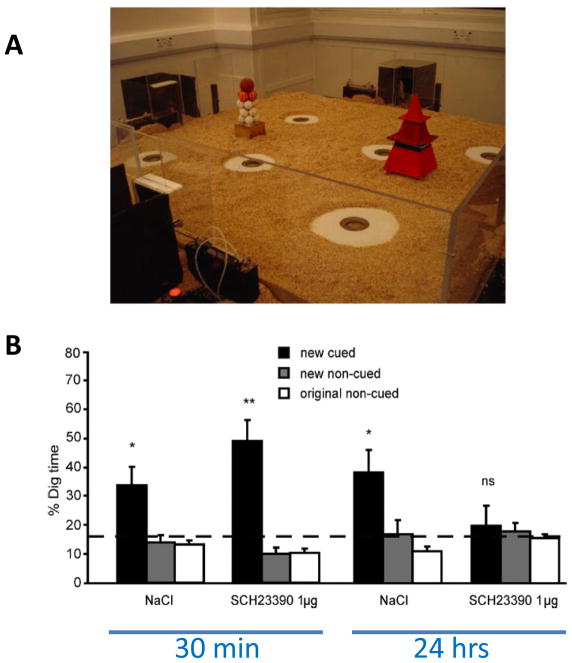
A D1 antagonist blocks long-term memory but not early memory (30min) for novel episodic-like information in rats. A In this event-arena apparatus, six sand wells are available to which the rat can run to collect food. Animals are trained over several sessions to learn six flavor/sand-well associations. After acquisition, they are given one trial of a new flavor-location paired associate. Memory recall is measured as time spent digging (% Dig time) at the correct location for a given flavor (new cued). The primary measure of memory recall is calculated as the proportion of time spent at the cued location relative to the average time at the non-cued locations for the originally acquired flavor locations (original non-cued) and the non-cued location of the other novel flavors introduced during a training day (new non-cued). B The D1 antagonist SCH23390 given 20 minutes prior to the encoding of the new flavor/location paired associate has no effect on short-term memory (tested 30 minutes after the last training trial) but eliminates long-term memory (24 hours later), as compared to vehicle control (NaCl). Reprinted with permission from [26].

References

    1. Watson JS, PERAM . In: Cicero (B.C.55) Cicero on Oratory and Orators (Landmarks in Rhetoric and Public Address) Potter David., editor. Southern Illinois University Press; 1986.
    1. Hebb DO. The Organization of Behavior: A Neuropsychological Theory. John Wiley and Sons, Inc; 1949.
    1. Wigstrom H, Gustafsson B. Postsynaptic control of hippocampal long-term potentiation. J Physiol (Paris) 1986;81:228–236. - PubMed
    1. Malinow R, Miller JP. Postsynaptic hyperpolarization during conditioning reversibly blocks induction of long-term potentiation. Nature. 1986;320:529–530. - PubMed
    1. Matsuzaki M, et al. Structural basis of long-term potentiation in single dendritic spines. Nature. 2004;429:761–766. - PMC - PubMed

Publication types