


Investigating the role of feedback and motivation in clinical reaction time assessment
- PMID: 21852221
- PMCID: PMC3643804
- DOI: 10.1016/j.pmrj.2011.04.022
Investigating the role of feedback and motivation in clinical reaction time assessment
Abstract
Objective: To investigate the influence of performance feedback and motivation during 2 tests of simple visuomotor reaction time (RT).
Design: Cross-sectional, observational study.
Setting: Outpatient academic physiatry clinic.
Participants: Thirty-one healthy adults (mean [SD], 54 ± 15 years).
Methods: Participants completed a clinical test of RT (RT(clin)) and a computerized test of RT with and without performance feedback (RT(compFB) and RT(compNoFB), respectively) in randomly assigned order. They then ranked their degree of motivation during each test. RT(clin) measured the time required to catch a suspended vertical shaft by hand closure after release of the shaft by the examiner. RT(compFB) and RT(compNoFB) both measured the time required to press a computer key in response to a visual cue displayed on a computer monitor. Performance feedback (visual display of the previous trial and summary results) was provided for RT(compFB), but not for RT(compNoFB).
Main outcome measurements: Means and standard deviations of RT(clin), RT(compFB), and RT(compNoFB) and participants' self-reported motivation on a 5-point Likert scale for each test.
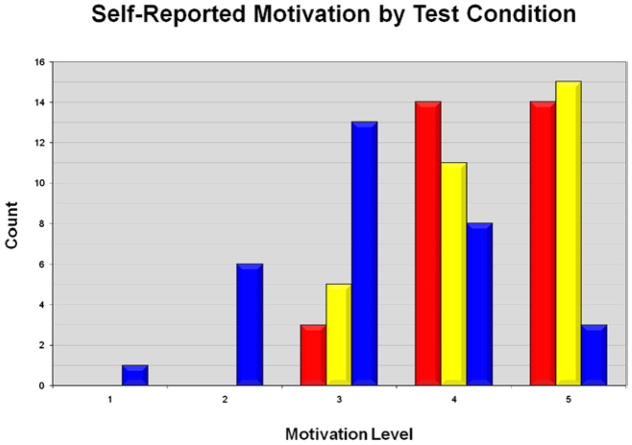
Results: There were significant differences in both the means and standard deviations of RT(clin), RT(compFB), and RT(compNoFB) (F(2,60) = 81.66, P < .0001; F(2,60) = 32.46, P < .0001, respectively), with RT(clin) being both the fastest and least variable of the RT measurements. RT(clin) was more strongly correlated with RT(compFB) (r = 0.449, P = .0011) than with RT(compNoFB) (r = 0.314, P = .086). The participants reported similar levels of motivation between RT(clin) and RT(compFB), both of which were reported to be more motivating than RT(compNoFB).
Conclusions: The stronger correlation between RT(clin) and RT(compFB) as well as the higher reported motivation during RT(clin) and RT(compFB) testing suggest that performance feedback is a positive motivating factor that is inherent to RT(clin) testing. RT(clin) is a simple, inexpensive technique for measuring RT and appears to be an intrinsically motivating task. This motivation may promote faster, more consistent RT performance compared with currently available computerized programs, which do not typically provide performance feedback.
Copyright © 2011 American Academy of Physical Medicine and Rehabilitation. Published by Elsevier Inc. All rights reserved.
Figures
References
-
- Callisaya ML, Blizzard L, Schmidt MD, McGinley JL, Lord SR, Srikanth VK. A population-based study of sensorimotor factors affecting gait in older people. Age Ageing. 2009;38(3):290–295. - PubMed
-
- Lord SR, Lloyd DG, Li SK. Sensori-motor function, gait patterns and falls in community-dwelling women. Age Ageing. 1996;25(4):292–299. - PubMed
-
- Tiedemann AC, Sherrington C, Lord SR. Physical and psychological factors associated with stair negotiation performance in older people. J Gerontol A Biol Sci Med Sci. 2007;62(11):1259–1265. - PubMed
-
- Smeesters C, Hayes WC, McMahon TA. The threshold trip duration for which recovery is no longer possible is associated with strength and reaction time. J Biomech. 2001;34(5):589–595. - PubMed
-
- Lord SR, Clark RD, Webster IW. Physiological factors associated with falls in an elderly population. J Am Geriatr Soc. 1991;39(12):1194–1200. - PubMed
Publication types
MeSH terms
Grants and funding
LinkOut - more resources
Full Text Sources
Miscellaneous
