


Solar UV doses of young Americans and vitamin D3 production
- PMID: 21852226
- PMCID: PMC3261929
- DOI: 10.1289/ehp.1003195
Solar UV doses of young Americans and vitamin D3 production
Abstract
Background: Sunlight contains ultraviolet B (UVB) radiation (290-315 nm) that affects human health in both detrimental (skin cancers) and beneficial (vitamin D3) ways. Serum 25-hydroxyvitamin D concentrations from young Americans (≤ 19 years) show that many have deficient (< 50 nmol/L, 20 ng/mL) or insufficient (< 75 nmol/L, 30 ng/mL) vitamin D levels, indicating that they are not getting enough sun exposure. Those findings are in conflict with some calculated, published values that suggest people make "ample" vitamin D3 (~ 1,000 IU/day) from their "casual," or everyday, outdoor exposures even if they diligently use sunscreens with sun protection factor (SPF) 15.
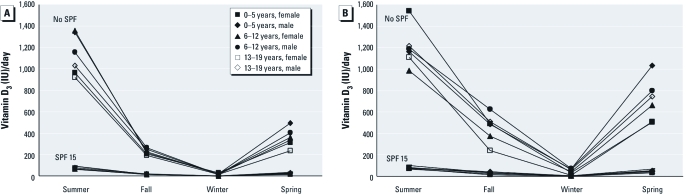
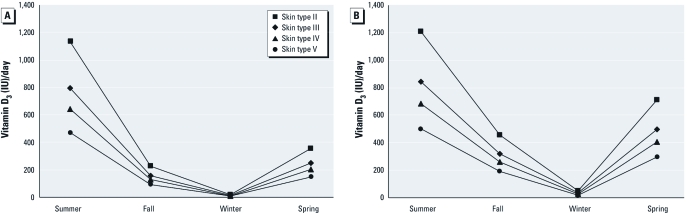
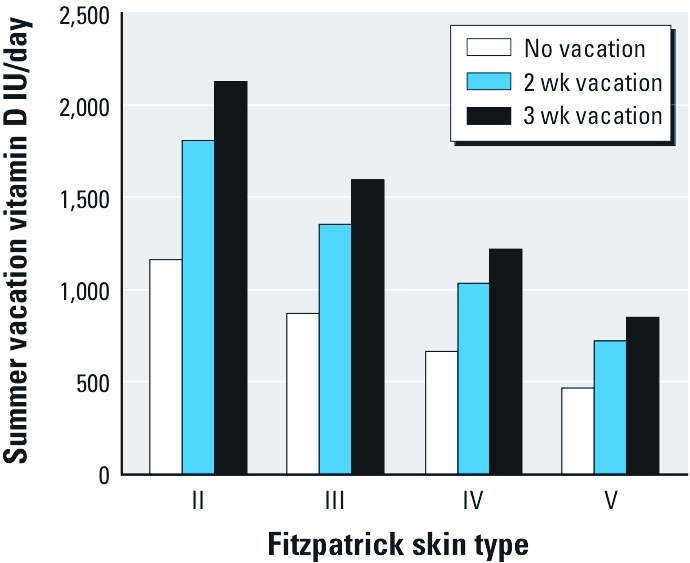
Objective: We estimated how much vitamin D3 young Americans (n = ~ 2,000) produce from their everyday outdoor ultraviolet doses in the North (45°N) and South (35°N) each season of the year with and without vacationing.
Methods: For these vitamin D3 calculations, we used geometric conversion factors that change planar to whole-body doses, which previous calculations did not incorporate.
Results: Our estimates suggest that American children may not be getting adequate outdoor UVB exposures to satisfy their vitamin D3 needs all year, except some Caucasians during the summer if they do not diligently wear sunscreens except during beach vacations.
Conclusion: These estimates suggest that most American children may not be going outside enough to meet their minimal (~ 600 IU/day) or optimal (≥ 1,200 IU/day) vitamin D requirements.
Figures
References
-
- Berwick M, Armstrong BK, Ben-Porat L, Fine J, Kricker A, Eberle C, et al. Sun exposure and mortality from melanoma. J Natl Cancer Inst. 2005;97:195–199. - PubMed
-
- Clemens TL, Adams JS, Henderson SL, Holick MF. Increased skin pigment reduces the capacity to synthesize vitamin D3. Lancet. 1982;1:74–76. - PubMed
-
- Eisman JA, Barkla DH, Tutton PJ. Suppression of in vivo growth of human cancer solid tumor xenografts by 1, 25-dihydroxyvitamin D3. Cancer Res. 1987;47:21–25. - PubMed
-
- Fitzpatrick TB. The validity and practicality of sun-reactive skin types I through VI. Arch Dermatol. 1988;124:869–871. - PubMed
Publication types
MeSH terms
Substances
LinkOut - more resources
Full Text Sources
Other Literature Sources