. 2011 Aug 15;25(16):1674-9.
doi: 10.1101/gad.16860911.

LRH-1 and PTF1-L coregulate an exocrine pancreas-specific transcriptional network for digestive function

Affiliations

LRH-1 and PTF1-L coregulate an exocrine pancreas-specific transcriptional network for digestive function

Sam R Holmstrom et al. Genes Dev. .

Abstract

We have determined the cistrome and transcriptome for the nuclear receptor liver receptor homolog-1 (LRH-1) in exocrine pancreas. Chromatin immunoprecipitation (ChIP)-seq and RNA-seq analyses reveal that LRH-1 directly induces expression of genes encoding digestive enzymes and secretory and mitochondrial proteins. LRH-1 cooperates with the pancreas transcription factor 1-L complex (PTF1-L) in regulating exocrine pancreas-specific gene expression. Elimination of LRH-1 in adult mice reduced the concentration of several lipases and proteases in pancreatic fluid and impaired pancreatic fluid secretion in response to cholecystokinin. Thus, LRH-1 is a key regulator of the exocrine pancreas-specific transcriptional network required for the production and secretion of pancreatic fluid.


Figures
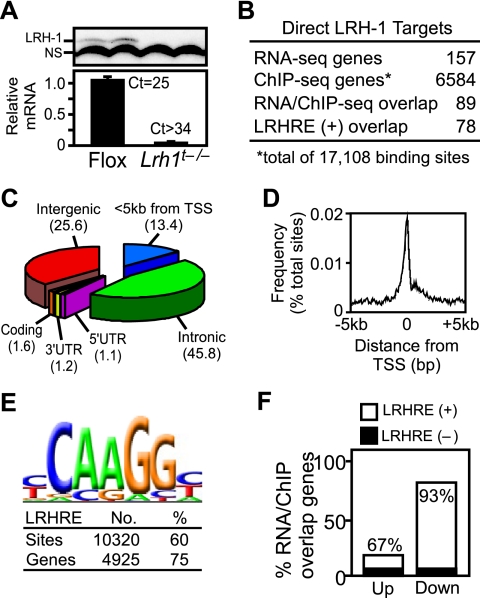
Figure 1.
Figure 1.
Identification of LRH-1 target genes in exocrine pancreas by RNA-seq and ChIP-seq analyses. (A) Immunoblots of LRH-1 protein (top panel, n = 2 mice per genotype) and qPCR of LRH-1 mRNA (bottom panel, n = 4 per group) from pancreas of Flox and Lrh1t−/− mice. (NS) Nonspecific band. (B) Comparison and overlap of LRH-1 target genes. RNA-seq identified genes up-regulated or down-regulated twofold or more in Lrh1t−/− pancreas compared with Flox pancreas. ChIP-seq analysis from pancreas of wild-type mice identified genes with at least one LRH-1-binding site within 50 kb of a gene. The overlap of genes found in both data sets containing a consensus LRHRE are shown. (C,D) Distribution of LRH-1 ChIP-seq peaks across the genome (C) and relative to gene transcriptional start sites (TSSs) (D). (E) Analysis of LRH-1 ChIP-seq peak sequences revealed the consensus LRHRE as an overrepresented motif. Numbers of LRHRE-positive peaks and associated genes are shown. (F) Direct LRH-1 target genes identified by RNA-seq and ChIP-seq that were up-regulated or down-regulated in the Lrh1t−/− pancreas are shown.
Figure 2.
Figure 2.
LRH-1 regulates exocrine pancreas-specific genes. (A) LRH-1-regulated genes identified by RNA-seq were confirmed by qPCR by comparing expression in Flox and Lrh1t−/− (KO) pancreas (n = 5 per group). (B) ChIP-seq data were confirmed by conventional ChIP using an LRH-1 antibody and Flox and Lrh1t−/− pancreas (n = 3 per group). (Cel) Carboxyl ester lipase; (Pnlip) pancreatic lipase; (Ela1) elastase 1; (Ctrl) chymotrypsin-like; (Cpa1) carboxypeptidase A1; (Shp) small heterodimer partner; (Aqp12) aquaporin 12; (Sycn) syncollin; (Gatm) glycine amidinotransferase; (Gls2) glutaminase 2.
Figure 3.
Figure 3.
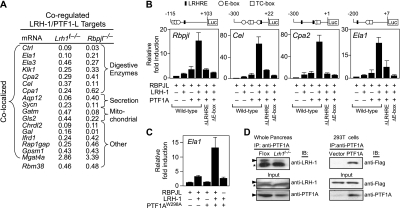
LRH-1 and PTF1-L coregulate exocrine pancreas-specific genes. (A) ChIP-seq and RNA-seq data from Lrh1t−/−, E17.5 Rbpjl−/−, and control mouse pancreas were used to identify genes that contained overlapping LRH-1 and PTF-1L ChIP-seq peaks (within 50 kb) and that were dysregulated twofold or more in the same direction (either up or down) in the absence of LRH-1 or PTF1-L. The relative mRNA levels in the Lrh1t−/− and Rbpjl−/− mice compared with control mice are shown. Common LRH-1/PTF1-L target genes are listed according to function. (B) 293T cells were cotransfected with expression plasmids for RBPJL, LRH-1, and PTF1A as indicated together with luciferase reporter plasmids containing the mouse Rbpjl, Cel, Cpa2, and Ela1 promoters, or these same promoters in which either the LRHRE or E-boxes were mutated. Schematics showing the relative positions of LRHREs, E-boxes, and TC-boxes in each promoter are shown. (C) 293T cells were cotransfected with the Ela1-luc reporter plasmid and expression plasmids for RBPJL, LRH-1, and PTF1AW298A as indicated. In B and C, n = 3 ± SEM. Luciferase activity is normalized to vector alone. (D) Coimmunoprecipitation experiments were performed with either whole pancreas extracts from Flox and Lrh1t−/− mice (left panels) or 293T cells transfected with Flag-tagged LRH-1 in the presence or absence of PTF1A (right panel). Immunoprecipitations were done with a PTF1A antibody, and immunoblotting was done with an LRH-1 antibody (top left panel) or an anti-Flag antibody (top right panel). Immunoblots for total input LRH-1 and PTF1A are shown at the bottom.
Figure 4.
Figure 4.
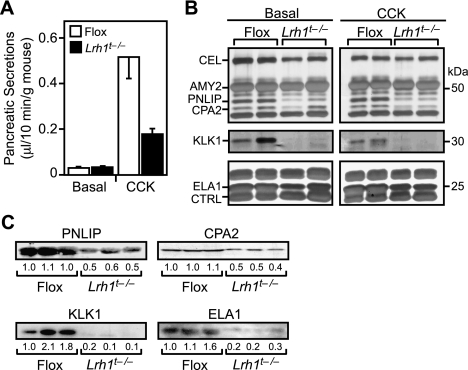
LRH-1 regulates the secretion and composition of pancreatic fluid. (A) Pancreatic fluid volumes from basal and CCK-stimulated secretions were collected for 10 min each, and volumes were normalized to body weight (n = 5–7 mice per group). (B) Pancreatic secretions from A were resolved by SDS-PAGE and visualized by silver staining. Each lane represents pancreatic fluid pooled from two mice. Expected positions of abundant digestive enzymes are indicated. (CEL) Carboxyl ester lipase; (AMY2) amylase 2; (PNLIP) pancreatic lipase; (CPA2) carboxypeptidase A2; (KLK1) kallikrein 1; (ELA1) elastase 1; (CTRL) chymotrypsin-like. (C) CCK-stimulated pancreatic secretions from three Flox and three Lrh1t−/− mice were analyzed by Western analysis for PNLIP, CPA2, KLK1, and ELA1.

References

    1. Bearer EL 2003. Overview of image analysis, image importing, and image processing using freeware. Curr Protoc Mol Biol 14.15.1–14.15.9 doi: 10.1002/0471142727.mb1415s63 - PMC - PubMed
    1. Beres TM, Masui T, Swift GH, Shi L, Henke RM, MacDonald RJ 2006. PTF1 is an organ-specific and Notch-independent basic helix–loop–helix complex containing the mammalian Suppressor of Hairless (RBP-J) or its paralogue, RBP-L. Mol Cell Biol 26: 117–130 - PMC - PubMed
    1. Bookout AL, Cummins CL, Mangelsdorf DJ, Pesola JM, Kramer MF 2006. High-throughput real-time quantitative reverse transcription PCR. Curr Protoc Mol Biol 15.8.1–15.8.28 doi: 10.1002/0471142727.mb1508s73 - PubMed
    1. Carroll JS, Meyer CA, Song J, Li W, Geistlinger TR, Eeckhoute J, Brodsky AS, Keeton EK, Fertuck KC, Hall GF, et al. 2006. Genome-wide analysis of estrogen receptor binding sites. Nat Genet 38: 1289–1297 - PubMed
    1. Cockell M, Stevenson BJ, Strubin M, Hagenbuchle O, Wellauer PK 1989. Identification of a cell-specific DNA-binding activity that interacts with a transcriptional activator of genes expressed in the acinar pancreas. Mol Cell Biol 9: 2464–2476 - PMC - PubMed

Publication types

MeSH terms