. 2011 Sep;22(9):1707-19.
doi: 10.1681/ASN.2011020132. Epub 2011 Aug 18.

Nedd4-2 modulates renal Na+-Cl- cotransporter via the aldosterone-SGK1-Nedd4-2 pathway

Affiliations

Nedd4-2 modulates renal Na+-Cl- cotransporter via the aldosterone-SGK1-Nedd4-2 pathway

Juan Pablo Arroyo et al. J Am Soc Nephrol. 2011 Sep.

Abstract

Regulation of renal Na(+) transport is essential for controlling blood pressure, as well as Na(+) and K(+) homeostasis. Aldosterone stimulates Na(+) reabsorption by the Na(+)-Cl(-) cotransporter (NCC) in the distal convoluted tubule (DCT) and by the epithelial Na(+) channel (ENaC) in the late DCT, connecting tubule, and collecting duct. Aldosterone increases ENaC expression by inhibiting the channel's ubiquitylation and degradation; aldosterone promotes serum-glucocorticoid-regulated kinase SGK1-mediated phosphorylation of the ubiquitin-protein ligase Nedd4-2 on serine 328, which prevents the Nedd4-2/ENaC interaction. It is important to note that aldosterone increases NCC protein expression by an unknown post-translational mechanism. Here, we present evidence that Nedd4-2 coimmunoprecipitated with NCC and stimulated NCC ubiquitylation at the surface of transfected HEK293 cells. In Xenopus laevis oocytes, coexpression of NCC with wild-type Nedd4-2, but not its catalytically inactive mutant, strongly decreased NCC activity and surface expression. SGK1 prevented this inhibition in a kinase-dependent manner. Furthermore, deficiency of Nedd4-2 in the renal tubules of mice and in cultured mDCT(15) cells upregulated NCC. In contrast to ENaC, Nedd4-2-mediated inhibition of NCC did not require the PY-like motif of NCC. Moreover, the mutation of Nedd4-2 at either serine 328 or 222 did not affect SGK1 action, and mutation at both sites enhanced Nedd4-2 activity and abolished SGK1-dependent inhibition. Taken together, these results suggest that aldosterone modulates NCC protein expression via a pathway involving SGK1 and Nedd4-2 and provides an explanation for the well-known aldosterone-induced increase in NCC protein expression.


Figures
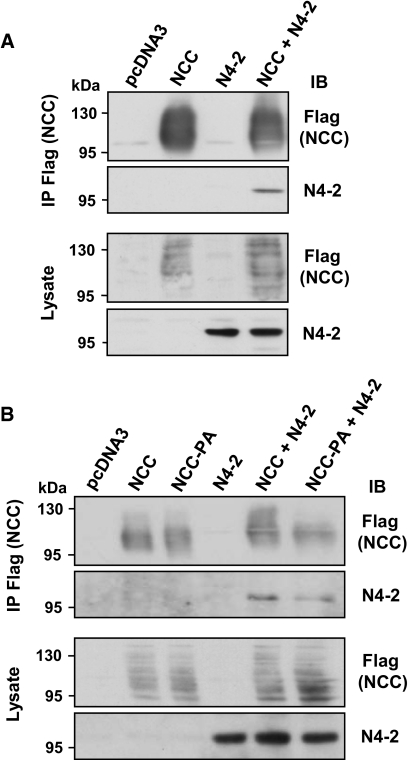
Figure 1.
Figure 1.
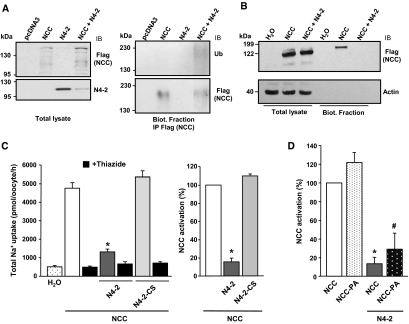
Nedd4-2 interacts with Na+-Cl cotransporter (NCC) independently of a PY-like motif in the cotransporter. HEK293 cells were transfected with wild-type Flag-tagged NCC (A) or with NCC-P847A, mutated in the PY-like motif (NCC-PA) (B) with or without Nedd4-2 (N4-2), as indicated. Immunoprecipitation was performed on cell lysates using an anti-Flag (NCC) antibody. Lysates and immunoprecipitates were analyzed by Western blot as indicated. The blots are representative of three independent experiments. IP, immunoprecipitation; IB, immunoblot.
Figure 2.
Figure 2.
Nedd4-2 down-regulates NCC cell-surface expression and function via ubiquitylation. (A) HEK293 cells were transiently transfected with Flag-NCC with or without Nedd4-2 (N4-2). Surface proteins were labeled with biotin and immunoprecipitated with anti-Flag (NCC). Biotinylated NCC was then captured using streptavidin-sepharose beads, and the precipitated material was analyzed by Western blotting using anti-Flag (NCC) or anti-ubiquitin (Ub) antibodies. The blot is representative of the results obtained from two independent experiments. (B) Oocytes were injected with H2O, Flag-NCC alone or with Nedd4-2 (N4-2). Surface proteins were labeled with biotin and precipitated with streptavidin-agarose beads. Total lysates and precipitates were analyzed by Western blotting using anti-Flag (NCC) or anti-actin. This blot is representative of four independent experiments. (C) NCC function was assessed as the [22Na+] uptake in the absence or presence (black bars) of thiazide (100 μM) in X. laevis oocytes injected with NCC cRNA with or without Nedd4-2 wild-type (N4-2) or the catalytically inactive Nedd4-2-CS cRNA (N4-2-CS), as stated (data represents the pool of 13 experiments). The graph on the left shows the results in pmol/oocyte/h, and the graph on the right depicts the NCC activation in percentage, taking as 100% the thiazide-sensitive Na+ uptake in oocytes injected with NCC alone. NCC basal function was markedly decreased when coinjected with Nedd4-2, but not with the catalytically inactive Nedd4-2-CS. (D) The effect of Nedd4-2 was assessed on wild-type NCC and NCC lacking the PY-like motif (NCC-PA). Activity in oocytes injected with NCC alone was taken as 100%. No difference was observed in basal activity or in response to Nedd4-2 between NCC wild-type and NCC-PA variant. *P < 0.001 versus NCC alone; #P < 0.01 versus NCC-PA variant alone. NCC, Na+-Cl cotransporter; IB, immunoblot.
Figure 3.
Figure 3.
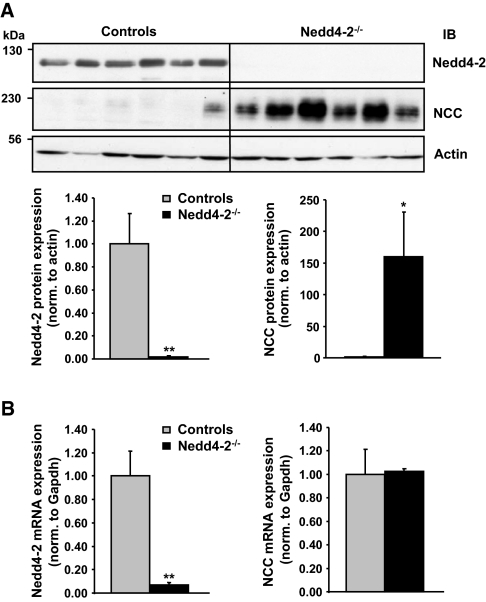
Loss of Nedd4-2 protein in vivo leads to increase in NCC protein expression but unchanged mRNA levels, suggesting a post-translational regulation of the cotransporter. (A) Inducible renal tubule-specific Nedd4-2Pax8/LC1 knockout mice (Nedd4-2−/−) and Nedd4-2Pax8 or Nedd4-2LC1 control littermates (controls) were treated with doxycycline and challenged with high-Na+ diet. Total kidney lysates were analyzed by Western blot as indicated (Nedd4-2−/−, n = 6; controls, n = 6). Graphs show quantification of Nedd4-2 and NCC protein expression in controls and induced Nedd4-2−/− mice in two independent experiments (Nedd4-2−/−, n = 9; controls, n = 12). Protein expression is expressed relative to control values and normalized to the amount of actin. (B) Nedd4-2 and NCC mRNA expression was analyzed by quantitative real-time PCR in controls (n = 7) and induced Nedd4-2−/− mice (n = 11). mRNA expression is expressed relative to control values and normalized to the expression of GAPDH mRNA. NCC mRNA levels were unchanged between controls and induced Nedd4-2−/− mice. *P < 0.05; **P < 0.01 versus controls. NCC, Na+-Cl cotransporter; IB, immunoblot.
Figure 4.
Figure 4.
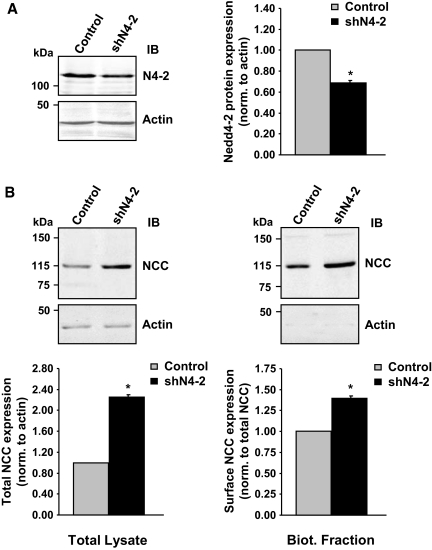
RNA interference of Nedd4-2 causes increased NCC expression. (A) mDCT15 cells were infected with a lentiviral shRNA construct specific for Nedd4-2 (shN4-2) or a control construct. Lysates were analyzed by Western blot as indicated. The accompanying graphs show quantification of Nedd4-2 (N4-2) protein expression by densitometry, demonstrating a reduction in Nedd4-2 expression with shN4-2 infection. Protein expression is expressed relative to control values and normalized to the amount of actin. A representative blot of four independent experiments is shown. (B) mDCT15 cells infected as above were treated with cell-impermeable biotin, with resulting lysates undergoing streptavidin pull-down to obtain biotinylated (cell surface expressed) fractions. Lysates and cell-surface fractions were analyzed by Western blot as indicated. The accompanying graphs show quantification of NCC protein expression by densitometry, demonstrating an increase in NCC expression with decreased Nedd4-2 expression. Protein expression is indicated relative to control values and normalized to the amount of actin for total NCC and to the amount of normalized total NCC for surface expressed NCC (biotinylated fraction). A representative blot of four independent experiments is shown. *P < 0.05. NCC, Na+-Cl cotransporter; IB, immunoblot.
Figure 5.
Figure 5.
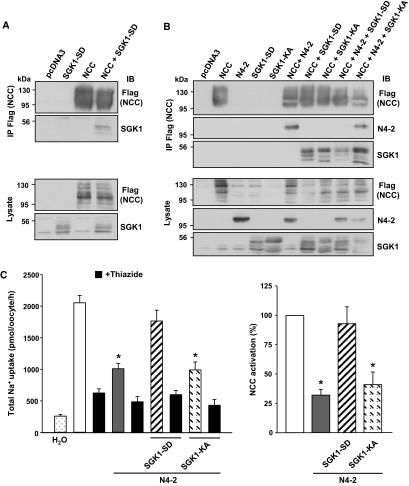
SGK1 prevents Nedd4-2-mediated inhibition of NCC in a kinase-dependent manner. (A) HEK293 cells were transfected with Flag-NCC with or without constitutively active SGK1-S422D (SGK1-SD). NCC was immunoprecipitated using an anti-Flag. Lysates and immunoprecipitates were analyzed by Western blot as indicated, demonstrating that SGK1 and NCC interact. A representative blot of three independent experiments is shown. (B) HEK293 cells were transfected with Flag-NCC alone, with Nedd4-2 (N4-2), or with SGK1-SD or the SGK1-K127A kinase-dead mutant (SGK1-KA). NCC was immunoprecipitated from cell lysates using an anti-Flag. Lysates and immunoprecipitates were analyzed by Western blot as indicated. SGK1 was able to abrogate interaction between NCC and Nedd4-2 in a kinase-dependent manner. (C) NCC function in X. laevis oocytes was assessed as total Na+ uptake in pmol/oocyte/h (left graph) and as NCC activation in percentage versus control (right graph) in the absence or presence (black bars) of thiazide (100 μM). NCC was inhibited by coinjection with Nedd4-2 cRNA (100% versus 32%). This effect was abrogated in the presence of the constitutively active SGK1-SD mutant, but not the kinase-dead SGK1-KA mutant (100% versus 41%). *P < 0.01 versus NCC. NCC, Na+-Cl cotransporter; IB, immunoblot; IP, immunoprecipitation.
Figure 6.
Figure 6.
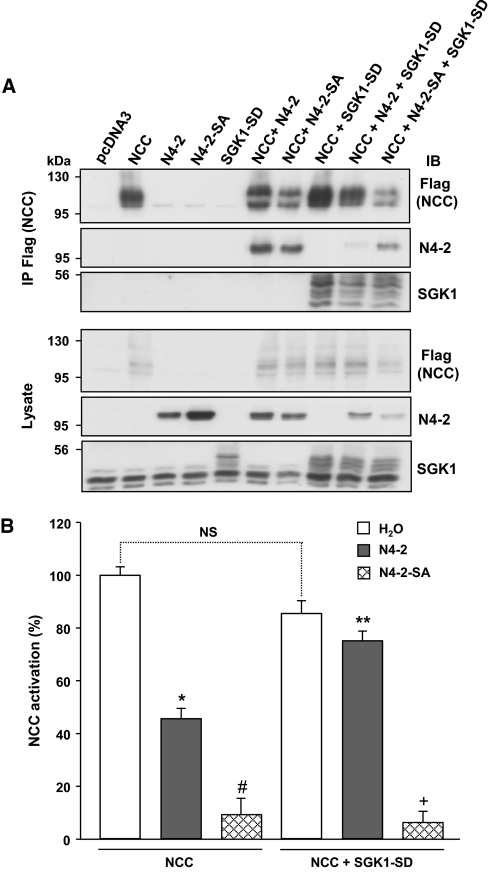
Nedd4-2-mediated NCC regulation by SGK1 involves Nedd4-2 phosphorylation on both S222 and S328. (A) HEK293 cells were transfected with Flag-NCC alone, with Nedd4-2 (N4-2), or the Nedd4-2-S222,328A (N4-2-SA), and with or without constitutively active SGK1 mutant (SGK1-SD), as indicated. NCC was immunoprecipitated using an anti-Flag antibody. Lysates and immunoprecipitates were analyzed by Western blot as indicated. The blot is representative of the results obtained from three independent experiments. (B) NCC function was assessed as the [22Na+] uptake in the absence or presence of thiazide (100 μM) in X. laevis oocytes injected with NCC with or without wild-type Nedd4-2 (N4-2) or the double mutant Nedd4-2-SA (N4-2-SA), with or without the constitutively active SGK1 (SGK1-SD), as indicated. SGK1 was able to recover inhibition by wild-type N4-2 but not by N4-2-SA, which in turn inhibited NCC more efficiently than the wild-type variant. The results of five different experiments, expressed as percentages of activity, taking the uptake in NCC control group as 100%. *P < 0.001 versus NCC, #P < 0.001 versus NCC, **P < 0.0001 versus NCC+N4-2, +P < 0.001 versus NCC+SGK1. NCC, Na+-Cl cotransporter; IB, immunoblot; IP, immunoprecipitation.

References

    1. Loffing J, Loffing-Cueni D, Valderrabano V, Klausli L, Hebert SC, Rossier BC, Hoenderop JG, Bindels RJ, Kaissling B: Distribution of transcellular calcium and sodium transport pathways along mouse distal nephron. Am J Physiol Renal Physiol 281: F1021–F1027, 2001 - PubMed
    1. Bostanjoglo M, Reeves WB, Reilly RF, Velazquez H, Robertson N, Litwack G, Morsing P, Dorup J, Bachmann S, Ellison DH, Bostonjoglo M: 11Beta-hydroxysteroid dehydrogenase, mineralocorticoid receptor, and thiazide-sensitive Na-Cl cotransporter expression by distal tubules. J Am Soc Nephrol 9: 1347–1358, 1998 - PubMed
    1. Reilly RF, Ellison DH: Mammalian distal tubule: Physiology, pathophysiology, and molecular anatomy. Physiol Rev 80: 277–313, 2000 - PubMed
    1. Bonvalet JP, Doignon I, Blot-Chabaud M, Pradelles P, Farman N: Distribution of 11 beta-hydroxysteroid dehydrogenase along the rabbit nephron. J Clin Invest 86: 832–837, 1990 - PMC - PubMed
    1. Rusvai E, Naray-Fejes-Toth A: A new isoform of 11 beta-hydroxysteroid dehydrogenase in aldosterone target cells. J Biol Chem 268: 10717–10720, 1993 - PubMed

Publication types

MeSH terms

Substances