Health status, neighborhood socioeconomic context, and premature mortality in the United States: The National Institutes of Health-AARP Diet and Health Study
- PMID: 21852636
- PMCID: PMC3489366
- DOI: 10.2105/AJPH.2011.300158
Health status, neighborhood socioeconomic context, and premature mortality in the United States: The National Institutes of Health-AARP Diet and Health Study
Abstract
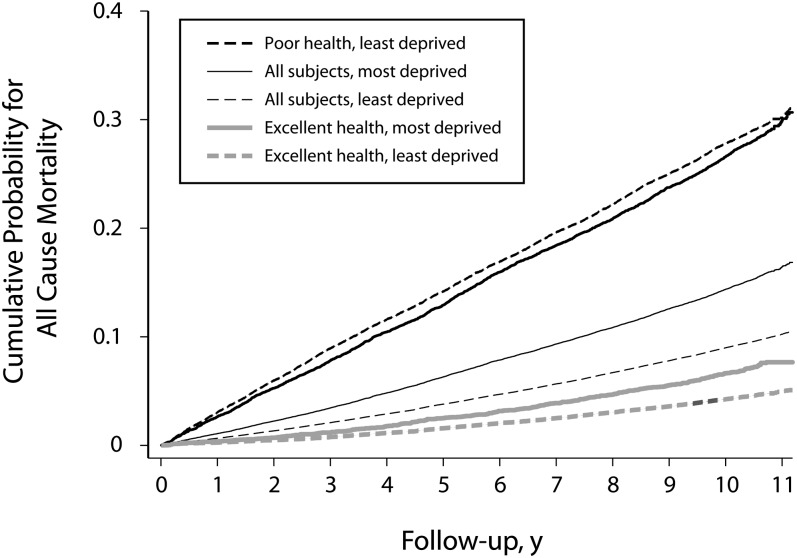
Objectives: We examined whether the risk of premature mortality associated with living in socioeconomically deprived neighborhoods varies according to the health status of individuals.
Methods: Community-dwelling adults (n = 566,402; age = 50-71 years) in 6 US states and 2 metropolitan areas participated in the ongoing prospective National Institutes of Health-AARP Diet and Health Study, which began in 1995. We used baseline data for 565,679 participants on health behaviors, self-rated health status, and medical history, collected by mailed questionnaires. Participants were linked to 2000 census data for an index of census tract socioeconomic deprivation. The main outcome was all-cause mortality ascertained through 2006.
Results: In adjusted survival analyses of persons in good-to-excellent health at baseline, risk of mortality increased with increasing levels of census tract socioeconomic deprivation. Neighborhood socioeconomic mortality disparities among persons in fair-to-poor health were not statistically significant after adjustment for demographic characteristics, educational achievement, lifestyle, and medical conditions.
Conclusions: Neighborhood socioeconomic inequalities lead to large disparities in risk of premature mortality among healthy US adults but not among those in poor health.
Figures
References
-
- Antonovsky A. Social class, life expectancy and overall mortality. Milbank Mem Fund Q. 1967;45(2):31–73 - PubMed
-
- Feldman JJ, Makuc DM, Kleinman JC, Cornoni-Huntley J. National trends in educational differentials in mortality. Am J Epidemiol. 1989;129(5):919–933 - PubMed
-
- Pappas G, Queen S, Hadden W, Fisher G. The increasing disparity in mortality between socioeconomic groups in the United States, 1960 and 1986. N Engl J Med. 1993;329(2):103–109 - PubMed
-
- Singh GK, Siahpush M. Widening socioeconomic inequalities in US life expectancy, 1980–2000. Int J Epidemiol. 2006;35(4):969–979 - PubMed
Publication types
MeSH terms
Grants and funding
LinkOut - more resources
Full Text Sources