Effectiveness and spillover of an after-school health promotion program for Hispanic elementary school children
- PMID: 21852659
- PMCID: PMC3222338
- DOI: 10.2105/AJPH.2011.300177
Effectiveness and spillover of an after-school health promotion program for Hispanic elementary school children
Abstract
Objectives: We evaluated the effectiveness and spillover of an after-school health education and physical activity program among Hispanic elementary school children.
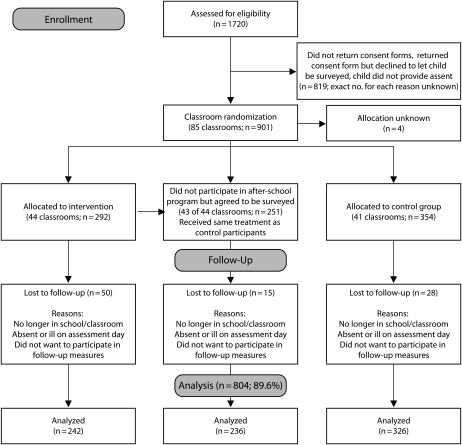
Methods: In fall 2008, students in third through fifth grades in 6 schools in El Paso, Texas (n = 901), were randomized to intervention (n = 292 participants) or control (n = 354) classrooms (4 unknown). Intervention classrooms also contained a spillover group (n = 251) that did not join the after-school program but that completed measurements and surveys. The intervention was a 12-week culturally tailored after-school program meeting twice a week. Four-month outcomes were body mass index, aerobic capacity, and dietary intentions and knowledge. We calculated intervention exposure as the proportion of after-school participants per classroom.
Results: Intervention exposure predicted lower body mass index (P = .045), higher aerobic capacity (P = .012), and greater intentions to eat healthy (P = .046) for the classroom at follow-up. Intervention effectiveness increased with increasing proportions of intervention participants in a classroom. Nonparticipants who had classroom contact with program participants experienced health improvements that could reduce their risk of obesity.
Conclusions: Spillover of beneficial intervention effects to nonparticipants is a valuable public health benefit and should be part of program impact assessments.
Figures
References
-
- Centers for Disease Control and Prevention, National Center for Health Statistics. 2008. Obesity and overweight in the US. Available at: http://www.cdc.gov/nchs/fastats/overwt.htm. Accessed March 16, 2009
-
- Magarey AM, Daniels LA, Boulton TJ, Cockington RA. Predicting obesity in early adulthood from childhood and parental obesity. Int J Obes. 2003;27(4):505–513 - PubMed
-
- Dietz WH. Childhood weight affects adult morbidity and mortality. J Nutr. 1998;128(2 Suppl):411S–414S - PubMed
-
- Eaton DK, Kann L, Kinchen S, et al. ; Centers for Disease Control and Prevention (CDC) Youth risk behavior surveillance—United States, 2007. MMWR Surveill Summ. 2008;57(4):1–131 - PubMed
-
- Fagot-Campagna A, Pettitt DJ, Engelgau MM, et al. Type 2 diabetes among North American children and adolescents: an epidemiologic review and a public health perspective. J Pediatr. 2000;136(5):664–672 - PubMed
Publication types
MeSH terms
Grants and funding
LinkOut - more resources
Full Text Sources
Medical