Pathologic predictors of renal outcome and therapeutic efficacy in IgA nephropathy: validation of the oxford classification
- PMID: 21852672
- PMCID: PMC3358999
- DOI: 10.2215/CJN.11521210
Pathologic predictors of renal outcome and therapeutic efficacy in IgA nephropathy: validation of the oxford classification
Abstract
Background and objectives: The Oxford classification of IgA nephropathy (IgAN) may aid in predicting prognosis and providing therapeutic strategy but must be validated in different ancestry.
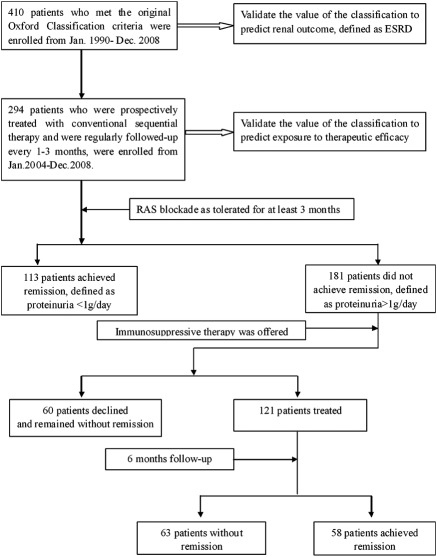
Design, setting, participants, & measurements: A total of 410 patients with IgAN, enrolled from one of the largest renal centers in China, were evaluated for the predictive value of the Oxford classification to prognosis defined as end stage renal disease. A total of 294 of these patients were prospectively treated with renin-angiotensin system blockade and immunosuppressants sequentially and were evaluated separately to assess the predictive value to therapeutic efficacy (defined as time-averaged proteinuria <1 g/d). Three pathologists reviewed specimens independently according to the Oxford classification and were blinded to clinical data.
Results: Segmental glomerulosclerosis and tubular atrophy and interstitial fibrosis were independent predictive factors of end stage renal disease. Patients who had >25% of glomeruli with endocapillary hypercellularity showed higher proteinuria, lower estimated GFR, and higher mean BP than patients with less endocapillary hypercellularity. Immunosuppressive therapy showed a protective effect to prognosis of endocapillary hypercellularity in patients with endoncapillary hypercellularity could benefit from immunosuppressive therapy. Mesangial hypercellularity and tubular atrophy and interstitial fibrosis were independent factors of inefficiency of renin-angiotensin system blockade alone. Crescents were not significant in predicting prognosis or in therapeutic efficacy.
Conclusions: The Oxford classification may aid in predicting prognosis and providing a therapeutic strategy in Chinese patients with IgAN.
Figures
References
-
- Lee SM, Rao VM, Franklin WA, Schiffer MS, Aronson AJ, Spargo BH, Katz AI: IgA nephropathy: Morphological predictors of progressive renal disease. Hum Pathol 13: 314–322, 1982 - PubMed
-
- Haas M: Histologic sub classification of IgA nephropathy: A clinicopathologic study of 244 cases. Am J Kidney Dis 29: 829–842, 1997 - PubMed
-
- D'Amico G: Natural history of idiopathic IgA nephropathy and factors predictive of disease outcome. Semin Nephrol 24: 179–196, 2004 - PubMed
-
- Roufosse CA, Cook HT: Pathological predictors of prognosis in immunoglobulin A nephropathy: A review. Curr Opin Nephrol Hypertens 18: 212–219, 2009 - PubMed
-
- Katafuchi R, Kiyoshi Y, Oh Y, Uesugi N, Ikeda K, Yanase T, Fujimi S: Glomerular score as a prognosticator in IgA nephropathy: Its usefulness and limitation. Clin Nephrol 49: 1–8, 1998 - PubMed
Publication types
MeSH terms
Substances
LinkOut - more resources
Full Text Sources
Medical
Miscellaneous