. 2011 Oct;60(10):2465-73.
doi: 10.2337/db11-0112. Epub 2011 Aug 18.

Nrf2 represses FGF21 during long-term high-fat diet-induced obesity in mice

Affiliations

Nrf2 represses FGF21 during long-term high-fat diet-induced obesity in mice

Dionysios V Chartoumpekis et al. Diabetes. 2011 Oct.

Abstract

Objective: Obesity is characterized by chronic oxidative stress. Fibroblast growth factor 21 (FGF21) has recently been identified as a novel hormone that regulates metabolism. NFE2-related factor 2 (Nrf2) is a transcription factor that orchestrates the expression of a battery of antioxidant and detoxification genes under both basal and stress conditions. The current study investigated the role of Nrf2 in a mouse model of long-term high-fat diet (HFD)-induced obesity and characterized its crosstalk to FGF21 in this process.

Research design and methods: Wild-type (WT) and Nrf2 knockout (Nrf2-KO) mice were fed an HFD for 180 days. During this period, food consumption and body weights were measured. Glucose metabolism was assessed by an intraperitoneal glucose tolerance test and intraperitoneal insulin tolerance test. Total RNA was prepared from liver and adipose tissue and was used for quantitative real-time RT-PCR. Fasting plasma was collected and analyzed for blood chemistries. The ST-2 cell line was used for transfection studies.

Results: Nrf2-KO mice were partially protected from HFD-induced obesity and developed a less insulin-resistant phenotype. Importantly, Nrf2-KO mice had higher plasma FGF21 levels and higher FGF21 mRNA levels in liver and white adipose tissue than WT mice. Thus, the altered metabolic phenotype of Nrf2-KO mice under HFD was associated with higher expression and abundance of FGF21. Consistently, the overexpression of Nrf2 in ST-2 cells resulted in decreased FGF21 mRNA levels as well as in suppressed activity of a FGF21 promoter luciferase reporter.

Conclusions: The identification of Nrf2 as a novel regulator of FGF21 expands our understanding of the crosstalk between metabolism and stress defense.


Figures
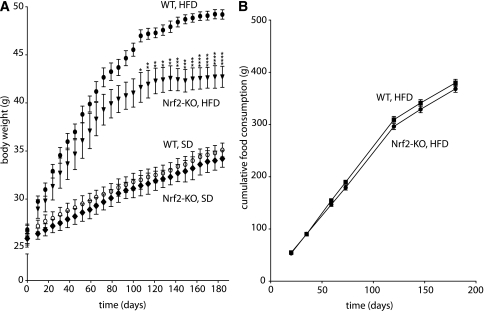
FIG. 1.
FIG. 1.
A: Nrf2-KO mice fed an HFD for 180 days gained less weight over time than WT mice. B: Cumulative food consumption is similar between Nrf2-KO and WT mice fed an HFD for 180 days. Data show means ± SEM. n = 8 for each genotype. *P < 0.05, **P < 0.01, ***P < 0.001, ****P < 0.0001 (WT HFD vs. Nrf2-KO HFD).
FIG. 2.
FIG. 2.
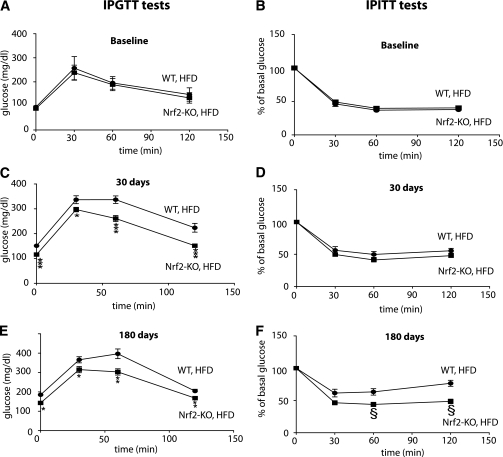
Nrf2-KO mice on HFD are less insulin resistant than WT mice. Results from glucose and insulin tolerance tests in WT and Nrf2-KO mice fed an HFD are shown. Tests were performed at baseline (A, B) and after 30 (C and D) and 180 (E and F) days on an HFD. Data are means ± SEM. n = 8 for each genotype. *P < 0.05, **P < 0.01, ***P < 0.001, §P < 0.01. IPGTT, intraperitoneal glucose tolerance test; IPITT, intraperitoneal insulin tolerance test.
FIG. 3.
FIG. 3.
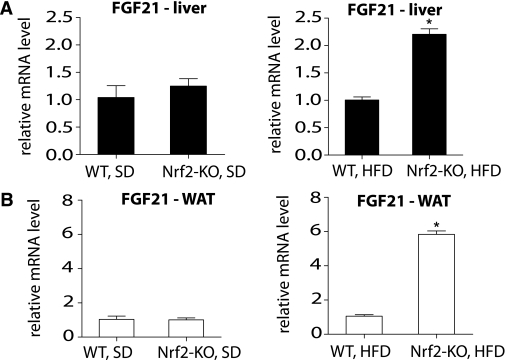
FGF21 mRNA levels are elevated in the liver (A) and WAT (B) of Nrf2-KO mice fed an HFD for 180 days. FGF21 mRNA levels were measured by quantitative RT-PCR in liver and WAT from WT and Nrf2-KO mice (n = 8 for each genotype) fed an SD or HFD. The RT-PCR was performed in triplicate wells for each sample. Bars show means ± SEM. *P < 0.001.
FIG. 4.
FIG. 4.
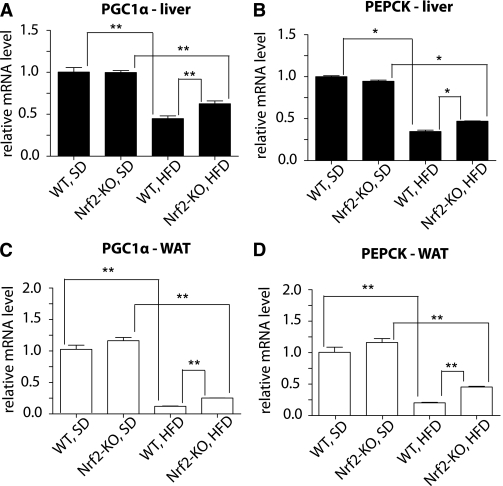
mRNA levels of FGF21-regulated genes are elevated in liver and WAT of Nrf2-KO mice fed an HFD for 180 days. PGC-1α and PEPCK mRNA levels were measured by quantitative RT-PCR in liver (A and B) and WAT (C and D) from WT and Nrf2-KO mice (n = 8 for each genotype) fed an HFD or an SD. The RT-PCR was performed in triplicate wells for each sample. Bars show means ± SEM. *P < 0.05, **P < 0.001.
FIG. 5.
FIG. 5.
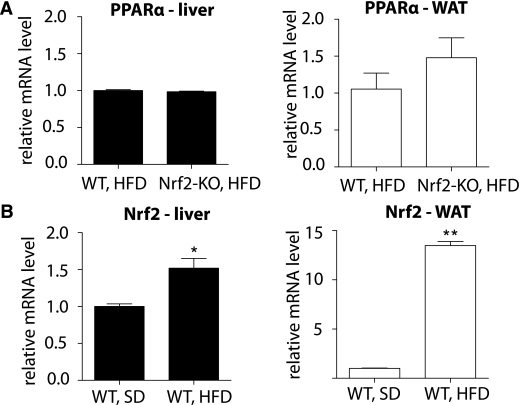
A: PPARα mRNA levels in liver and WAT are similar between WT and Nrf2-KO mice on a long-term HFD. PPARα mRNA levels were measured by quantitative RT-PCR in liver and WAT of WT and Nrf2-KO mice (n = 8 for each genotype) fed an HFD for 180 days. The RT-PCR was performed in triplicate wells for each sample. Bars show means ± SEM. B: Nrf2 mRNA levels are elevated in the liver and WAT of mice fed an HFD for 180 days compared with an SD. Nrf2 mRNA levels were measured by quantitative RT-PCR in liver and WAT of WT mice fed an HFD or SD (n = 8 for each diet group). The RT-PCR was performed in triplicate wells for each sample. Bars show means ± SEM. *P < 0.01, **P < 0.0001.
FIG. 6.
FIG. 6.
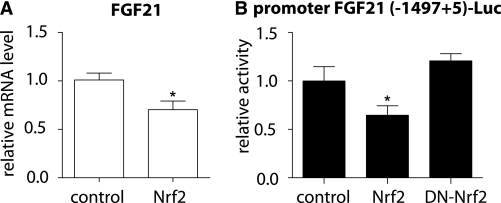
Overexpression of Nrf2 reduces FGF21 mRNA levels and suppresses FGF21 promoter activity. A: Nrf2 was overexpressed in ST-2 cells in a 60-mm plate, and FGF21 mRNA level was measured by quantitative RT-PCR 48 h after transfection. The RT-PCR was performed in triplicate wells for each sample. Bars show means ± SEM of three independent experiments. B: (−1497+5) promoter FGF21-Luc was transiently transfected in ST-2 cells in 24-well plates, and luciferase activity was measured after cotransfection with pcDNA 3.1 Hygro(–)-mNrf2, pcDNA 3.1 Hygro(–)-DN-Nrf2, or the empty vector. The luciferase activity was normalized to β-galactosidase activity. In each experiment, the luciferase activity was measured in 12 technical replicates. Bars show means ± SEM of three independent experiments. *P < 0.001.
FIG. 7.
FIG. 7.
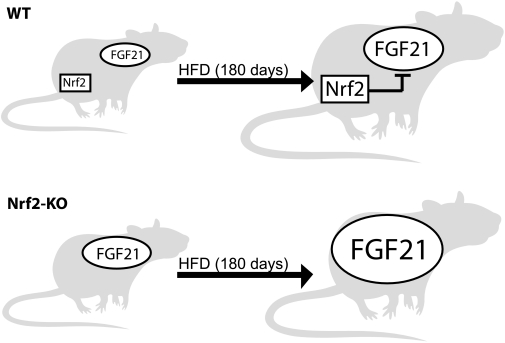
Model depicting the repressive role of Nrf2 on the induced expression of FGF21 during HFD. WT and Nrf2-KO mice have similar low basal FGF21 levels. After HFD feeding, FGF21 levels increase in both genotypes, but to different extents. In WT mice, Nrf2 is induced by HFD and compromises the increase of FGF21 levels. In contrast, the lack of Nrf2 in the KO mice abolishes its inhibitory effect on FGF21, which leads to the significantly higher induction of FGF21 in Nrf2-KO mice.

References

    1. Itoh N, Ornitz DM. Functional evolutionary history of the mouse Fgf gene family. Dev Dyn 2008;237:18–27 - PubMed
    1. Goetz R, Beenken A, Ibrahimi OA, et al. Molecular insights into the klotho-dependent, endocrine mode of action of fibroblast growth factor 19 subfamily members. Mol Cell Biol 2007;27:3417–3428 - PMC - PubMed
    1. Nishimura T, Nakatake Y, Konishi M, Itoh N. Identification of a novel FGF, FGF-21, preferentially expressed in the liver. Biochim Biophys Acta 2000;1492:203–206 - PubMed
    1. Muise ES, Azzolina B, Kuo DW, et al. Adipose fibroblast growth factor 21 is up-regulated by peroxisome proliferator-activated receptor gamma and altered metabolic states. Mol Pharmacol 2008;74:403–412 - PubMed
    1. Kharitonenkov A, Dunbar JD, Bina HA, et al. FGF-21/FGF-21 receptor interaction and activation is determined by betaKlotho. J Cell Physiol 2008;215:1–7 - PubMed

Publication types

MeSH terms