Pervasive sharing of genetic effects in autoimmune disease
- PMID: 21852963
- PMCID: PMC3154137
- DOI: 10.1371/journal.pgen.1002254
Pervasive sharing of genetic effects in autoimmune disease
Abstract
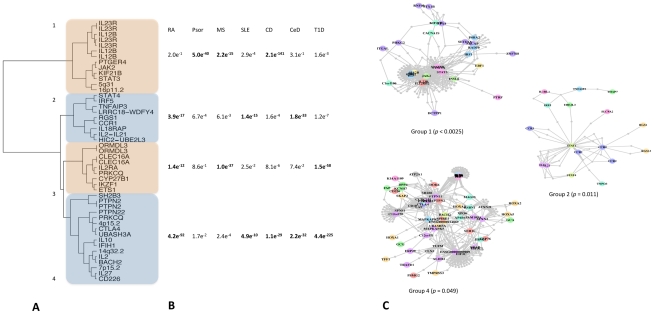
Genome-wide association (GWA) studies have identified numerous, replicable, genetic associations between common single nucleotide polymorphisms (SNPs) and risk of common autoimmune and inflammatory (immune-mediated) diseases, some of which are shared between two diseases. Along with epidemiological and clinical evidence, this suggests that some genetic risk factors may be shared across diseases-as is the case with alleles in the Major Histocompatibility Locus. In this work we evaluate the extent of this sharing for 107 immune disease-risk SNPs in seven diseases: celiac disease, Crohn's disease, multiple sclerosis, psoriasis, rheumatoid arthritis, systemic lupus erythematosus, and type 1 diabetes. We have developed a novel statistic for Cross Phenotype Meta-Analysis (CPMA) which detects association of a SNP to multiple, but not necessarily all, phenotypes. With it, we find evidence that 47/107 (44%) immune-mediated disease risk SNPs are associated to multiple-but not all-immune-mediated diseases (SNP-wise P(CPMA)<0.01). We also show that distinct groups of interacting proteins are encoded near SNPs which predispose to the same subsets of diseases; we propose these as the mechanistic basis of shared disease risk. We are thus able to leverage genetic data across diseases to construct biological hypotheses about the underlying mechanism of pathogenesis.
Conflict of interest statement
The authors have declared that no competing interests exist.
Figures
References
-
- Vyse T, Todd J. Genetic analysis of autoimmune disease. Cell. 1996;85:311–318. - PubMed
Publication types
MeSH terms
Grants and funding
LinkOut - more resources
Full Text Sources
Other Literature Sources
Medical