


Multimodal pyrethroid resistance in malaria vectors, Anopheles gambiae s.s., Anopheles arabiensis, and Anopheles funestus s.s. in western Kenya
- PMID: 21853038
- PMCID: PMC3154902
- DOI: 10.1371/journal.pone.0022574
Multimodal pyrethroid resistance in malaria vectors, Anopheles gambiae s.s., Anopheles arabiensis, and Anopheles funestus s.s. in western Kenya
Abstract
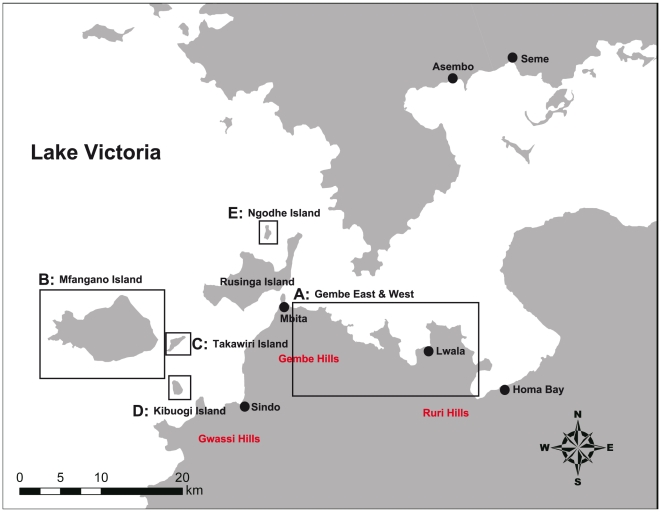
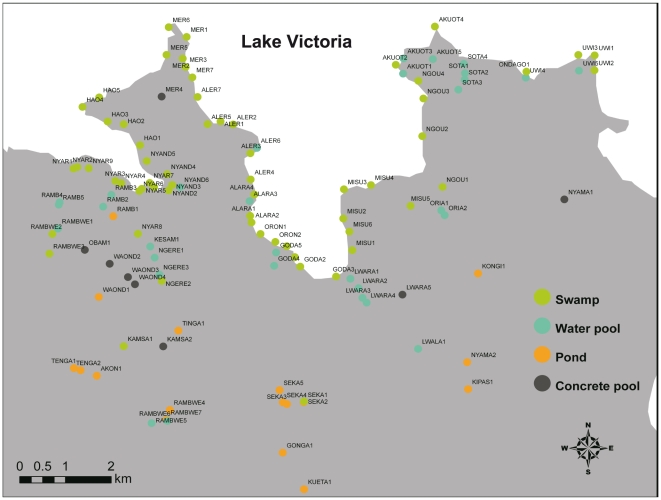
Anopheles gambiae s.s., Anopheles arabiensis, and Anopheles funestus s.s. are the most important species for malaria transmission. Pyrethroid resistance of these vector mosquitoes is one of the main obstacles against effective vector control. The objective of the present study was to monitor the pyrethroid susceptibility in the 3 major malaria vectors in a highly malaria endemic area in western Kenya and to elucidate the mechanisms of pyrethroid resistance in these species. Gembe East and West, Mbita Division, and 4 main western islands in the Suba district of the Nyanza province in western Kenya were used as the study area. Larval and adult collection and bioassay were conducted, as well as the detection of point mutation in the voltage-gated sodium channel (1014L) by using direct DNA sequencing. A high level of pyrethroid resistance caused by the high frequency of point mutations (L1014S) was detected in An. gambiae s.s. In contrast, P450-related pyrethroid resistance seemed to be widespread in both An. arabiensis and An. funestus s.s. Not a single L1014S mutation was detected in these 2 species. A lack of cross-resistance between DDT and permethrin was also found in An. arabiensis and An. funestus s.s., while An. gambiae s.s. was resistant to both insecticides. It is noteworthy that the above species in the same area are found to be resistant to pyrethroids by their unique resistance mechanisms. Furthermore, it is interesting that 2 different resistance mechanisms have developed in the 2 sibling species in the same area individually. The cross resistance between permethrin and DDT in An. gambiae s.s. may be attributed to the high frequency of kdr mutation, which might be selected by the frequent exposure to ITNs. Similarly, the metabolic pyrethroid resistance in An. arabiensis and An. funestus s.s. is thought to develop without strong selection by DDT.
Conflict of interest statement
Figures
References
-
- Bruce-Chwatt LJ. Essential Malariology. New York: John Wiley & Sons, Inc; 1985. 452
-
- Nabarro DN, Tayler EM. The “roll back malaria” campaign. Science. 1998;280:2067–2068. - PubMed
-
- Wacira DG, Hill J, McCall PJ, Kroeger A. Delivery of insecticide treated net services through employer and community based approaches in Kenya. Trop Med Int Hlth. 2007;12:140–149. - PubMed
Publication types
MeSH terms
Substances
LinkOut - more resources
Full Text Sources
Medical
Miscellaneous
