


Repeated exposure to severely limited sleep results in distinctive and persistent physiological imbalances in rats
- PMID: 21853062
- PMCID: PMC3154920
- DOI: 10.1371/journal.pone.0022987
Repeated exposure to severely limited sleep results in distinctive and persistent physiological imbalances in rats
Abstract
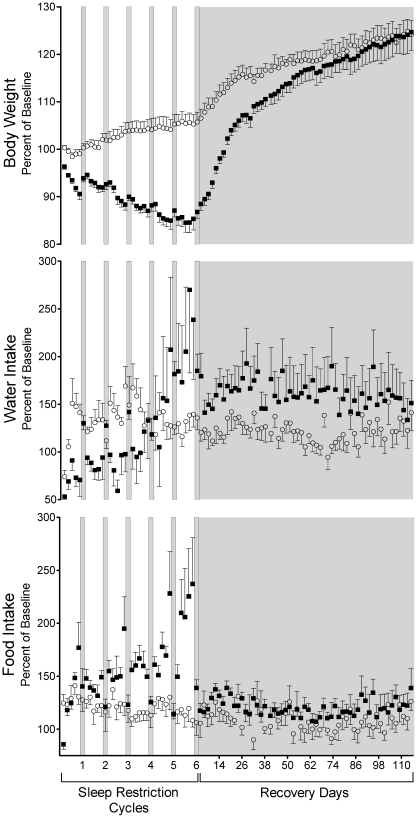
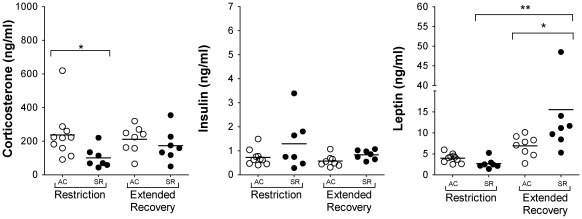
Chronic sleep disruption in laboratory rats leads to increased energy expenditure, connective tissue abnormalities, and increased weights of major organs relative to body weight. Here we report on expanded findings and the extent to which abnormalities become long-lasting, potentially permanent changes to health status after apparent recuperation from chronic sleep disruption. Rats were exposed 6 times to long periods of disrupted sleep or control conditions during 10 weeks to produce adaptations and then were permitted nearly 4 months of undisturbed sleep. Measurements were made in tissues from these groups and in preserved tissue from the experimental and control groups of an antecedent study that lacked a lengthy recuperation period. Cycles of sleep restriction resulted in energy deficiency marked by a progressive course of hyperphagia and major (15%) weight loss. Analyses of tissue composition in chronically sleep-restricted rats indicated that protein and lipid amounts in internal organs were largely spared, while adipose tissue depots appeared depleted. This suggests high metabolic demands may have preserved the size of the vital organs relative to expectations of severe energy deficiency alone. Low plasma corticosterone and leptin concentrations appear to reflect low substrate availability and diminished adiposity. After nearly 4 months of recuperation, sleep-restricted rats were consuming 20% more food and 35% more water than did comparison control rats, despite normalized weight, normalized adipocytes, and elevated plasma leptin concentrations. Plasma cholesterol levels in recuperated sleep-restricted rats were diminished relative to those of controls. The chronically increased intake of nutriments and water, along with altered negative feedback regulation and substrate use, indicate that internal processes are modified long after a severe period of prolonged and insufficient sleep has ended.
Conflict of interest statement
Figures
References
-
- Barnett SA. Adaptation of mice to cold. Biol Rev Camb Philos Soc. 1965;40:5–51. - PubMed
-
- Boutilier RG. Mechanisms of cell survival in hypoxia and hypothermia. J Exp Biol. 2001;204:3171–3181. - PubMed
-
- Convertino VA. Fluid shifts and hydration state: effects of long-term exercise. Can J Sport Sci. 1987;12:136–139. - PubMed
-
- Hazel JR, Williams EE. The role of alterations in membrane lipid composition in enabling physiological adaptation of organisms to their physical environment. Prog Lipid Res. 1990;29:167–227. - PubMed
-
- Kochan Z, Karbowska J, Swierczynski J. Unusual increase of lipogenesis in rat white adipose tissue after multiple cycles of starvation-refeeding. Metab Clin Exp. 1997;46:10–17. - PubMed
MeSH terms
Substances
Grants and funding
LinkOut - more resources
Full Text Sources
