


Randomized Controlled Trial
doi: 10.1186/1749-8090-6-99.
Effect of short-acting beta blocker on the cardiac recovery after cardiopulmonary bypass
Affiliations
- PMID: 21854625
- PMCID: PMC3179708
- DOI: 10.1186/1749-8090-6-99
Item in Clipboard
Randomized Controlled Trial
Effect of short-acting beta blocker on the cardiac recovery after cardiopulmonary bypass
J Cardiothorac Surg.
.
Abstract
The objective of this study was to investigate the effect of beta blocker on cardiac recovery and rhythm during cardiac surgeries. Sixty surgical rheumatic heart disease patients were received esmolol 1 mg/kg or the same volume of saline prior to removal of the aortic clamp. The incidence of cardiac automatic re-beat, ventricular fibrillation after reperfusion, the heart rate after steady re-beat, vasoactive drug use during weaning from bypass, the posterior parallel time and total bypass time were decreased by esmolol treatment.
In conclusion: Esmolol has a positive effect on the cardiac recovery in cardiopulmonary bypass surgeries.
Figures
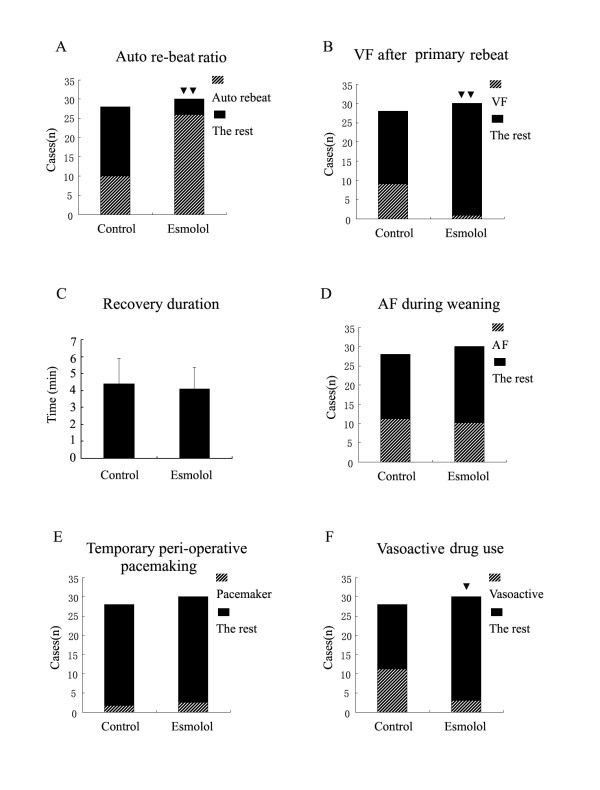
The heart recovery data after unclamping. A: The auto re-beat ratio in the control group and esmolol group. (two black triangles) P < 0.01 compared with control group. B: Ventricular fibrillation ratio in the control group and esmolol group. (two black triangles) P < 0.01 compared with control group. VF represents for Ventricular fibrillation. C: The recovery duration (time from reperfusion to steady heart beat) in the two groups. min represents minute. D: Atrial fibrillation during weaning from CPB. AF represents atrial fibrillation. E: Temporary peri-operative pacemaking use in the two groups. F: Vasoactive drug use in the two groups. (one black triangle) P < 0.05 compared with control group.
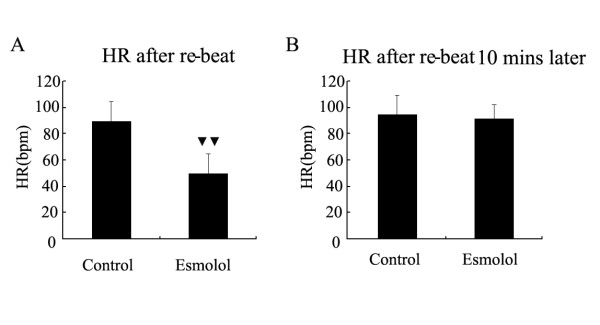
HR after unclamping. A: Heart rate after successful re-beat. (two black triangles) P < 0.01 compared with control group. HR represents heart rate and bpm represents beat per minute. B: Heart rate ten minutes after successful re-beat. HR represents heart rate and bpm represents beat per minute.
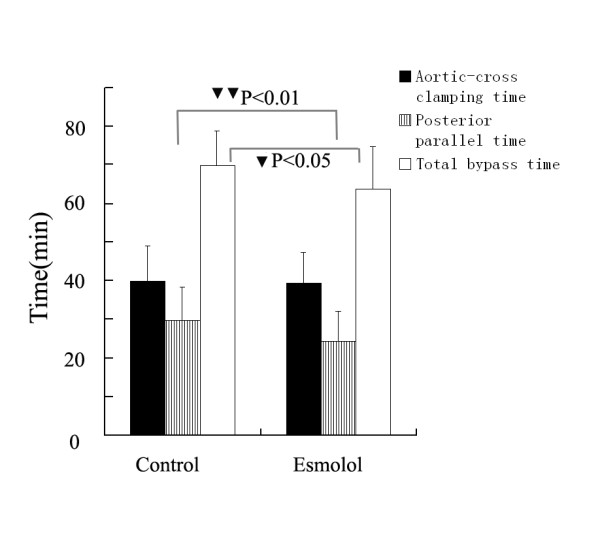
Bypass associated time. The bypass associated time between the groups. (one black triangle) P < 0.05 and (two black triangles) P < 0.01 compared with control group. The posterior parallel time means the time from releasing of aortic clamp to weaning from CPB.
References
-
- Booth JV, Spahn DR, McRae RL, Chesnut LC, El-Moalem H, Atwell DM, Leone BJ, Schwinn DA. Esmolol improves left ventricular function via enhanced beta-adrenergic receptor signaling in a canine model of coronary revascularization. Anesthesilogy. 2002;97:162–169. doi: 10.1097/00000542-200207000-00023. - DOI - PubMed
-
- Cork RC, Azari DM, McQueen KA, Aufderheide S, Mitchell M, Naraghi M. Effect of esmolol given during cardiopulmonary bypass on fractional area of contraction from transesophageal echocardiography. Anesth Analg. 1995;81:219–224. - PubMed
-
- Scorsin M, Mebazaa A, Al Attar N, Medini B, Callebert J, Raffoul R, Ramadan R, Maillet JM, Ruffenach A, Simoneau F, Nataf P, Payen D, Lessana A. Efficacy of esmolol as a myocardial protective agent during continuous retrograde blood cardioplegia. J Thorac Cardiovasc Surg. 2003;125:1022–1029. doi: 10.1067/mtc.2003.175. - DOI - PubMed
Publication types
MeSH terms
Substances
LinkOut - more resources
Full Text Sources
