


Determinants of homodimerization specificity in histidine kinases
- PMID: 21854787
- PMCID: PMC3210482
- DOI: 10.1016/j.jmb.2011.08.011
Determinants of homodimerization specificity in histidine kinases
Abstract
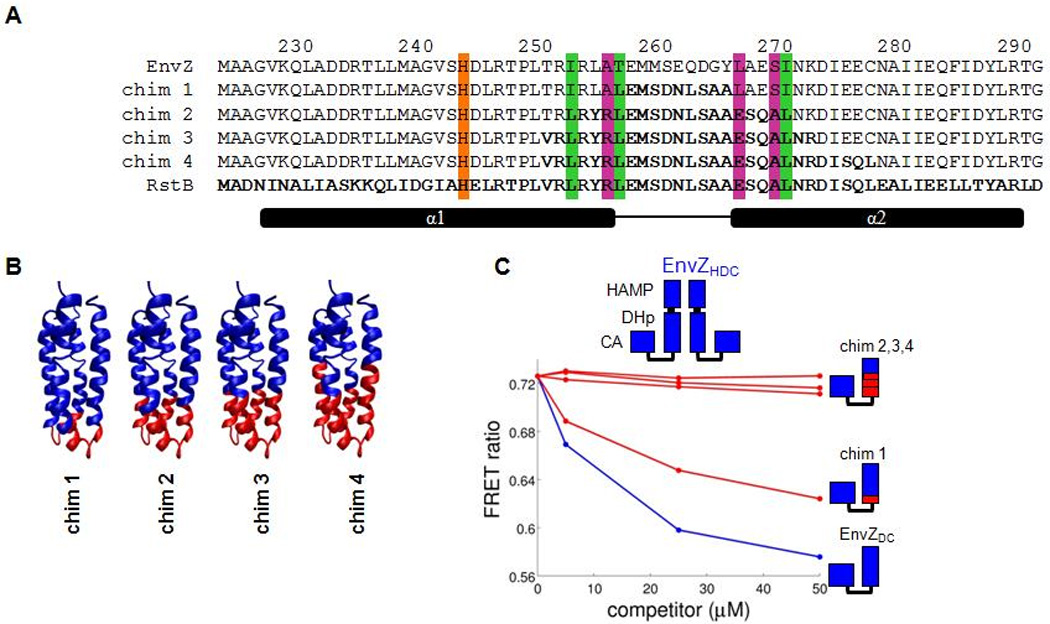
Two-component signal transduction pathways consisting of a histidine kinase and a response regulator are used by prokaryotes to respond to diverse environmental and intracellular stimuli. Most species encode numerous paralogous histidine kinases that exhibit significant structural similarity. Yet in almost all known examples, histidine kinases are thought to function as homodimers. We investigated the molecular basis of dimerization specificity, focusing on the model histidine kinase EnvZ and RstB, its closest paralog in Escherichia coli. Direct binding studies showed that the cytoplasmic domains of these proteins each form specific homodimers in vitro. Using a series of chimeric proteins, we identified specificity determinants at the base of the four-helix bundle in the dimerization and histidine phosphotransfer domain. Guided by molecular coevolution predictions and EnvZ structural information, we identified sets of residues in this region that are sufficient to establish homospecificity. Mutating these residues in EnvZ to the corresponding residues in RstB produced a functional kinase that preferentially homodimerized over interacting with EnvZ. EnvZ and RstB likely diverged following gene duplication to yield two homodimers that cannot heterodimerize, and the mutants we identified represent possible evolutionary intermediates in this process.
Copyright © 2011 Elsevier Ltd. All rights reserved.
Figures



References
-
- Newman JR, Keating AE. Comprehensive identification of human bZIP interactions with coiled-coil arrays. Science. 2003;300:2097–2101. - PubMed
-
- Chen L, Willis SN, Wei A, Smith BJ, Fletcher JI, Hinds MG, Colman PM, Day CL, Adams JM, Huang DC. Differential targeting of prosurvival Bcl-2 proteins by their BH3-only ligands allows complementary apoptotic function. Mol Cell. 2005;17:393–403. - PubMed
Publication types
MeSH terms
Substances
Grants and funding
LinkOut - more resources
Full Text Sources
