


Threshold of adulthood for the onset of nicotine self-administration in male and female rats
- PMID: 21854810
- PMCID: PMC3179820
- DOI: 10.1016/j.bbr.2011.08.005
Threshold of adulthood for the onset of nicotine self-administration in male and female rats
Abstract
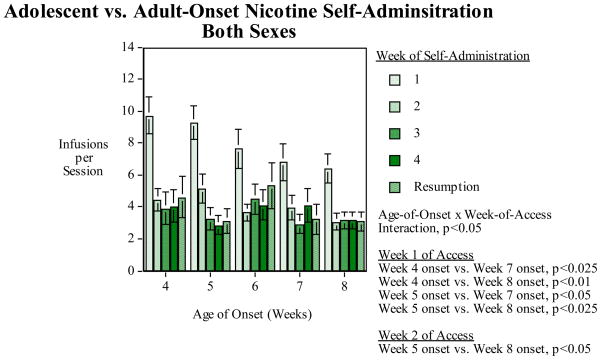
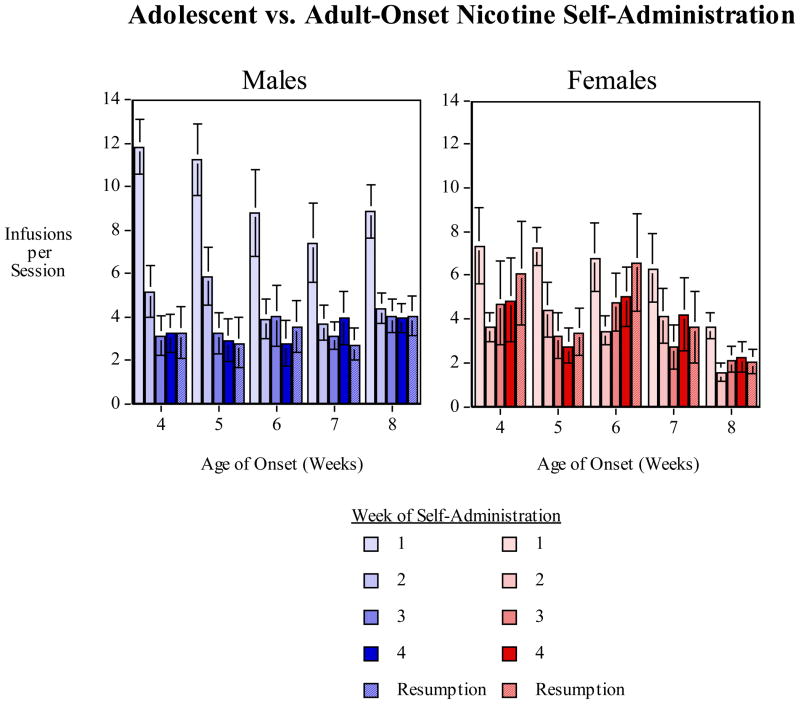
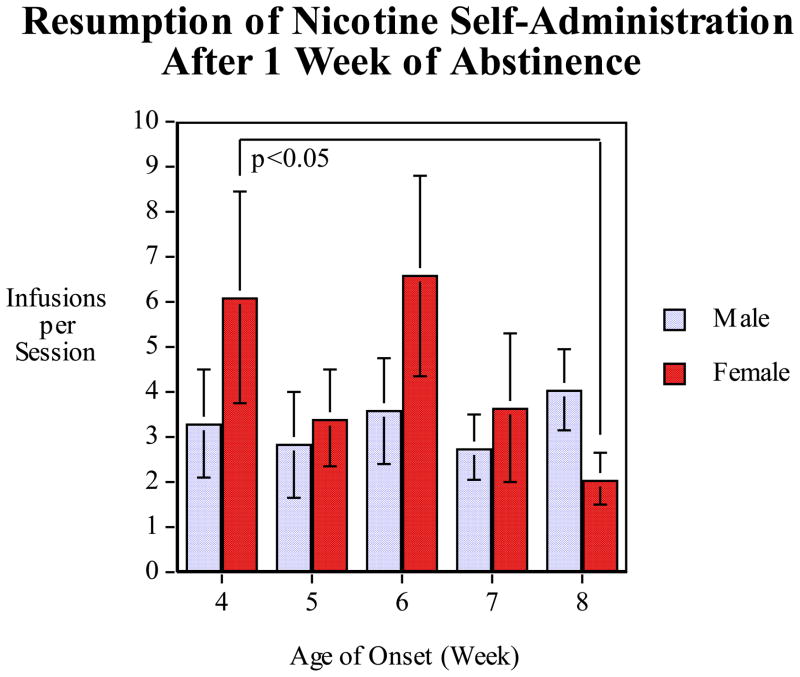
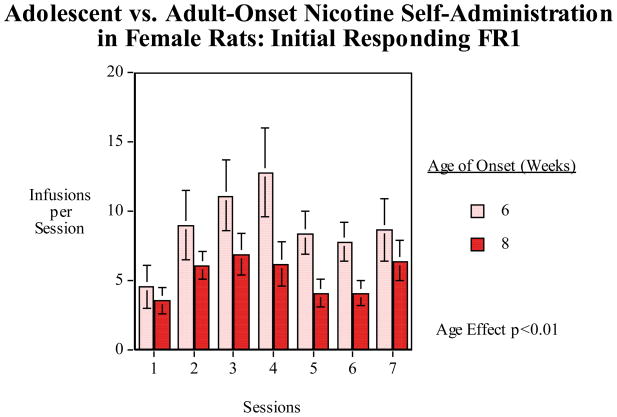
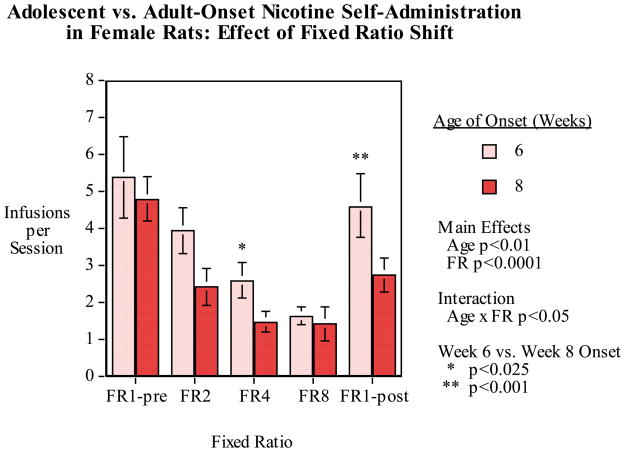
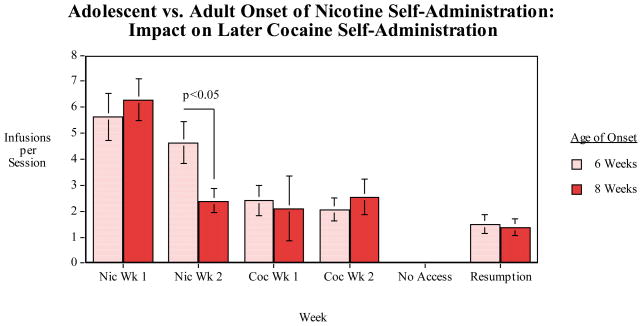
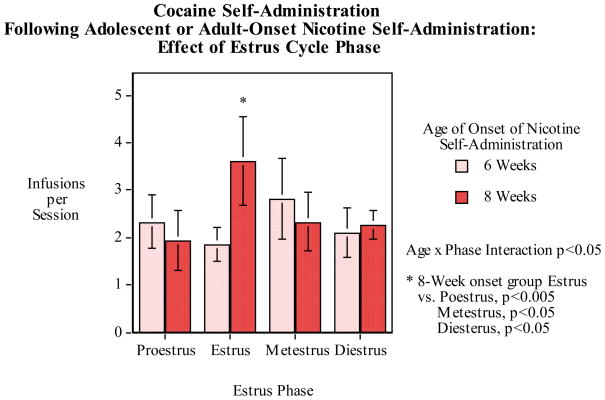
The great majority of tobacco addiction begins during adolescence. More heavily addicted smokers begin smoking earlier, but differentiating the neurobehavioral impact of nicotine self-administration during adolescence from self-selection bias (whereby people more prone to heavy addiction also begin earlier) cannot be ethically unconfounded in humans. The goals of this research were to determine the age threshold for the adult-like nicotine self-administration and determine sex differences. Male and female Sprague-Dawley rats were tested for nicotine self-administration starting at 4, 5, 6, 7, and 8 weeks of age in an operant FR1 schedule for IV nicotine (0.03 mg/kg/infusion) in 45-min sessions for 2 weeks, with 1 week of enforced abstinence and 1 week of resumed access. This study replicated our earlier work that nicotine self-administration was increased in adolescent vs. adult rats and that the effect was more pronounced in adolescent males, but the increased nicotine self-administration was more persistent in adolescent-onset females. The age threshold for adult-like behavior was 6-7 weeks of age. Adolescent-onset nicotine self-administration had persisting effects of eggaurated increases of nicotine self-administration when fixed-ratio requirements for self-administration were lowered. Female rats that had begun nicotine self-administration during adolescence showed exaggerated increases in nicotine self-administration after a switch back to FR1 from FR8, indicating a lessened control over their self-administration. Adolescent-onset nicotine self-administration was not found to potentiate cocaine self-administration. Adolescent-onset nicotine self-administration causes persistent increases in nicotine self-administration in female rats even after they reach adulthood and disrupts control over self-administration behavior.
Copyright © 2011 Elsevier B.V. All rights reserved.
Figures
References
-
- Centers for Disease Control and Prevention. Differences in the age of smoking initiation between blacks and whites, United States. Mortality and Morbidity Weekly Report. 1991;40:754–757. - PubMed
-
- Rigotti N. How can we help the remaining smokers to quit? American Journal of Preventative Medicine. 1990;6:249–250. - PubMed
-
- Eissenberg T, Balster RL. Initial tobacco use episodes in children and adolescents: current knowledge, future directions. Drug & Alcohol Dependence. 2000;59(Suppl 1):S41–60. - PubMed
-
- Glynn T, et al. Youth tobacco use in the United States: Problems, progress, goals, and potential solutions. Preventative Medicine. 1993;22:568–575. - PubMed
-
- US Public Health Service. US Department of Health, Education and Welfare. Washington, DC: US Government Printing Office; 1994. Preventing tobacco use among young people: A report of the Surgeon General.
Publication types
MeSH terms
Substances
Grants and funding
LinkOut - more resources
Full Text Sources
