


Characterization of multidrug-resistant Escherichia coli isolates from animals presenting at a university veterinary hospital
- PMID: 21856835
- PMCID: PMC3194860
- DOI: 10.1128/AEM.00599-11
Characterization of multidrug-resistant Escherichia coli isolates from animals presenting at a university veterinary hospital
Abstract
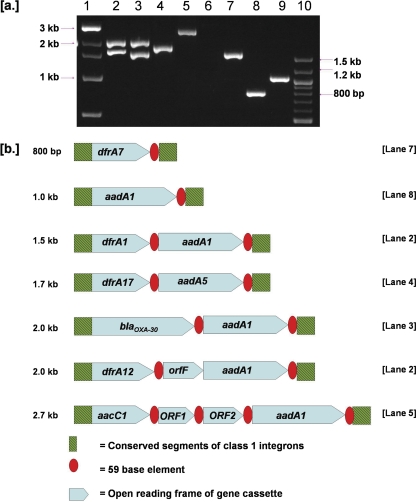
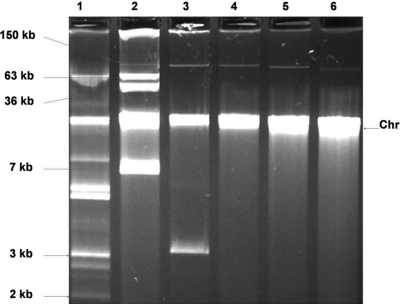
In this study, we examined molecular mechanisms associated with multidrug resistance (MDR) in a collection of Escherichia coli isolates recovered from hospitalized animals in Ireland. PCR and DNA sequencing were used to identify genes associated with resistance. Class 1 integrons were prevalent (94.6%) and contained gene cassettes recognized previously and implicated mainly in resistance to aminoglycosides, β-lactams, and trimethoprim (aadA1, dfrA1-aadA1, dfrA17-aadA5, dfrA12-orfF-aadA2, bla(OXA-30)-aadA1, aacC1-orf1-orf2-aadA1, dfr7). Class 2 integrons (13.5%) contained the dfrA1-sat1-aadA1 gene array. The most frequently occurring phenotypes included resistance to ampicillin (97.3%), chloramphenicol (75.4%), florfenicol (40.5%), gentamicin (54%), neomycin (43.2%), streptomycin (97.3%), sulfonamide (98.6%), and tetracycline (100%). The associated resistance determinants detected included bla(TEM), cat, floR, aadB, aphA1, strA-strB, sul2, and tet(B), respectively. The bla(CTX-M-2) gene, encoding an extended-spectrum β-lactamase (ESβL), and bla(CMY-2), encoding an AmpC-like enzyme, were identified in 8 and 18 isolates, respectively. The mobility of the resistance genes was demonstrated using conjugation assays with a representative selection of isolates. High-molecular-weight plasmids were found to be responsible for resistance to multiple antimicrobial compounds. The study demonstrated that animal-associated commensal E. coli isolates possess a diverse repertoire of transferable genetic determinants. Emergence of ESβLs and AmpC-like enzymes is particularly significant. To our knowledge, the bla(CTX-M-2) gene has not previously been reported in Ireland.
Figures
References
-
- Bager F., Aarestrup F. M., Madsen M., Wegener H. C. 1999. Glycopeptide resistance in Enterococcus faecium from broilers and pigs following discontinued use of avoparcin. Microb. Drug Resist. 5:53–56 - PubMed
-
- Barlow R. S., Gobius K. S. 2006. Diverse class 2 integrons in bacteria from beef cattle sources. J. Antimicrob. Chemother. 58:1133–1138 - PubMed
-
- Belaaouaj A., et al. 1994. Nucleotide sequences of the genes coding for TEM-like β-lactamases IRT-1 and IRT-2 (formerly called TRI-1 and TRI-2). FEMS Microbiol. Lett. 120:75–80 - PubMed
Publication types
MeSH terms
Substances
LinkOut - more resources
Full Text Sources
Medical
Research Materials
Miscellaneous
