


doi: 10.1128/JB.05759-11.
Epub 2011 Aug 19.
Vestibules are part of the substrate path in the multidrug efflux transporter AcrB of Escherichia coli
Affiliations
- PMID: 21856849
- PMCID: PMC3187200
- DOI: 10.1128/JB.05759-11
Item in Clipboard
Vestibules are part of the substrate path in the multidrug efflux transporter AcrB of Escherichia coli
J Bacteriol.
2011 Oct.
Abstract
The path of substrates in the multidrug efflux pump AcrB of Escherichia coli was examined by using labeling with a lipophilic substrate mimic, Bodipy FL maleimide. Four (out of eight) residues in the vestibule bound the dye, suggesting its role in substrate transport, whereas only one (out of nine) residue in the central cavity tested positive.
Figures
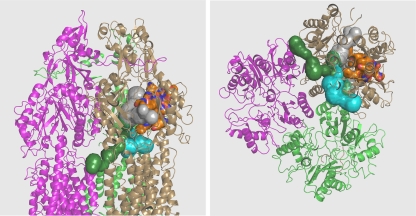
Possible substrate pathways leading to the deep binding pocket. The structure of the AcrB asymmetric trimer 2DRD (6) is shown in cartoon representations. The binding protomer is shown in the sand color, the extrusion protomer in green, and the access protomer in mauve. The deep binding pocket (identified by the binding of minocycline [6]) is shown as an orange surface. A wide tunnel (gray) leads from the external cleft of the periplasmic domain to this pocket. This tunnel is also connected to the branches that lead to the vestibule (green) and central cavity (cyan). Left, side view; right, view from the bottom. Portions of the protein close to the viewer have been clipped off to better reveal the tunnels. The tunnels were visualized with the program CAVER (10), and the drawing was made with PyMol (http://www.pymol.org ).
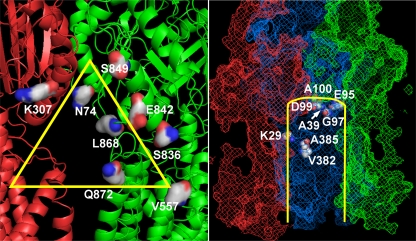
Residues examined. (Left) Residues in the vestibule. Shown is the structure of the vestibule (yellow triangle), between two protomers of model 2DRD (6), in red and green. (Right) Residues in the central cavity (S462 is behind the G97 residue and is not visible). The protein is shown in a mesh representation and corresponds to access (red), binding (blue), and extrusion (green) protomers of model 2DRD. The yellow lines show the approximate position of the central cavity, with the proximal part of the model cut off to reveal the examined residues (in space-filling models).
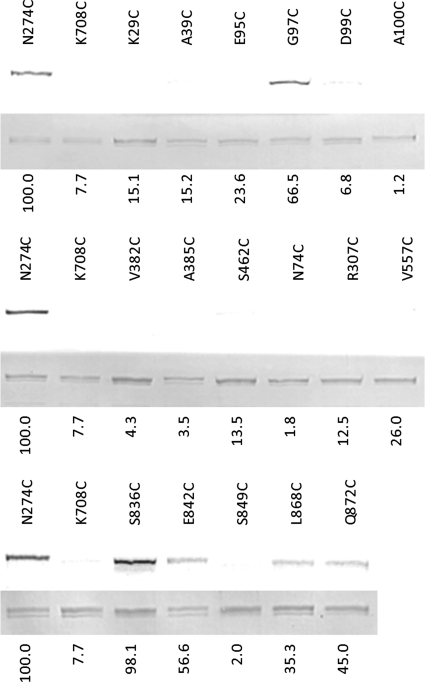
Bodipy FL maleimide labeling of AcrB residues in the vestibule and the central cavity. N274C and K708C are positive and negative controls, respectively. The residues K29C, A39C, E95C, G97C, D99C, A100C, V382C, A385C, and S462C are in the central cavity. The residues N74C, R307C, V557C, S836C, E842C, S849C, L868C, and Q872 are in the vestibule. Each lane represents the labeling of a single cysteine residue by Bodipy FL maleimide (top) and a Coomassie stain (bottom) of the same gel. The labeling intensities (numbers below each lane) have been normalized (corrected for the amount of AcrB protein, determined with Coomassie stain), based on two independent experiments. The normalized labeling intensity in the positive control, N274C, was set as 100. Those residues showing intensities of <30 were considered negative.
References
-
- Murakami S., Nakashima R., Yamashita E., Yamaguchi A. 2002. Crystal structure of bacterial multidrug efflux transporter AcrB. Nature 419:587–593 - PubMed
Publication types
MeSH terms
Substances
Grants and funding
LinkOut - more resources
Full Text Sources
Other Literature Sources
Molecular Biology Databases
