. 2011 Aug 21;477(7363):211-5.
doi: 10.1038/nature10353.

Mutations in UBQLN2 cause dominant X-linked juvenile and adult-onset ALS and ALS/dementia

Affiliations

Mutations in UBQLN2 cause dominant X-linked juvenile and adult-onset ALS and ALS/dementia

Han-Xiang Deng et al. Nature. .

Abstract

Amyotrophic lateral sclerosis (ALS) is a paralytic and usually fatal disorder caused by motor-neuron degeneration in the brain and spinal cord. Most cases of ALS are sporadic but about 5-10% are familial. Mutations in superoxide dismutase 1 (SOD1), TAR DNA-binding protein (TARDBP, also known as TDP43) and fused in sarcoma (FUS, also known as translocated in liposarcoma (TLS)) account for approximately 30% of classic familial ALS. Mutations in several other genes have also been reported as rare causes of ALS or ALS-like syndromes. The causes of the remaining cases of familial ALS and of the vast majority of sporadic ALS are unknown. Despite extensive studies of previously identified ALS-causing genes, the pathogenic mechanism underlying motor-neuron degeneration in ALS remains largely obscure. Dementia, usually of the frontotemporal lobar type, may occur in some ALS cases. It is unclear whether ALS and dementia share common aetiology and pathogenesis in ALS/dementia. Here we show that mutations in UBQLN2, which encodes the ubiquitin-like protein ubiquilin 2, cause dominantly inherited, chromosome-X-linked ALS and ALS/dementia. We describe novel ubiquilin 2 pathology in the spinal cords of ALS cases and in the brains of ALS/dementia cases with or without UBQLN2 mutations. Ubiquilin 2 is a member of the ubiquilin family, which regulates the degradation of ubiquitinated proteins. Functional analysis showed that mutations in UBQLN2 lead to an impairment of protein degradation. Therefore, our findings link abnormalities in ubiquilin 2 to defects in the protein degradation pathway, abnormal protein aggregation and neurodegeneration, indicating a common pathogenic mechanism that can be exploited for therapeutic intervention.


Conflict of interest statement

Competing interest declaration: None

Figures

Fig. 1
Fig. 1
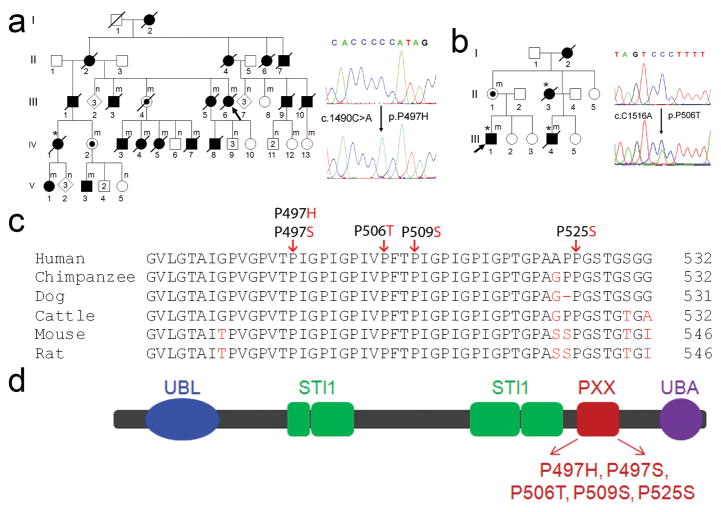
Mutations of UBQLN2 in patients with ALS and ALS/dementia. (a) A mutation, c.1490C>A, resulting in p.P497H, was identified in a large family with ALS (F#186). This family was used to map X-chromosome-linked ALS. The pedigree is shown on the left and sequences are shown on the right. The wild-type sequence is shown in the upper panel. A representative hemizygous mutation in a male patient (V3) is shown in the lower panel. All of the affected members whose DNA samples were available for sequencing analysis had the mutation. Two obligate carriers (III4 and IV2) were identified to have the same mutation. For simplicity and clarity, more than one unaffected individual of both genders is represented by a single diamond and more than one unaffected male individual is represented by a single square. Individuals with mutation in the UBQLN2 are labeled by (m) and those without mutation are labeled by (n). (b) A mutation c.1516C>A (p.P506T) was identified in F#6316. Shown in the right lower panel is a heterozygous mutation from a female obligate carrier (II1). (a–b) Probands are indicated with arrows and patients with dementia are indicated with asterisks. (c) Evolutionary conservation of amino acids in the mutated region of ubiquilin2 in different species. Comparison of human (H. sapiens) ubiquilin and its orthologues in chimpanzee (P. troglodytes), dog (C. lupus familiaris), cattle (B. taurus), mouse (M. musculus) and rat (R. norvegicus). Amino acids identical to human UBQLN2 are in black letters and non-identical ones are denoted in red letters. The positions of the C-terminal amino acids are shown on the right. The mutated amino acids are indicated by arrows on the top. (d) Predicted structural and functional domains of ubiquilin2. Ubiquilin2 is a protein of 624 amino acids. Predicted structural and functional domains include a UBL (ubiquitin-like domain, 33–103), four STI1 (heat shock chaperonin-binding motif), a 12 PXX repeats (491–526) and a UBA (ubiquitin-associated domain). ALS- and ALS/dementia-linked mutations are clustered in the 12 PXX repeats.
Fig. 2
Fig. 2
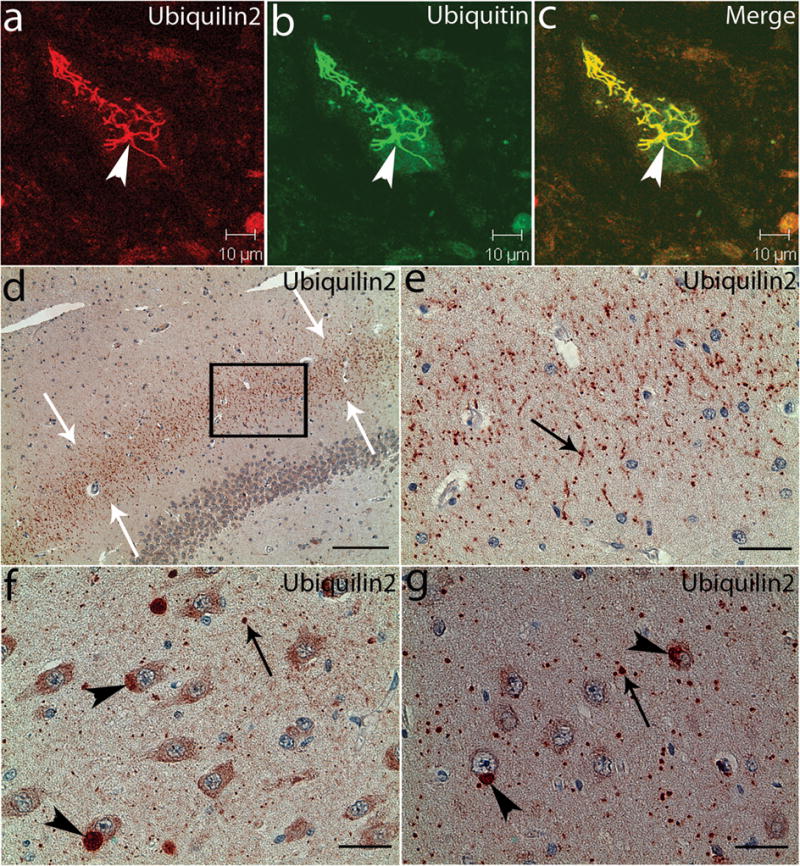
Ubiquilin2-immunoreactive inclusions in the spinal cord and hippocampus. Spinal cord (a–c) and hippocampal (d–g) sections from a patient with a UBQLN2P506T mutation were analyzed with confocal microscopy (a–c) and immunohistochemistry (d–g) using a monoclonal antibody against ubiquilin2 (ubiquilin2-C). The ubiquilin2-positive and skein-like inclusions (arrowhead) are shown in a spinal motor neuron (a). These inclusions are also ubiquitin-positive (b and c). In the hippocampus, the ubiquilin2-positive inclusions are shown in the molecular layer of the fascia dentate (d and e), CA3 (f) and CA1 (g). White arrows in the panel (d) indicate the middle region of the molecular layer with ubiquilin2-positive inclusions. The higher magnification image of the boxed area in panel (d) is shown in panel (e). Black arrows indicate the representative inclusions in neurites (e–g), and arrowheads indicate cytoplasmic inclusions in the cell bodies (f and g). Scale bar, 200μm in panel (d), 50μm in panel (e) and 25 μm in panels (f and g).
Fig. 3
Fig. 3
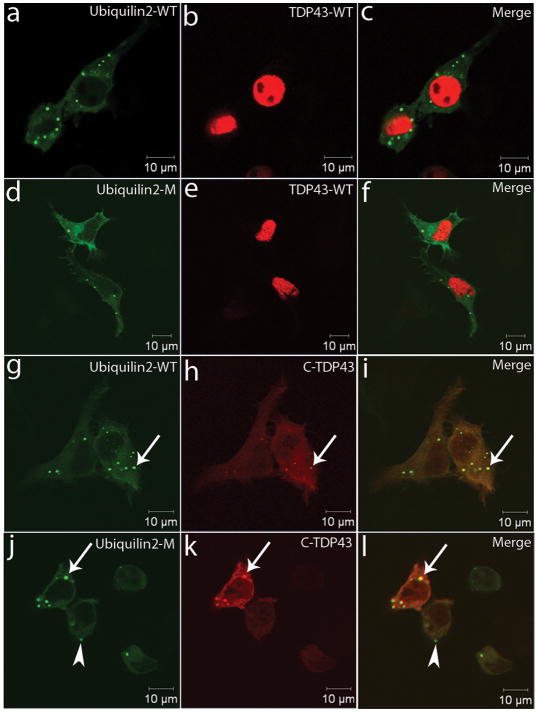
Co-localization of ubiquilin2 and ALS- and dementia-linked TDP43. Neuro2a cells were transfected with various combinations of wild-type ubiquilin2, wild-type TDP43, mutant ubiquilin2 (P497H), and C-terminal fragment of TDP43 that is linked to ALS and FTLD. Ubiquilin2 is GFP-tagged and TDP43 is mCherry-tagged. Wild-type and mutant ubiquilin2 are largely cytoplasmic. WtTDP43 are almost exclusively distributed in the nuclei. The C-TDP43, an ALS- and dementia-linked TDP43 fragment (aa218-414) is almost exclusively cytoplasmic. TDP43 inclusions are co-localized with wild-type (g–i) and mutant (P497H) ubiquilin2 (j–l) (arrows). Some ubiquilin2-positive inclusions are TDP43-negative (arrowhead).
Fig. 4
Fig. 4
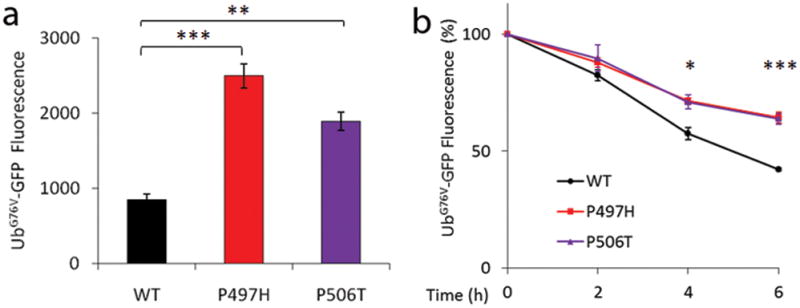
Mutations in ubiquilin2 lead to ubiquitin-mediated impairment of proteasomal degradation. UbG76V-GFP fluorescence intensity was quantified by FACS 48 hours post-transfection in Neuro2a cells (a) transiently transfected with either wild-type (WT) or mutant ubiquilin2. The dynamics of UbG76V-GFP reporter degradation after blockage of protein synthesis with cycloheximide for 0, 2, 4, and 6 hours in Neuro2a cells are shown in panel (b). The rates of UPS reporter degradation were significantly slower in both ubiquilin2-P497H and ubiquilin2-P506T mutants when compared to the wild-type ubiquilin2 at 4 and 6 hours (b). The mean fluorescence intensity was determined at the indicated time points by flow cytometry. Mean fluorescence before cycloheximide administration was standardized as 100%. Data are averaged from at least three independent experiments. *p <0.05, **p <0.01, and ***p <0.001 indicating significant differences when compared to WT-UBQLN2 (two-tailed Student t test). Error bars, means ± s.e.m.

Comment in

References

    1. Deng HX, et al. Amyotrophic lateral sclerosis and structural defects in Cu, Zn superoxide dismutase. Science. 1993;261:1047–1051. - PubMed
    1. Rosen DR, et al. Mutations in Cu/Zn superoxide dismutase gene are associated with familial amyotrophic lateral sclerosis. Nature. 1993;362:59–62. - PubMed
    1. Kabashi E, et al. TARDBP mutations in individuals with sporadic and familial amyotrophic lateral sclerosis. Nat Genet. 2008;40:572–574. doi: 10.1038/ng.132. ng.132 [pii] - DOI - PubMed
    1. Sreedharan J, et al. TDP-43 mutations in familial and sporadic amyotrophic lateral sclerosis. Science. 2008;319:1668–1672. doi: 10.1126/science.1154584. 1154584 [pii] - DOI - PMC - PubMed
    1. Kwiatkowski TJ, Jr, et al. Mutations in the FUS/TLS gene on chromosome 16 cause familial amyotrophic lateral sclerosis. Science. 2009;323:1205–1208. doi: 10.1126/science.1166066. 323/5918/1205 [pii] - DOI - PubMed

Publication types

MeSH terms