


Evolutionary genomics implies a specific function of Ant4 in mammalian and anole lizard male germ cells
- PMID: 21858006
- PMCID: PMC3155547
- DOI: 10.1371/journal.pone.0023122
Evolutionary genomics implies a specific function of Ant4 in mammalian and anole lizard male germ cells
Abstract
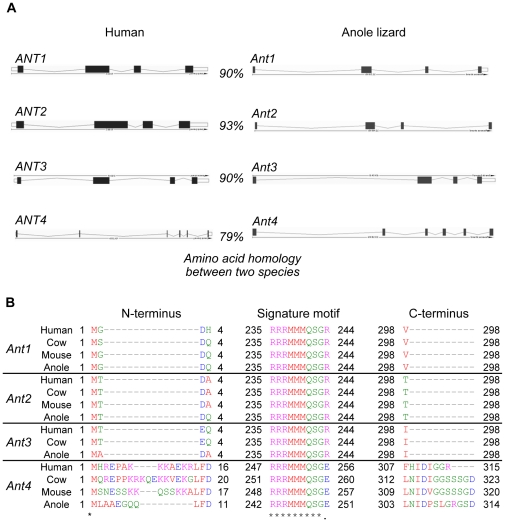
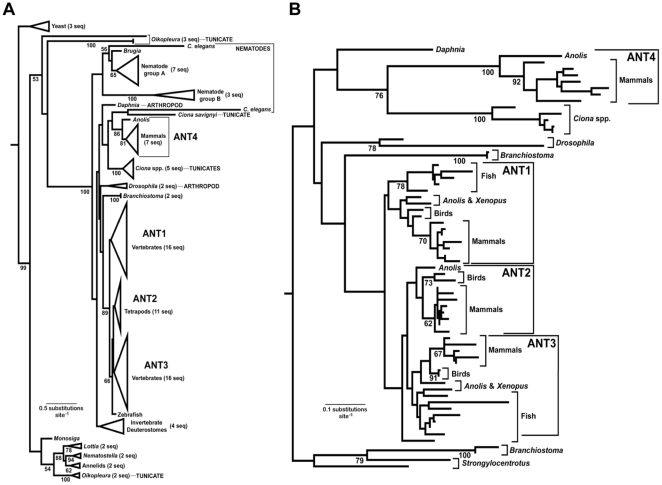
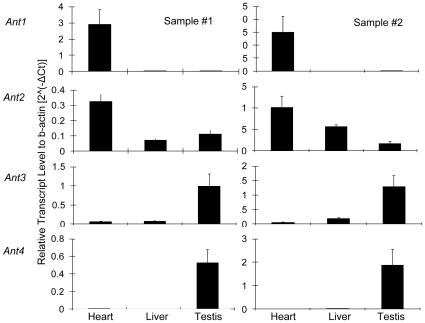
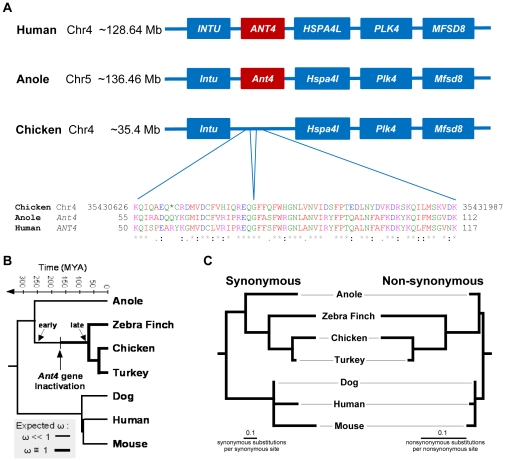
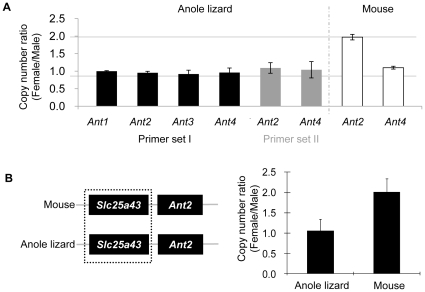
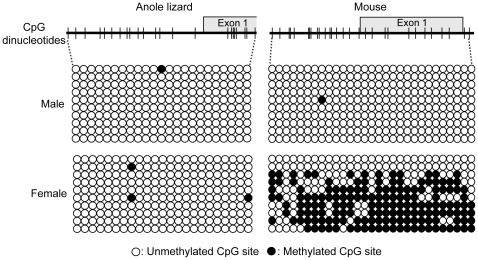
Most vertebrates have three paralogous genes with identical intron-exon structures and a high degree of sequence identity that encode mitochondrial adenine nucleotide translocase (Ant) proteins, Ant1 (Slc25a4), Ant2 (Slc25a5) and Ant3 (Slc25a6). Recently, we and others identified a fourth mammalian Ant paralog, Ant4 (Slc25a31), with a distinct intron-exon structure and a lower degree of sequence identity. Ant4 was expressed selectively in testis and sperm in adult mammals and was indeed essential for mouse spermatogenesis, but it was absent in birds, fish and frogs. Since Ant2 is X-linked in mammalian genomes, we hypothesized that the autosomal Ant4 gene may compensate for the loss of Ant2 gene expression during male meiosis in mammals. Here we report that the Ant4 ortholog is conserved in green anole lizard (Anolis carolinensis) and demonstrate that it is expressed in the anole testis. Further, a degenerate DNA fragment of putative Ant4 gene was identified in syntenic regions of avian genomes, indicating that Ant4 was present in the common amniote ancestor. Phylogenetic analyses suggest an even more ancient origin of the Ant4 gene. Although anole lizards are presumed male (XY) heterogametic, like mammals, copy numbers of the Ant2 as well as its neighboring gene were similar between male and female anole genomes, indicating that the anole Ant2 gene is either autosomal or located in the pseudoautosomal region of the sex chromosomes, in contrast to the case to mammals. These results imply the conservation of Ant4 is not likely simply driven by the sex chromosomal localization of the Ant2 gene and its subsequent inactivation during male meiosis. Taken together with the fact that Ant4 protein has a uniquely conserved structure when compared to other somatic Ant1, 2 and 3, there may be a specific advantage for mammals and lizards to express Ant4 in their male germ cells.
Conflict of interest statement
Figures
References
-
- Klingenberg M. Molecular aspects of the adenine nucleotide carrier from mitochondria. Arch Biochem Biophys. 1989;270:1–14. - PubMed
-
- Nelson DR, Felix CM, Swanson JM. Highly conserved charge-pair networks in the mitochondrial carrier family. J Mol Biol. 1998;277:285–308. - PubMed
-
- Fiore C, Trezeguet V, Le Saux A, Roux P, Schwimmer C, et al. The mitochondrial ADP/ATP carrier: structural, physiological and pathological aspects. Biochimie. 1998;80:137–150. - PubMed
-
- Palmieri L, Lasorsa FM, Vozza A, Agrimi G, Fiermonte G, et al. Identification and functions of new transporters in yeast mitochondria. Biochim Biophys Acta. 2000;1459:363–369. - PubMed
-
- Amiri H, Karlberg O, Andersson SG. Deep origin of plastid/parasite ATP/ADP translocases. J Mol Evol. 2003;56:137–150. - PubMed
Publication types
MeSH terms
Substances
Grants and funding
LinkOut - more resources
Full Text Sources
