. 2012 Jan;26(1):242-8.
doi: 10.1007/s00464-011-1861-4. Epub 2011 Aug 20.

Visual force feedback in laparoscopic training

Affiliations

Visual force feedback in laparoscopic training

Tim Horeman et al. Surg Endosc. 2012 Jan.

Abstract

Background: To improve endoscopic surgical skills, an increasing number of surgical residents practice on box or virtual reality (VR) trainers. Current training is focused mainly on hand-eye coordination. Training methods that focus on applying the right amount of force are not yet available.

Methods: The aim of this project is to develop a low-cost training system that measures the interaction force between tissue and instruments and displays a visual representation of the applied forces inside the camera image. This visual representation continuously informs the subject about the magnitude and the direction of applied forces. To show the potential of the developed training system, a pilot study was conducted in which six novices performed a needle-driving task in a box trainer with visual feedback of the force, and six novices performed the same task without visual feedback of the force. All subjects performed the training task five times and were subsequently tested in a post-test without visual feedback.

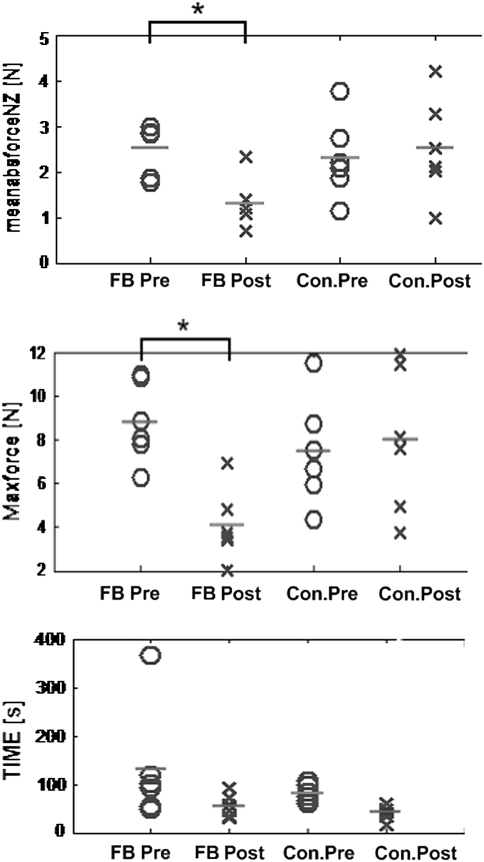
Results: The subjects who received visual feedback during training exerted on average 1.3 N (STD 0.6 N) to drive the needle through the tissue during the post-test. This value was considerably higher for the group that received no feedback (2.6 N, STD 0.9 N). The maximum interaction force during the post-test was noticeably lower for the feedback group (4.1 N, STD 1.1 N) compared with that of the control group (8.0 N, STD 3.3 N).

Conclusions: The force-sensing training system provides us with the unique possibility to objectively assess tissue-handling skills in a laboratory setting. The real-time visualization of applied forces during training may facilitate acquisition of tissue-handling skills in complex laparoscopic tasks and could stimulate proficiency gain curves of trainees. However, larger randomized trials that also include other tasks are necessary to determine whether training with visual feedback about forces reduces the interaction force during laparoscopic surgery.


Figures
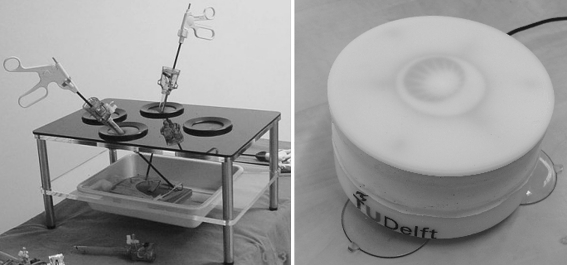
Fig. 1
Fig. 1
Left Standard box for laparoscopic training. Right New and waterproof version of the Force Platform
Fig. 2
Fig. 2
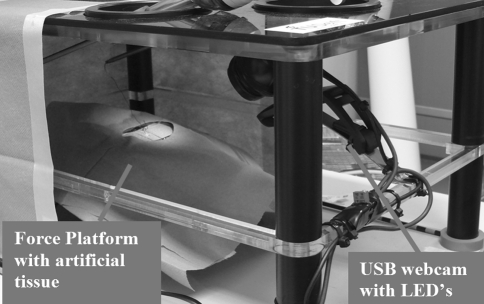
A webcam, light source, and new Force Platform equipped with artificial tissue are fixed inside the custom-made box trainer
Fig. 3
Fig. 3
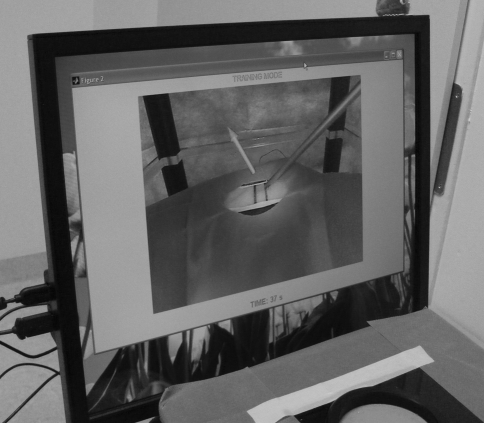
Arrow representation of the force magnitude and direction. The arrow is displayed as an overlay inside the laparoscopic image. An offset between point of needle insertion and arrow prevents blockage of the view of interest
Fig. 4
Fig. 4
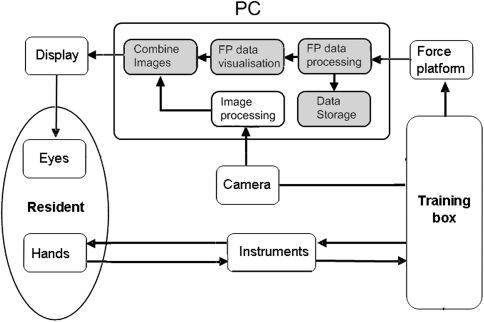
Time delays in the training system. The colored blocks show where noticeable processing time is lost during training. The total time delay is determined by a summation of the delays in each individual colored block in the representation
Fig. 5
Fig. 5
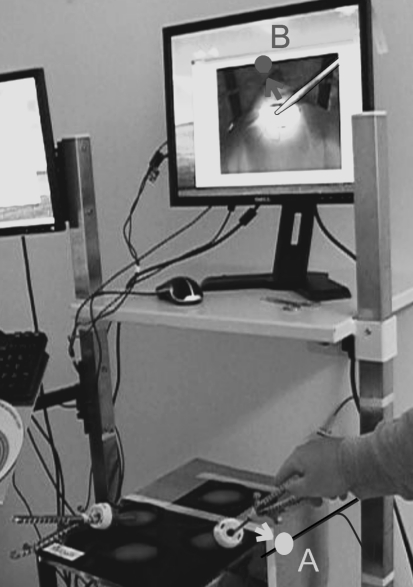
Determination of the total time delay. An additional camera (not in photo) is placed in front of the system and records the instrument’s movements and monitor simultaneously. After recording, the number of frames can be counted between the moment the real instrument reaches point A and the moment that the displayed instrument reaches the corresponding point B at the screen
Fig. 6
Fig. 6
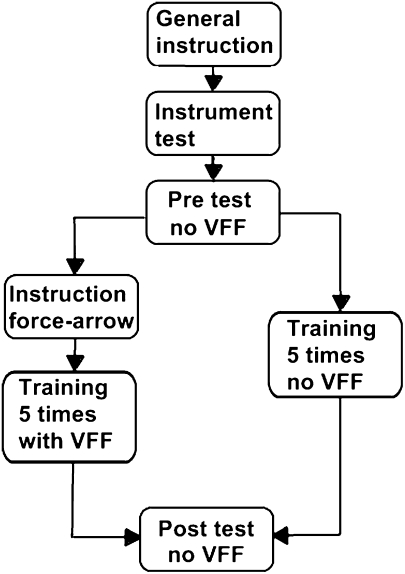
Setup of this pilot study. This illustration shows how the participants were divided into two groups. One group received visual feedback about the interaction forces (VFF) during the training session and one group received no visual feedback
Fig. 7
Fig. 7
Results of the pilot study. FB Pre, pretest of the group that received visual feedback; FB post, post-test of the group that received visual feedback; Con.Pre, pretest of the control group that received no visual feedback; Con.Post, post-test of the control group that received no visual feedback. The “*” indicates that the difference between pre- and post-test is significant

References

    1. Schijven M, Jakimowicz J. Virtual reality surgical laparoscopic simulators. Surg Endosc. 2003;17(12):1943–1950. doi: 10.1007/s00464-003-9052-6. - DOI - PubMed
    1. Aggarwal R, Moorthy K, Darzi A. Laparoscopic skills training and assessment. Br J Surg. 2004;91(12):1549–1558. doi: 10.1002/bjs.4816. - DOI - PubMed
    1. Tholey G, Desai JP, Castellanos AE. Force feedback plays a significant role in minimally invasive surgery: results and analysis. Ann Surg. 2005;241(1):102–109. - PMC - PubMed
    1. Horeman T, Rodrigues SP, Jansen F-W, Dankelman J, van den Dobbelsteen JJ. Force measurement platform for training and assessment of laparoscopic skills. Surg Endosc. 2010;24(12):3102–3108. doi: 10.1007/s00464-010-1096-9. - DOI - PMC - PubMed
    1. Botden SMBI, Torab F, Buzink SN, Jakimowicz JJ. The importance of haptic feedback in laparoscopic suturing training and the additive value of virtual reality simulation. Surg Endosc. 2008;22(5):1214–1222. doi: 10.1007/s00464-007-9589-x. - DOI - PubMed