


Indexing disease progression at study entry with individuals at-risk for Huntington disease
- PMID: 21858921
- PMCID: PMC3174494
- DOI: 10.1002/ajmg.b.31232
Indexing disease progression at study entry with individuals at-risk for Huntington disease
Abstract
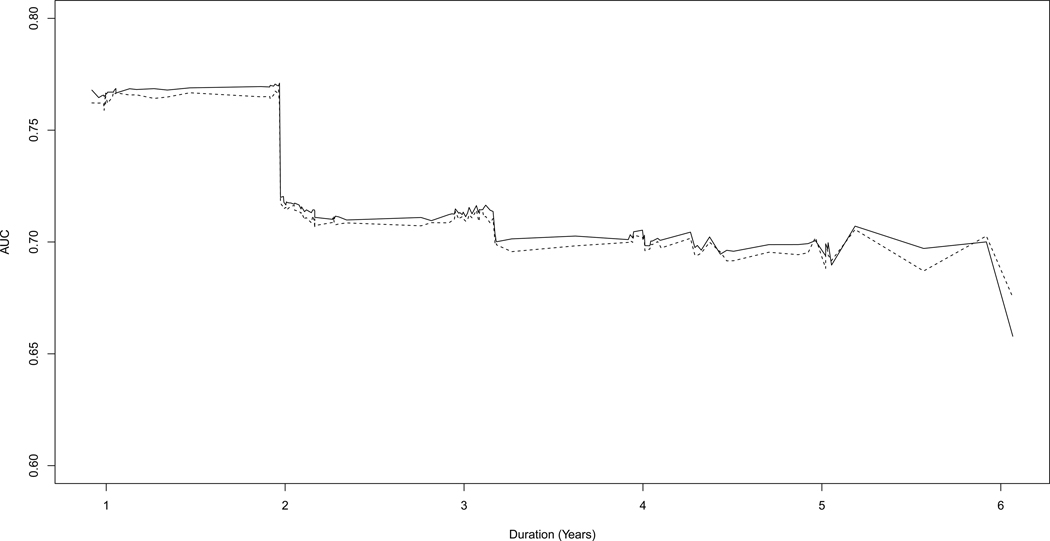
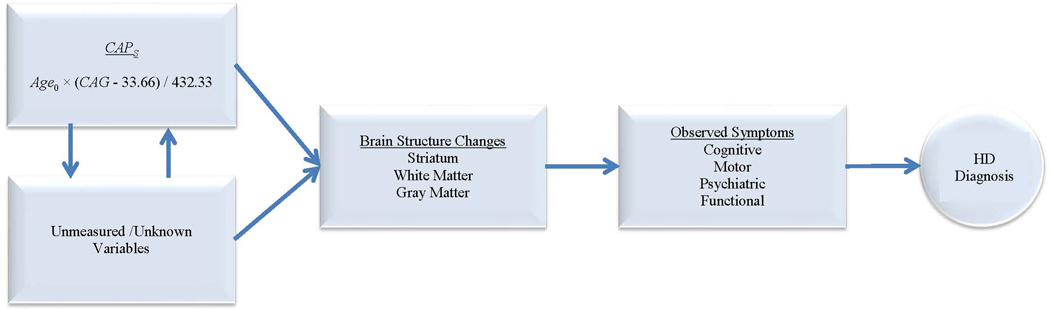
The identification of clinical and biological markers of disease in persons at risk for Huntington disease (HD) has increased in efforts to better quantify and characterize the epoch of prodrome prior to clinical diagnosis. Such efforts are critical in the design and implementation of clinical trials for HD so that interventions can occur at a time most likely to increase neuronal survival and maximize daily functioning. A prime consideration in the examination of prodromal individuals is their proximity to diagnosis. It is necessary to quantify proximity so that individual differences in key marker variables can be properly interpreted. We take a data-driven approach to develop an index that can be viewed as a proxy for time to HD diagnosis known as the CAG-Age Product Scaled or CAP(S) . CAP(S) is an observed utility variable computed for all genetically at-risk individuals based on age at study entry and CAG repeat length. Results of a longitudinal receiver operating characteristic (ROC) analysis showed that CAP(S) had a relatively strong ability to predict individuals who became diagnosed, especially in the first 2 years. Bootstrap validation provided evidence that CAP(S) computed on a new sample from the same population could have similar discriminatory power. Cutoffs for the empirical CAP(S) distribution can be used to create a classification for mutation-positive individuals (Low-Med-High), which is, useful for comparison with the naturally occurring mutation-negative Control group. The classification is an improvement over the one currently in use as it is based on observed data rather than model-based estimated values. © 2011 Wiley-Liss, Inc.
Copyright © 2011 Wiley-Liss, Inc.
Figures
References
-
- Andresen JM, Gayan J, Djousse L, Roberts S, Brocklebank D, Cherny SS, Cardon LR, Gusella JF, MacDonald ME, Myers RH, et al. The relationship between CAG repeat length and age of onset differs for Huntington's disease patients with juvenile onset or adult onset. Ann Hum Genet. 2007b;71(Pt 3):295–301. - PubMed
-
- Andrew SE, Goldberg YP, Kremer B, Telenius H, Theilmann J, Adam S, Starr E, Squitieri F, Lin B, Kalchman MA, et al. The relationship between trinucleotide (CAG) repeat length and clinical features of Huntington's disease. Nat Genet. 1993;4(4):398–403. - PubMed
Publication types
MeSH terms
Grants and funding
LinkOut - more resources
Full Text Sources
Medical
Miscellaneous
