


Social cognition as a mediator variable between neurocognition and functional outcome in schizophrenia: empirical review and new results by structural equation modeling
- PMID: 21860046
- PMCID: PMC3160114
- DOI: 10.1093/schbul/sbr079
Social cognition as a mediator variable between neurocognition and functional outcome in schizophrenia: empirical review and new results by structural equation modeling
Abstract
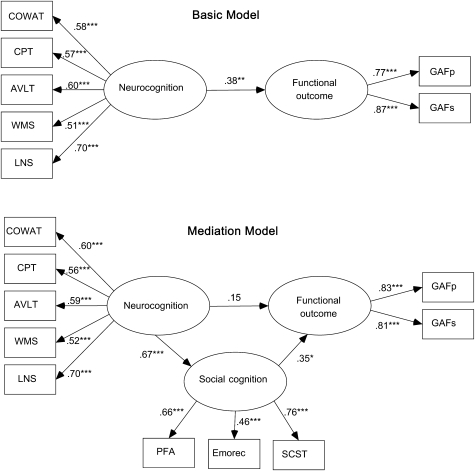
Cognitive impairments are currently regarded as important determinants of functional domains and are promising treatment goals in schizophrenia. Nevertheless, the exact nature of the interdependent relationship between neurocognition and social cognition as well as the relative contribution of each of these factors to adequate functioning remains unclear. The purpose of this article is to systematically review the findings and methodology of studies that have investigated social cognition as a mediator variable between neurocognitive performance and functional outcome in schizophrenia. Moreover, we carried out a study to evaluate this mediation hypothesis by the means of structural equation modeling in a large sample of 148 schizophrenia patients. The review comprised 15 studies. All but one study provided evidence for the mediating role of social cognition both in cross-sectional and in longitudinal designs. Other variables like motivation and social competence additionally mediated the relationship between social cognition and functional outcome. The mean effect size of the indirect effect was 0.20. However, social cognitive domains were differentially effective mediators. On average, 25% of the variance in functional outcome could be explained in the mediation model. The results of our own statistical analysis are in line with these conclusions: Social cognition mediated a significant indirect relationship between neurocognition and functional outcome. These results suggest that research should focus on differential mediation pathways. Future studies should also consider the interaction with other prognostic factors, additional mediators, and moderators in order to increase the predictive power and to target those factors relevant for optimizing therapy effects.
Figures
References
-
- World Health Organization (WHO) World Health Report 2001, Mental Health: New Understanding, New Hope. Geneva, Switzerland: : World Health Organization;; 2001.
-
- American Psychiatric Association (APA) Diagnostic and Statistical Manual of Mental Disorders. 4th text revision. Washington, DC: : American Psychiatric Association; 2000.
-
- Albert N, Bertelsen M, Thorup A, et al. Predictors of recovery from psychosis: analyses of clinical and social factors associated with recovery among patients with first-episode psychosis after 5 years. Schizophr Res. 2011;125:257–266. - PubMed
-
- Bottlender R, Strauss A, Möller HJ. Social disability in schizophrenic, schizoaffective and affective disorders 15 years after admission. Schizophr Res. 2010;116:9–15. - PubMed
