. 2011;26(4):767-78.
doi: 10.3233/JAD-2011-110512.

Therapeutic potential and anti-amyloidosis mechanisms of tert-butylhydroquinone for Alzheimer's disease

Affiliations

Therapeutic potential and anti-amyloidosis mechanisms of tert-butylhydroquinone for Alzheimer's disease

Hasina Akhter et al. J Alzheimers Dis. 2011.

Abstract

Alzheimer's disease (AD) is a major cause of dementia in the elderly with no effective treatment. Accumulation of amyloid-β peptide (Aβ) in the brain, one of the pathological features of AD, is considered to be a central disease-causing and disease-promoting event in AD. In this study, we showed that feeding male AβPP/PS1 transgenic mice, a well established mouse model of AD, with a diet containing phenolic antioxidant tert-butylhydroquinone (TBHQ) dramatically reduced brain Aβ load with no significant effect on the amounts of alpha- and beta-C-terminal fragments or full-length AβPP. Further studies showed that TBHQ diet inhibited the expression of plasminogen activator inhibitor-1 (PAI-1), a protease inhibitor which plays a critical role in brain Aβ accumulation in AD, accompanied by increases in the activities of tissue type and urokinase type plasminogen activators (tPA and uPA) as well as plasmin. Moreover, we showed that TBHQ diet increased the expression of low density lipoprotein related protein-1, a multi ligand endocytotic receptor involved in transporting Aβ out of the brain, and plasma Aβ(40) and Aβ(42) levels. We also showed that TBHQ diet increased the concentration of glutathione, an important antioxidant, and suppressed the expression of NADPH oxidase 2 as well as lipid peroxidation. Collectively, our data suggest that TBHQ may have therapeutic potential for AD by increasing brain antioxidant capacity/reducing oxidative stress level and by stimulating Aβ degradation/clearance pathways.


Figures
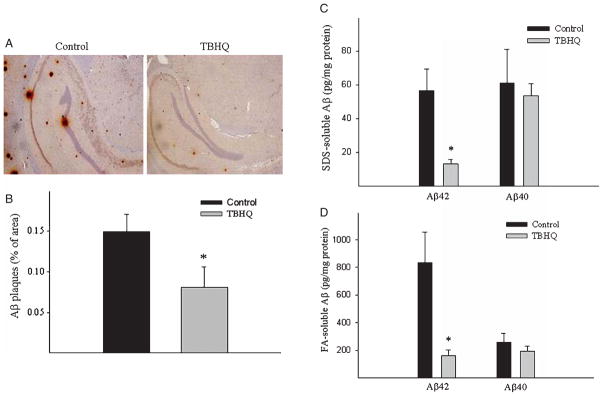
Fig. 1
Fig. 1
Effect of TBHQ diet on Aβ load in the brain of AβPP/PS1 mice. Two and a half month old male AβPP/PS1 mice were fed with TBHQ or control diet for 6 weeks. Aβ deposits in the brain were revealed by immunohistochemical staining using antibody specific to human Aβ (6E10) (A) and quantified by the histomorphometry system and expressed as percentage of total area of brain (B). The amounts of Aβ40 and Aβ 42, both soluble and insoluble, in the brain were determined by ELISA and calculated based on the total protein content (C&D). *Significantly different from the corresponding control diet fed mice (p < 0.05, n = 5–7).
Fig. 2
Fig. 2
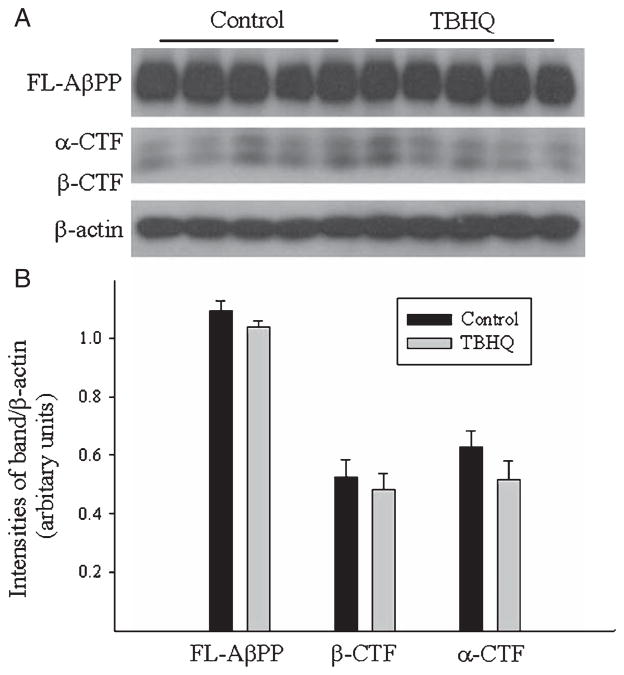
Effects of TBHQ diet on the amounts of full-length AβPP, α-CTF, and β-CTF in the brain of AβPP/PS1 mice. Full-length AβPP (FL-AβPP) and α/β-CTF in the brain of AβPP/PS1 mice were determined by western analyses using 4–20% gradient SDS-PAGE and anti-human Aβ antibody (6E10) or C terminus of human AβPP (CT695) (top panel). The intensities of the bands were semi-quantified by densitometric scanning and normalized by β-actin (bottom panel). *Significantly different from control diet fed mice (p < 0.05, n = 3–5).
Fig. 3
Fig. 3
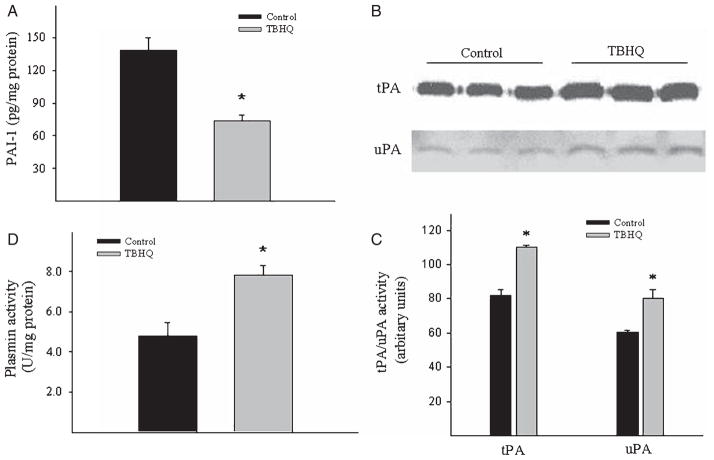
Effects of TBHQ diet on PAI-1 protein expression and the activities of tPA, uPA, and plasmin in the brain of AβPP/PS1 mice. (A) PAI-1 protein levels in the brain tissue were determined by ELISA. (B) The activities of tPA and uPA in brain tissue were determined by zymography. (C) the intensities of the bands semi-quantified by densitometric scanning using Image J software. (D) Plasmin activity was determined using a specific chromogenic substrate as described in the Materials and Methods section. *Significantly different from control mice (p < 0.05, n = 5–6).
Fig. 4
Fig. 4
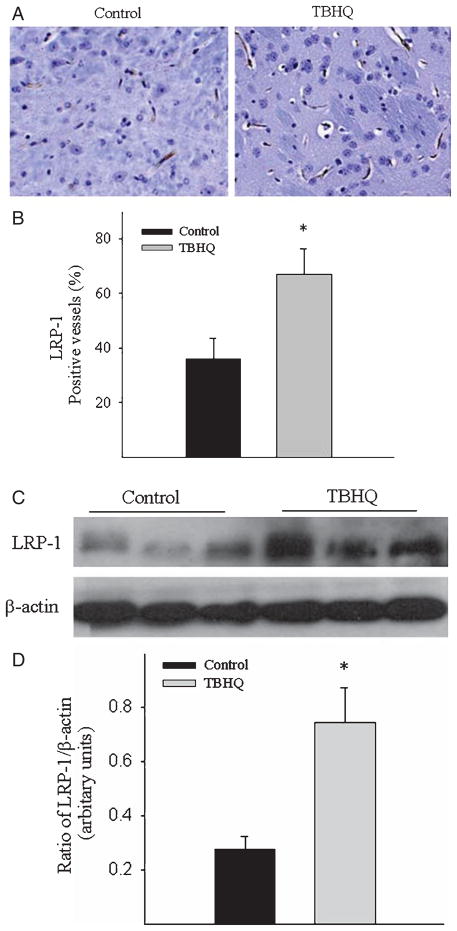
Effects of TBHQ diet on the expression of LRP-1 at the BBB in AβPP/PS1 mice. A) Representative immunostaining pictures of LRP-1 protein in the brains of control-diet and TBHQ-diet fed mice. B) Quantification of LRP-1 positive blood vessels in cerebral cortex/hippocampus, expressed as percentage of total number of blood vessels in the same area of the brain. C) Representative western blotting picture of LRP-1 protein in cerebral cortex and hippocampus of AβPP/PS1 mice. D) Semi-quantitative data of western blotting. *Significantly different from control diet fed AβPP/PS1 transgenic mice (p < 0.05, n = 5).
Fig. 5
Fig. 5
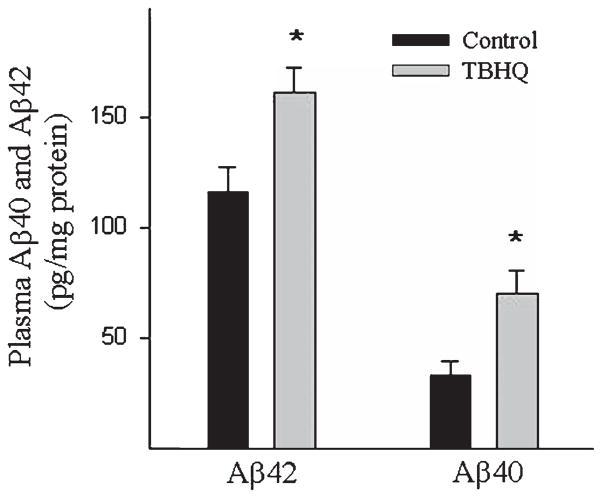
Effect of TBHQ on plasma Aβ42 and Aβ40 levels in AβPP/PS1 mice. Aβ40 and Aβ42 levels in the plasma were determined by ELISA. *Significantly different from control diet fed mice (p < 0.05, n = 5).
Fig. 6
Fig. 6
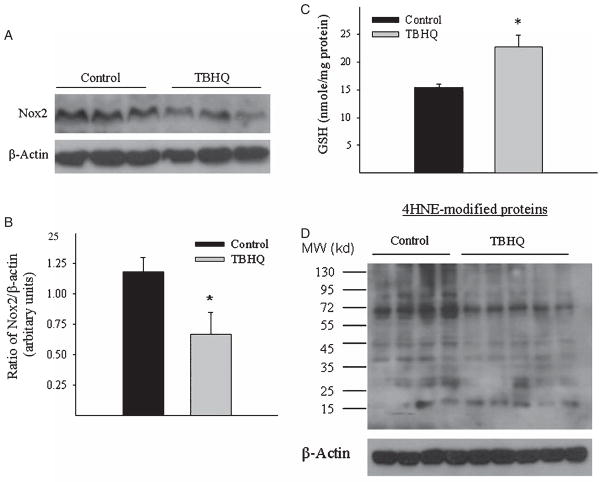
Effects of TBHQ diet on brain oxidative stress and antioxidant levels in AβPP/PS1 mice. A) Representative western blotting picture of Nox2 protein in the brain of AβPP/PS1 transgenic mice. B) Semi-quantitative data of western blotting. *Significantly different from control diet fed AβPP/PS1 transgenic mice (p < 0.05, n = 5–6). C) GSH content in the brain. *Significantly different from control diet fed mice (p < 0.05, n = 5–6); D) Representative western blotting picture of 4-HNE modified proteins in the brain of AβPP/PS1 mice. β-actin was used to show equal protein loading between samples.
Fig. 7
Fig. 7
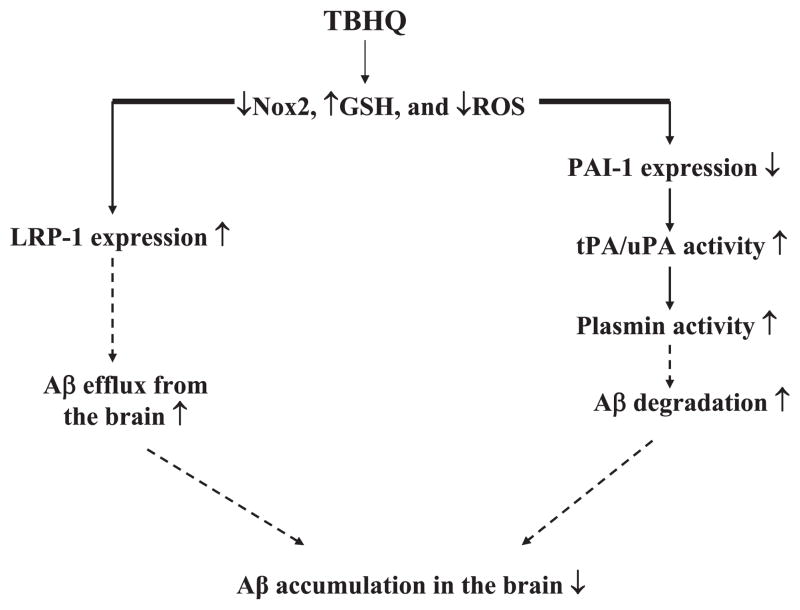
The hypothetic mechanisms by which TBHQ reduces brain Aβ load in AD. TBHQ increases antioxidant capacity and reduces oxidative stress levels in the brain, which leads to suppression of the expression of PAI-1, a redox regulated protein, and induction of LRP-1 and thereby increased Aβ degradation/efflux from the brain. Solid lines represent evidence demonstrated directly from the present study.

References

    1. Morgan D, Diamond DM, Gottschall PE, Ugen KE, Dickey C, Hardy J, Duff K, Jantzen P, DiCarlo G, Wilcock D, Connor K, Hatcher J, Hope C, Gordon M, Arendash GW. A[beta] peptide vaccination prevents memory loss in an animal model of Alzheimer’s disease. Nature. 2000;408:982–985. - PubMed
    1. Hock C, Konietzko U, Streffer JR, Tracy J, Signorell A, Müller-Tillmanns B, Lemke U, Henke K, Moritz E, Garcia E, Wollmer MA, Umbricht D, de Quervain DJF, Hofmann M, Maddalena A, Papassotiropoulos A, Nitsch RM. Antibodies against [beta]-Amyloid slow cognitive decline in Alzheimer’s disease. Neuron. 2003;38:547–554. - PubMed
    1. Wilcock DM, Rojiani A, Rosenthal A, Subbarao S, Freeman MJ, Gordon MN, Morgan D. Passive immunotherapy against Abeta in aged APP-transgenic mice reverses cognitive deficits and depletes parenchymal amyloid deposits in spite of increased vascular amyloid and microhemorrhage. J Neuroinflammation. 2004;1:24. - PMC - PubMed
    1. Fukumoto H, Takahashi H, Tarui N, Matsui J, Tomita T, Hirode M, Sagayama M, Maeda R, Kawamoto M, Hirai K, Terauchi J, Sakura Y, Kakihana M, Kato K, Iwatsubo T, Miyamoto M. A noncompetitive BACE1 inhibitor TAK-070 ameliorates Aβ pathology and behavioral deficits in a mouse model of Alzheimer’s disease. J Neurosci. 2010;30:11157–11166. - PMC - PubMed
    1. Kimura R, Devi L, Ohno M. Partial reduction of BACE1 improves synaptic plasticity, recent and remote memories in Alzheimer’s disease transgenic mice. J Neurochem. 2010;113:248–261. - PMC - PubMed

Publication types

MeSH terms