


Temporomandibular disorder and generalized joint hypermobility: application of diagnostic criteria
- PMID: 21860966
- PMCID: PMC9450698
- DOI: 10.1590/S1808-86942011000400003
Temporomandibular disorder and generalized joint hypermobility: application of diagnostic criteria
Abstract
Generalized joint hypermobility (GJH) has been considered a predisposing factor for the development of temporomandibular disorder (TMD).
Aim: To evaluate clinical and psychosocial aspects in individuals diagnosed with TMD with or without GJH.
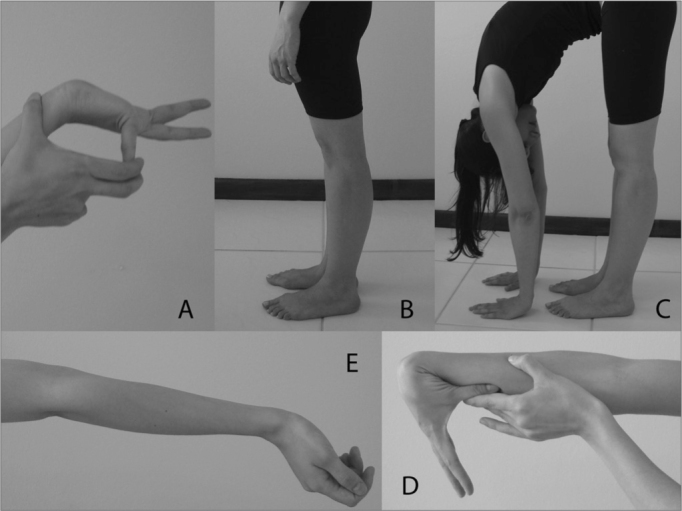
Materials and methods: Clinical and experimental study, which enrolled 34 women, from 18 to 35 years of age with TMD diagnosed by RDC/TMD. The GJH was assessed by the Beighton score and volunteers were broken down into 2 groups: with GJH (n = 22) and without GJH (n = 12).
Results: We found a high percentage of GJH (64. 71%). All participants had myofascial pain; 79. 41% had arthralgia and 41% had disk displacement. There was a correlation between higher GJH scores and higher passive mouth opening amplitude (p = 0.0034), with pain (p = 0.0029) and without pain (p = 0.0081). Greater mandibular range of motion was observed in the group with GJH, except for protrusion. Painful mouth opening was statistically higher in the GJH group (p = 0.0279).
Conclusions: Individuals with TMD associated or not to GJH do not differ significantly regarding clinical and psychosocial aspects, except in the mandibular opening range of motion, which if kept at physiological levels can lead to a late diagnosis of TMD in these individuals.
Figures
References
-
- Bevilaqua-Grossi D, Chaves TC, de Oliviera AS, Monteiro-Pedro V. Anamnestic index severity and signs and symptoms of TMD. Cranio. 2006;24(2):112–118. - PubMed
-
- Pedroni CR, De Oliveira AS, Guaratini MI. Prevalence study of signs and symptoms of temporomandibular disorders in university students. J Oral Rehabil. 2003;30:283–289. - PubMed
-
- Dworkin SF, Huggins KH, LeResche L, Von Korff M, Howard J, Truelove E, et al. Epidemiology of signs and symptoms in temporomandibular disorders: clinical signs in cases and controls. J Am Dent Assoc. 1990;120:228–273. - PubMed
-
- Conti PCR, Miranda JES, Araujo CRP. Relationship between systemtaic joint laxity, TMJ hypertranslation and intra-articular disorders. Cranio. 2000;18:192–197. - PubMed
-
- Winocur E, Gavish A, Halachmi M, Bloom A, Gazit E. Generalized joint laxity and its relation with oral habits and temporomandibular disorders in adolescent girls. J Oral Rehabil. 2000;27:614–622. - PubMed
MeSH terms
LinkOut - more resources
Full Text Sources
Medical
