Comparative Study
. 2012 Aug;34(4):917-33.
doi: 10.1007/s11357-011-9289-2. Epub 2011 Aug 23.

Late-onset intermittent fasting dietary restriction as a potential intervention to retard age-associated brain function impairments in male rats

Affiliations
Comparative Study

Late-onset intermittent fasting dietary restriction as a potential intervention to retard age-associated brain function impairments in male rats

Rumani Singh et al. Age (Dordr). 2012 Aug.

Abstract

Lifelong dietary restriction (DR) is known to have many potential beneficial effects on brain function as well as delaying the onset of neurological diseases. In the present investigation, the effect of late-onset short-term intermittent fasting dietary restriction (IF-DR) regimen was studied on motor coordination and cognitive ability of ageing male rats. These animals were further used to estimate protein carbonyl content and mitochondrial complex I-IV activity in different regions of brain and peripheral organs, and the degree of age-related impairment and reversion by late-onset short-term IF-DR was compared with their levels in 3-month-old young rats. The results of improvement in motor coordination by rotarod test and cognitive skills by Morris water maze in IF-DR rats were found to be positively correlated with the decline in the oxidative molecular damage to proteins and enhanced mitochondrial complex IV activity in different regions of ageing brain as well as peripheral organs. The work was further extended to study the expression of synaptic plasticity-related proteins, such as synaptophysin, calcineurin and CaM kinase II to explore the molecular basis of IF-DR regimen to improve cognitive function. These results suggest that even late-onset short-term IF-DR regimen have the potential to retard age-associated detrimental effects, such as cognitive and motor performance as well as oxidative molecular damage to proteins.


Figures
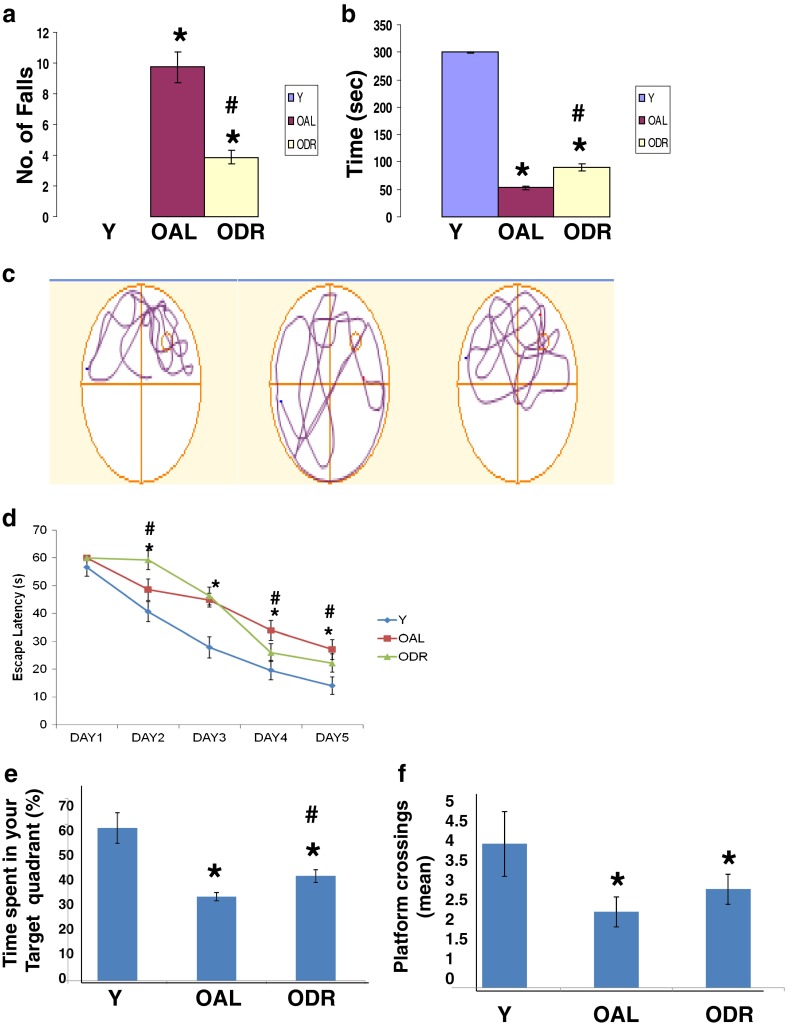
Fig. 1
Fig. 1
Old intermittent fasting–dietary restricted (ODR) rats performed better than their respective OAL (old ad libitum fed) groups as assessed by latency to fall from the rotarod (a) and time spent on the rotarod (b). Morris water maze performance during training and testing is shown in cf. OAL rats show significantly longer latencies to find the platform compared with ODR (d), and they failed to swim in the correct quadrant during trial sessions (e, f). Comparatively, ODR spent significantly higher time in target quadrant as compared to OAL rats (e). ODR rats also had more platform crossings than OAL animals, but the change was not significant (f). Values are mean ± SEM of five experiments (n = 20) from 3 months young adult, 24-month-old AL and DR rats. *p < 0.05 young vs old AL and DR rats, #p < 0.05 old AL vs old DR rats, Bonferroni’s test after one-way ANOVA
Fig. 2
Fig. 2
Effects of age and IF-DR on carbonyl content (nmol carbonyls/mg protein) of aged rats. a Average carbonyl content of age matched old ad libitum fed (OAL) and old intermittent fasting–dietary restricted (ODR) are shown in comparison to their young counterparts. be Specific activity of mitochondrial complex I (DPNH-coenzyme Q reductase), complex II (succinate dehydrogenase coenzyme Q reductase), complex III (coenzyme Q cytochrome C reductase) and complex IV (cytochrome C oxidase) from different brain regions such as pyriform cortex (PC), hippocampus (HIP) and hypothalamus (HYP) and peripheral organs, kidney (K), liver (L) and heart (H) from young, OAL and ODR rats. Values are mean ± SEM of five experiments (n = 3–6) from 3-month young adult, 24-month-old AL and DR rats. *p < 0.05 young vs old AL and DR rats, #p < 0.05 old AL vs old DR rats, Bonferroni’s test after one-way ANOVA
Fig. 3
Fig. 3
Representative immunohistochemical images for synaptophysin DAB staining in CA1, CA3 and dentate gyrus (DG) of hippocampus and piriform cortex (PC) and median eminence (ME) region of hypothalamus of young (Y), old ad libitum fed (OAL) and old intermittent fasting dietary restricted (ODR) rats. The intense staining was observed in CA1, CA3 and DG regions of hippocampus and PC of brain in old DR rats. Histograms represent percent change in staining intensity taking intensity in 3-month-old young rats as 100%. Values are mean ± SEM of five experiments (n = 3–5) from 3-month young adult, 24-month-old AL and DR rats. *p < 0.05 young vs old AL and DR rats, #p < 0.05 old AL vs old DR rats, Bonferroni’s test after one-way ANOVA
Fig. 4
Fig. 4
Representative immunohistochemical images for calcineurin DAB staining in CA1, CA3 and dentate gyrus (DG) of hippocampus and piriform cortex (PC) and median eminence (ME) region of hypothalamus of young (Y), old ad libitum fed (OAL) and old intermittent fasting dietary restricted (ODR) rats. The intense staining was observed in CA1, CA3 and DG regions of hippocampus and PC of brain in old DR rats. Histograms represent percent change in staining intensity taking intensity in 3-month-old young rats as 100%. Values are mean ± SEM of five experiments (n = 3–5) from 3 months young adult, 24-month-old AL and DR rats. *p < 0.05 young vs old AL and DR rats, #p < 0.05 old AL vs old DR rats, Bonferroni’s test after one-way ANOVA
Fig. 5
Fig. 5
Representative immunohistochemical images for CaMKinase DAB staining in CA1, CA3 and dentate gyrus (DG) of hippocampus and piriform cortex (PC) and median eminence (ME) region of hypothalamus of young (Y), old ad libitum fed (OAL) and old intermittent fasting dietary restricted (ODR) rats. The intense staining was observed in CA1, CA3 and DG regions of hippocampus and PC of brain in old DR rats. Histograms represent percent change in staining intensity taking intensity in 3-month-old young rats as 100%. Values are mean ± SEM of five experiments (n = 3–5) from 3-month young adult, 24-month-old AL and DR rats. *p < 0.05 young vs old AL and DR rats, #p < 0.05 old AL vs old DR rats, Bonferroni’s test after one-way ANOVA
Fig. 6
Fig. 6
Representative Western blot and RT-PCR images for synaptophysin (Syn), calcineurin (CaN) and CaMKinae II (CaM) in pyriform cortex (PC), hippocampus (HIP), hypothalamus (HYP) regions of young adult, old AL and old DR rats (n = 3 for each group). Quantitative densitometric analysis for synaptic markers is shown in histograms. *p < 0.05 young vs old AL and DR rats, #p < 0.05 old AL vs old DR rats, Bonferroni’s test after one-way ANOVA

References

    1. Adams MM, Shi L, Linville MC, Forbes ME, Long AB, Bennett C, Newton IG, Carter CS, Sonntag WE, Riddle D, Brunso-Bechtold JK. Caloric restriction and age affect synaptic proteins in hippocampal CA3 and spatial learning ability. Exp Neurol. 2008;211:141–149. doi: 10.1016/j.expneurol.2008.01.016. - DOI - PMC - PubMed
    1. Ahmet I, Wan R, Mattson MP, Lakatta EG, Talan M. Cardioprotection by intermittent fasting in rats. Circulation. 2005;112(20):3115–3121. doi: 10.1161/CIRCULATIONAHA.105.563817. - DOI - PubMed
    1. Aksenov V, Long J, Lokuge S, Foster JA, Liu J, Rollo CD. Dietary amelioration of locomotor, neurotransmitter and mitochondrial aging. Exp Biol Med. 2010;235:66–76. doi: 10.1258/ebm.2009.009219. - DOI - PubMed
    1. Albers DS, Beal MF. Mitochondrial dysfunction and oxidative stress in aging and neurodegenerative disease. J Neural Transm Suppl. 2000;59:133–154. - PubMed
    1. Altun M, Bergman E, Edström E, Johnson H, Ulfhake B. Behavioral impairments of the aging rat. Physiol Behav. 2007;92(5):911–923. doi: 10.1016/j.physbeh.2007.06.017. - DOI - PubMed

Publication types

MeSH terms

LinkOut - more resources