


Environmental, entomological, socioeconomic and behavioural risk factors for malaria attacks in Amerindian children of Camopi, French Guiana
- PMID: 21861885
- PMCID: PMC3196925
- DOI: 10.1186/1475-2875-10-246
Environmental, entomological, socioeconomic and behavioural risk factors for malaria attacks in Amerindian children of Camopi, French Guiana
Abstract
Background: Malaria is a major health issue in French Guiana. Amerindian communities remain the most affected. A previous study in Camopi highlighted the predominant role of environmental factors in the occurrence of malaria. However, all parameters involved in the transmission were not clearly identified. A new survey was conducted in order to clarify the risk factors for the presence of malaria cases in Camopi.
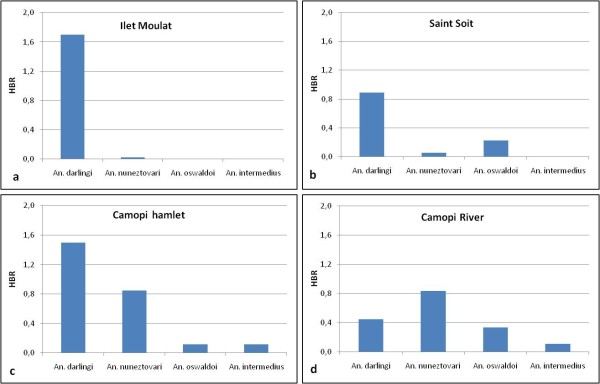
Methods: An open cohort of children under seven years of age was set up on the basis of biologically confirmed malaria cases for the period 2001-2009. Epidemiological and observational environmental data were collected using two structured questionnaires. Data were analysed with a multiple failures multivariate Cox model. The influence of climate and the river level on malaria incidence was evaluated by time-series analysis. Relationships between Anopheles darlingi human biting rates and malaria incidence rates were estimated using Spearman's rank correlation.
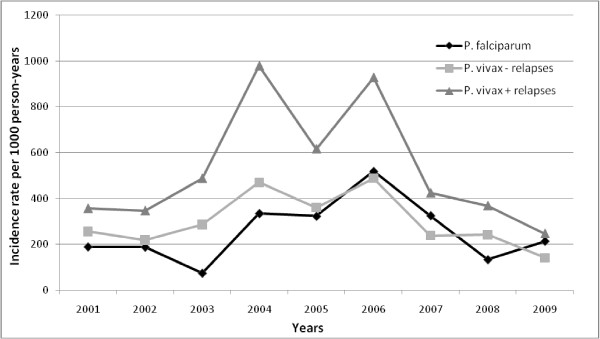
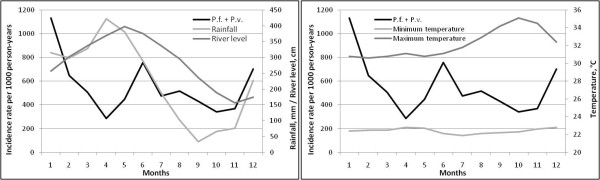
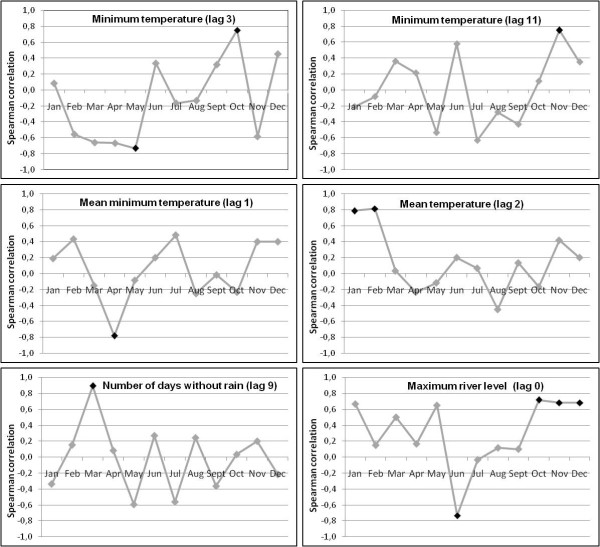
Results: The global annual incidence over the nine-year period was 238 per 1,000 for Plasmodium falciparum, 514 per 1,000 for Plasmodium visa and 21 per 1,000 for mixed infections. The multivariate survival analysis associated higher malaria incidence with living on the Camopi riverside vs. the Oyapock riverside, far from the centre of the Camopi hamlet, in a home with numerous occupants and going to sleep late. On the contrary, living in a house cleared of all vegetation within 50 m and at high distance of the forest were associated with a lower risk. Meteorological and hydrological characteristics appeared to be correlated with malaria incidence with different lags. Anopheles darlingi human biting rate was also positively correlated to incident malaria in children one month later.
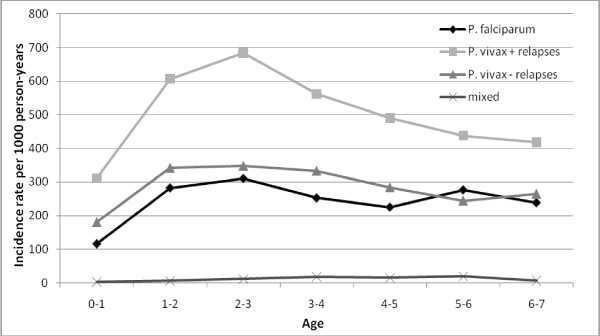
Conclusions: Malaria incidence in children remains high in young children despite the appearance of immunity in children around three years of age. The closeness environment but also the meteorological parameters play an important role in malaria transmission among children under seven years of age in Camopi.
Figures
References
-
- Carme B, Venturin C. [Malaria in the Americas](in French) Med Trop (Mars) 1999;59:298–302. - PubMed
-
- Carme B, Ardillon V, Girod R, Grenier C, Joubert M, Djossou F, Ravachol F. [Update on the epidemiology of malaria in French Guiana] (in French) Med Trop (Mars) 2009;69:19–25. - PubMed
-
- Carme B, Lecat J, Lefebvre P. [Malaria in an outbreak zone in Oyapock (French Guiana): incidence of malaria attacks in the American Indian population of Camopi] (in French) Med Trop (Mars) 2005;65:149–154. - PubMed
-
- Hustache S, Nacher M, Djossou F, Carme B. Malaria risk factors in Amerindian children in French Guiana. Am J Trop Med Hyg. 2007;76:619–625. - PubMed
-
- Floch H. La lutte antipaludique en Guyane française. L'anophélisme. Riv Malariol. 1955;24:57–65. - PubMed
Publication types
MeSH terms
LinkOut - more resources
Full Text Sources
Medical
Miscellaneous
