Review
. 2011 Dec;21(6):719-25.
doi: 10.1016/j.gde.2011.07.009. Epub 2011 Aug 19.

Pattern formation by receptor tyrosine kinases: analysis of the Gurken gradient in Drosophila oogenesis

Affiliations
Review

Pattern formation by receptor tyrosine kinases: analysis of the Gurken gradient in Drosophila oogenesis

Lily S Cheung et al. Curr Opin Genet Dev. 2011 Dec.

Abstract

Spatial patterns of cell differentiation in developing tissues can be controlled by receptor tyrosine kinase (RTK) signaling gradients, which may form when locally secreted ligands activate uniformly expressed receptors. Graded activation of RTKs can span multiple cell diameters, giving rise to spatiotemporal patterns of signaling through the Extracellular Signal Regulated/Mitogen Activated Protein Kinase (ERK/MAPK), which connects receptor activation to multiple aspects of tissue morphogenesis. This general mechanism has been identified in numerous developmental contexts, from body axis specification in insects to patterning of the mammalian neocortex. We review recent quantitative studies of this mechanism in Drosophila oogenesis, an established genetic model of signaling through the Epidermal Growth Factor Receptor (EGFR), a highly conserved RTK.


Figures

Figure 1
Figure 1
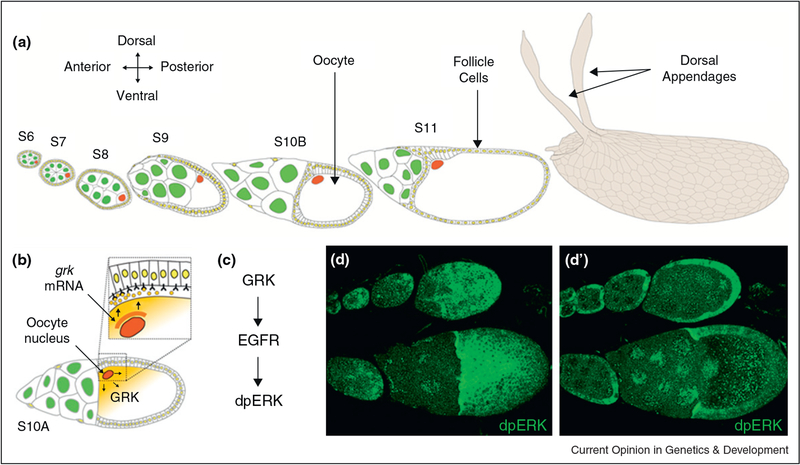
The body axes of the Drosophila eggshell and the future embryo are established by the asymmetrical localization of the oocyte nucleus, and Gurken (GRK) synthesis, during oogenesis, (a) Schematic of egg chamber development during stages 6–11 of oogenesis (left) and the resulting eggshell (right), (b) grk mRNA accumulates in close proximity of the oocyte nucleus. The protein is locally produced by the oocyte and secreted into the perivitelline space, where it diffuses and binds receptors in the surrounding follicle cells, (c) Activation of EGFR by GRK initiates a protein kinase cascade that leads to double phosphorylation of ERK (dpERK). (d-d’) Dorsal surface and cross section views of egg chambers at different stages of oogenesis. The pattern of ERK activation, as recognized by an antibody specific for the double phosphorylated form of the protein, reflects the distribution pattern of the ligand. During early stages (top), dpERK is activated in a posterior-to-anterior gradient, while at late stages (bottom), dpERK is activated in a dorsal-to-ventral gradient.
Figure 2
Figure 2
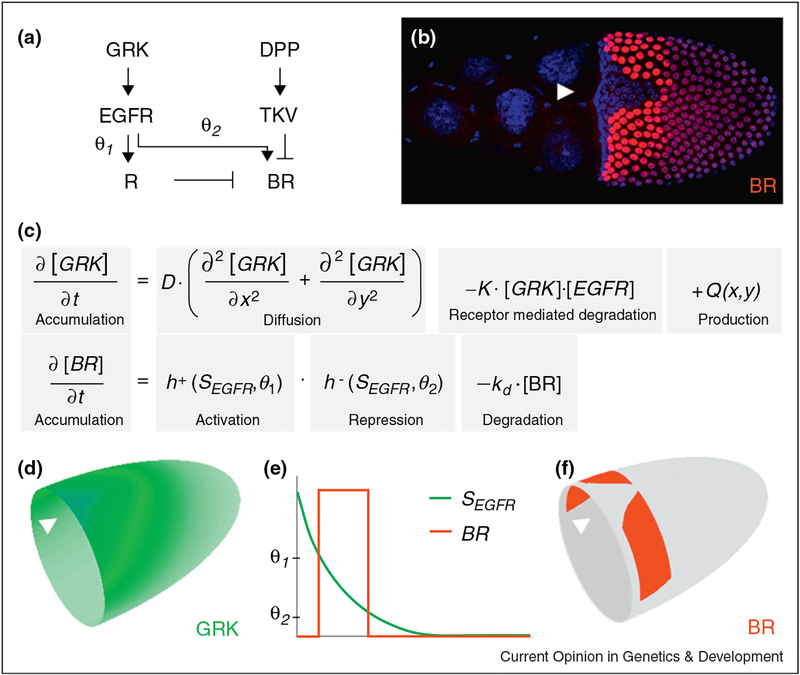
Model for the regulation of the expression pattern of broad (br). (a, e) The EGFR pathway regulates br in an incoherent feedforward loop, where EGFR activation induces both br (at a low threshold value θ2) and its repressor R (at a higher threshold value θ2). (b) BR (red) is expressed in two groups of follicle cells (nuclei shown in blue) on either side of the dorsal midline, (c–f) Mathematical model for the two-dimensional distribution of GRK and BR expression. Arrow heads mark the position of the dorsal midline.
Figure 3
Figure 3
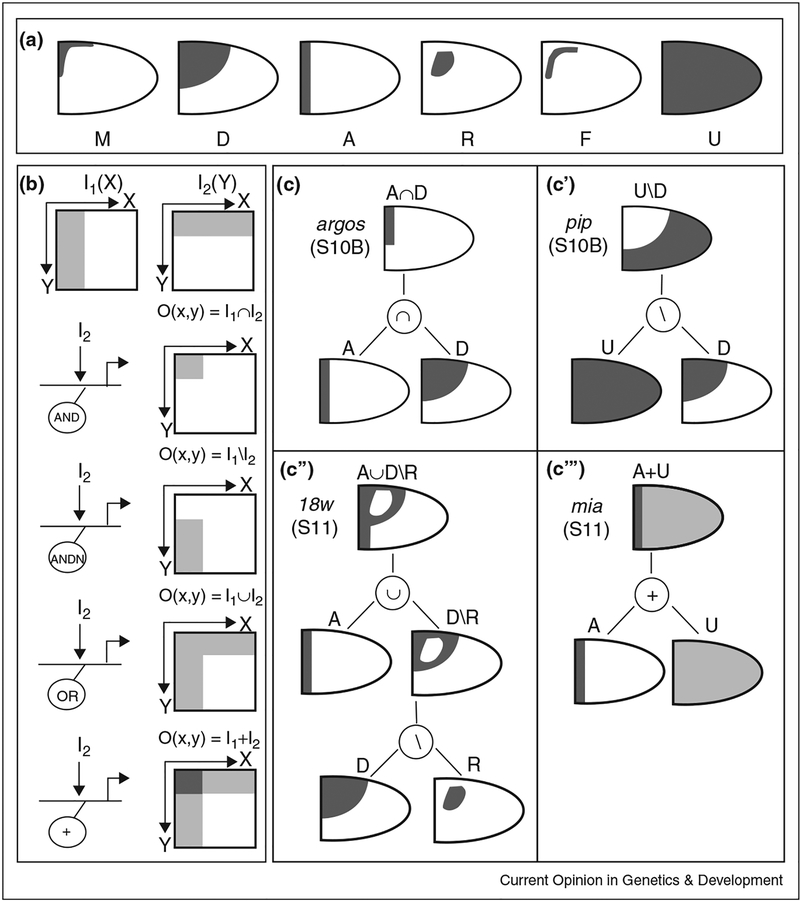
Combinatorial code for pattern formation during Drosophila oogenesis, (a) Lateral views of the six building blocks (primitives) used to describe two- dimension expression patterns in the follicle cells. The M and D primitives reflect the activation gradient of the EGFR pathway, while the A primitive reflects the activation of the DPP pathway, (b) The primitives are combined by the Boolean and arithmetic operations of intersection (∩), difference (\), union (∪) and addition (+). These operations are realized at the c/s-regulatory level by the combined action of one or more inputs and the AND, AND (AND NOT), OR and + logic gates. I/O refer to the input/output, respectively, (c-c’”) Expression patterns of the genes argos, pip, 18w and mia can be constructed from the primitives and the combinatorial operations.
Figure 4
Figure 4
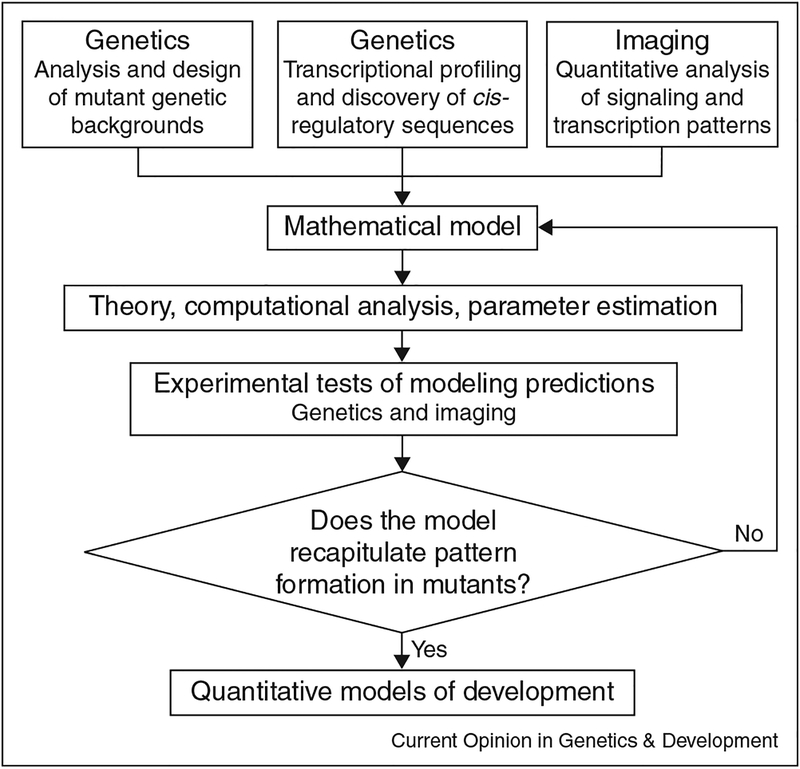
Flowchart summarizing the cycle of model development, computational analysis, and experimental validation.

References

    1. Spradling AC: Developmental genetics of oogenesis The Development of Drosophila melanogaster. Plainview: Cold Spring Harbor Laboratory Press; 1993:. 1–70.
    1. Nilson LA, Schupbach T: EGF receptor signaling in Drosophila oogenesis. Curr Top Dev Biol 1999, 44:203–243. - PubMed
    1. Gonzalez-Reyes A, St Johnston D: Patterning of the follicle cell epithelium along the anterior-posterior axis during Drosophila oogenesis. Development 1998, 125:2837–2846. - PubMed
    1. Neuman-Silberberg FS, Schupbach T: Dorsoventral axis formation in Drosophila depends on the correct dosage of the gene Gurken. Development 1994, 120:2457–2463. - PubMed
    1. Pai L, Barcelo G, Schupbach T: D-cbl, negative regulator of the Egfr pathway, is required for dorsoventral patterning in Drosophila oogenesis. Cell 2000, 103:51–61. - PubMed

MeSH terms

Substances

LinkOut - more resources