Review
. 2011 Oct;15(5):636-42.
doi: 10.1016/j.cbpa.2011.07.019. Epub 2011 Aug 20.

RNA helicases and remodeling proteins

Affiliations
Review

RNA helicases and remodeling proteins

Anna Marie Pyle. Curr Opin Chem Biol. 2011 Oct.

Abstract

It is becoming increasingly clear that RNA molecules play a major role in all aspects of metabolism. The conformational state and stability of RNA are controlled by RNA remodeling proteins, which are ubiquitous motor proteins in the cell. Here, we review advances in our understanding of the structure and function of three major structural families of RNA remodeling proteins, the hexameric ring proteins, the processive monomeric RNA translocase/helicases, and the functionally diverse DEAD-box remodeling proteins. New studies have revealed molecular mechanisms for coupling between ATP hydrolysis and unwinding, the physical basis for regulatory control by cofactors, and novel functions for RNA remodeling proteins.


Figures

Figure 1
Figure 1
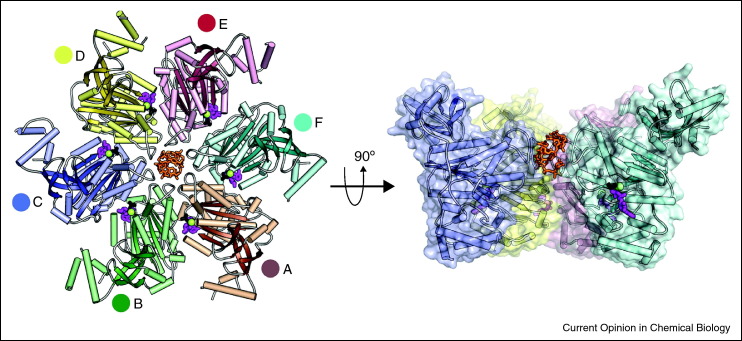
The hexameric Rho helicase bound to an RNA translocation substrate and ATP analogs. On the left is a top-down view of single-stranded RNA threading through the hexameric ring. The ATP analog ADP-BeF3 (pink) is bound at the interface of each RecA-fold subunit. There is an increasing level of engagement with ADP-BeF3 as one progresses from subunits F to B, signifying their respective place in each hydrolysis/translocation cycle.
Figure 2
Figure 2
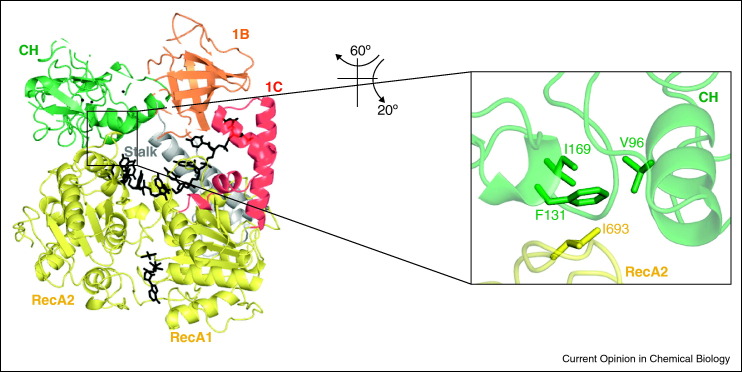
Structure of Upf1 containing the CH and 1B domains. These domains (green and orange, respectively) help the RecA folds (yellow) to clamp down on the RNA molecule (black). Note the interface between the CH domain and the RecA2 domain (inset).
Figure 3
Figure 3
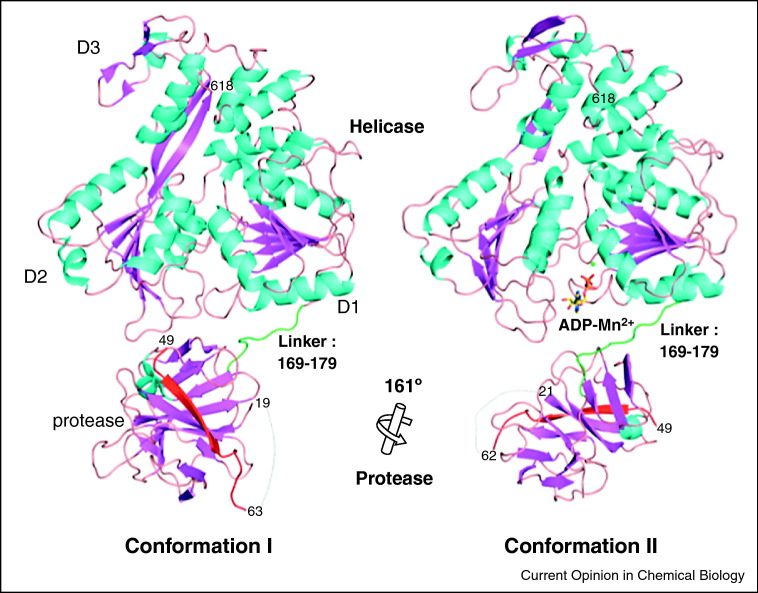
Two conformations of the NS3 protein from Dengue virus. In both conformations, the protease domain is located beneath Domains 1 and 2, but it has been visualized in two possible rotational conformations, which differ in their ability to interact with nucleotide.
Figure 4
Figure 4
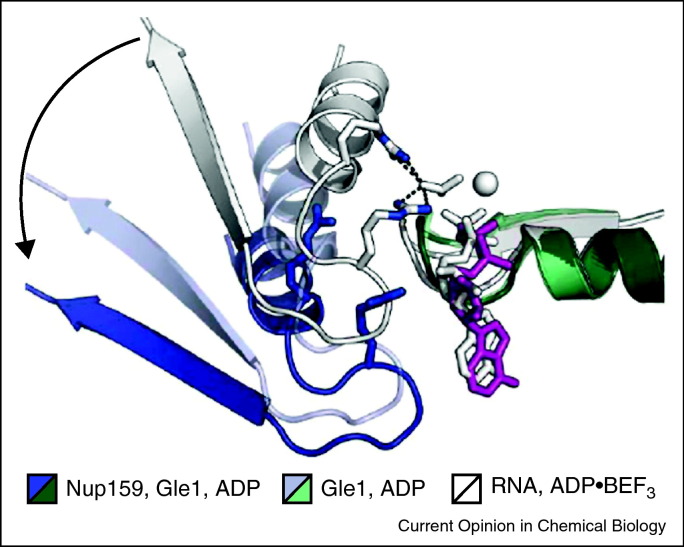
Cofactors modulate the active site of Dbp5: the C-terminal domain of Dbp5 moves from an active state that is engaged with nucleotide (white), to a progressively inactive state in the presence of Nup159 (purple), where a catalytically essential arginine is completely displaced.

References

    1. Birney E., Stamatoyannopoulos J.A., Dutta A., Guigo R., Gingeras T.R., Margulies E.H., Weng Z., Snyder M., Dermitzakis E.T., Thurman R.E. Identification and analysis of functional elements in 1% of the human genome by the ENCODE pilot project. Nature. 2007;447:799–816. - PMC - PubMed
    1. Giuliodori A.M., Di Pietro F., Marzi S., Masquida B., Wagner R., Romby P., Gualerzi C.O., Pon C.L. The cspA mRNA is a thermosensor that modulates translation of the cold-shock protein CspA. Mol Cell. 2010;37:21–33. - PubMed
    1. Kortmann J., Sczodrok S., Rinnenthal J., Schwalbe H., Narberhaus F. Translation on demand by a simple RNA-based thermosensor. Nucleic Acids Res. 2011;39:2855–2868. - PMC - PubMed
    1. Owttrim G.W. RNA helicases and abiotic stress. Nucleic Acids Res. 2006;34:3220–3230. - PMC - PubMed
    1. Linder P., Owttrim G.W. Plant RNA helicases: linking aberrant and silencing RNA. Trends Plant Sci. 2009;14:344–352. - PubMed

Publication types

LinkOut - more resources