. 2011 Nov;62(15):5607-21.
doi: 10.1093/jxb/err245. Epub 2011 Aug 23.

Lignin metabolism has a central role in the resistance of cotton to the wilt fungus Verticillium dahliae as revealed by RNA-Seq-dependent transcriptional analysis and histochemistry

Affiliations

Lignin metabolism has a central role in the resistance of cotton to the wilt fungus Verticillium dahliae as revealed by RNA-Seq-dependent transcriptional analysis and histochemistry

Li Xu et al. J Exp Bot. 2011 Nov.

Abstract

The incompatible pathosystem between resistant cotton (Gossypium barbadense cv. 7124) and Verticillium dahliae strain V991 was used to study the cotton transcriptome changes after pathogen inoculation by RNA-Seq. Of 32,774 genes detected by mapping the tags to assembly cotton contigs, 3442 defence-responsive genes were identified. Gene cluster analyses and functional assignments of differentially expressed genes indicated a significant transcriptional complexity. Quantitative real-time PCR (qPCR) was performed on selected genes with different expression levels and functional assignments to demonstrate the utility of RNA-Seq for gene expression profiles during the cotton defence response. Detailed elucidation of responses of leucine-rich repeat receptor-like kinases (LRR-RLKs), phytohormone signalling-related genes, and transcription factors described the interplay of signals that allowed the plant to fine-tune defence responses. On the basis of global gene regulation of phenylpropanoid metabolism-related genes, phenylpropanoid metabolism was deduced to be involved in the cotton defence response. A closer look at the expression of these genes, enzyme activity, and lignin levels revealed differences between resistant and susceptible cotton plants. Both types of plants showed an increased level of expression of lignin synthesis-related genes and increased phenylalanine-ammonia lyase (PAL) and peroxidase (POD) enzyme activity after inoculation with V. dahliae, but the increase was greater and faster in the resistant line. Histochemical analysis of lignin revealed that the resistant cotton not only retains its vascular structure, but also accumulates high levels of lignin. Furthermore, quantitative analysis demonstrated increased lignification and cross-linking of lignin in resistant cotton stems. Overall, a critical role for lignin was believed to contribute to the resistance of cotton to disease.


Figures
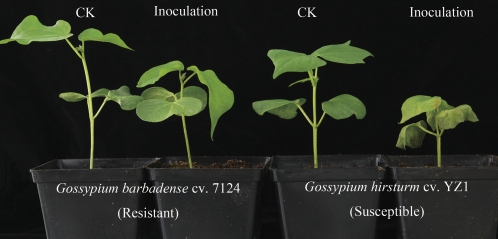
Fig. 1.
Fig. 1.
Growth and disease symptoms on both resistant and susceptible cotton plants 14 d after V. dahliae inoculation.
Fig. 2.
Fig. 2.
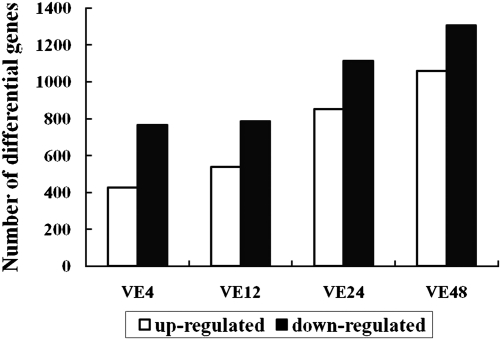
Number of differentially expressed genes at different times after inoculation. Ve4, Ve12, Ve24, and Ve48 refer to 4, 12, 24, and 48 h after inoculation with V. dahliae.
Fig. 3.
Fig. 3.
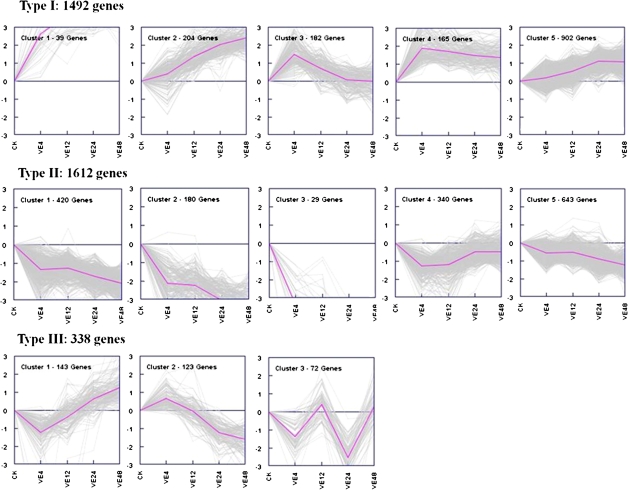
Cluster analysis was developed by the K-means method on the gene expression profiles. CK indicates the mock control, and Ve4, Ve12, Ve24, and Ve48 refer to 4, 12, 24, and 48 h after inoculation with V. dahliae. (This figure is available in colour at JXB online.)
Fig. 4.
Fig. 4.
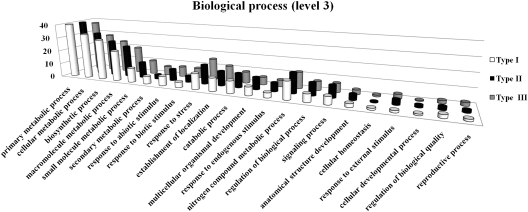
GO functional classification analysis on each type of gene. Histograms represent the functional distribution, which is expressed as a percentage of the amount of genes. Type I, II, and III are indicated as in Fig. 3.
Fig. 5.
Fig. 5.
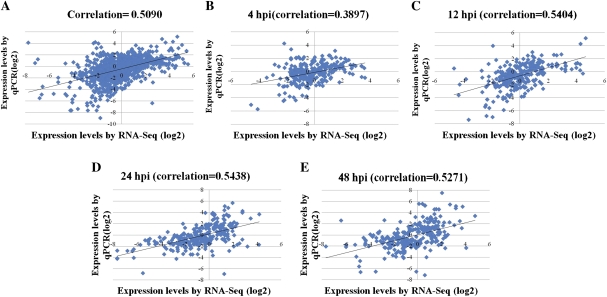
Correlations between RNA-Seq and qPCR for different time points. hpi, hours post-inoculation. (This figure is available in colour at JXB online.)
Fig. 6.
Fig. 6.
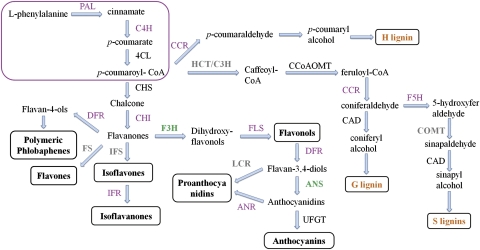
Overview of putative phenylpropanoid pathway involved in cotton and expression profiles of genes involved in this pathway (Ferrer et al., 2008). The box includes the critical enzymes comprising the entry pathway. Enzymes coloured in purple or green indicate the induction or suppression of the genes, respectively. Enzymes in black are those with both increased and decreased transcripts, whereas enzymes shown in grey are those that have not been identified in the present study. PAL, phenylalanine ammonia-lyase; C4H, cinnamate 4-hydroxylase; 4CL, 4-coumarate:CoA ligase; CHS, chalcone synthase; CHI, chalcone isomerase; IFS, isoflavone synthase; IFR, isoflavone reductase; FS, flavone synthases; F3H, flavanone 3-hydroxylase; FLS, flavonol synthase; DFR, dihydroflavonol-4-reductase; ANS, anthocyanidin synthase; ANR, anthocyanidin reductase; UFGT, UDP-flavonoid glucosyltransferase; C3H, p-coumarate 3 hydroxylase; HCT, hydroxycinnamoyl transferase; CCR, cinnamoyl CoA reductase; CAD, cinnamyl alcohol dehydrogenase; CCoAOMT, caffeoyl-CoA O-methyltransferase.
Fig. 7.
Fig. 7.
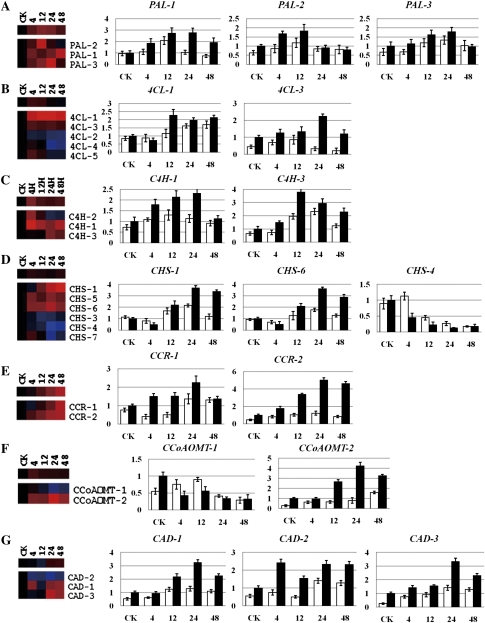
Detailed expression profiles of genes in the major lignin biosynthetic pathway. The relative expression level was obtained by RNA-Seq after taking the equation and logarithmic transformations of TPM, and also by qPCR for data verification. White and black columns refer to G. hirsutum (susceptible) and G. barbadense (resistant), respectively. Error bars represent the SD for three independent experiments, and three technical replicates were analysed. CK, 4, 12, 24, and 48 on the x-axis refer to control and 4, 12, 24, and 48 h after inoculation with V. dahliae. The y-axis represents the relative expression level. (A) PAL, phenylalanine ammonia-lyase; (B) 4CL, 4-coumarate:CoA ligase; (C) C4H, cinnamate 4-hydroxylase; (D) CHS, chalcone synthase; (E) CCR, cinnamoyl CoA reductase; (F) CCoAOMT, caffeoyl-CoA O-methyltransferase; (G) CAD, cinnamyl alcohol dehydrogenase.
Fig. 8.
Fig. 8.
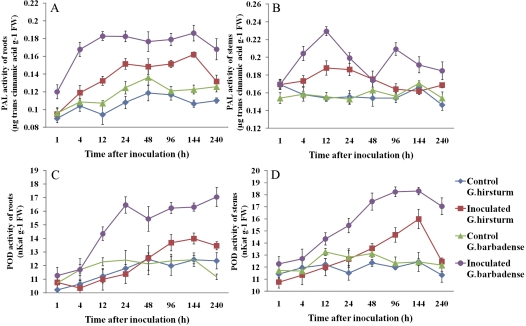
Enzyme activity in roots and stems of both control and inoculated susceptible and resistant cotton plants at different time points after inoculation. (A) PAL, roots; (B) PAL, stems; (C) POD, roots; (D) POD, stems. Error bars represent the SD for three independent experiments. (This figure is available in colour at JXB online.)
Fig. 9.
Fig. 9.
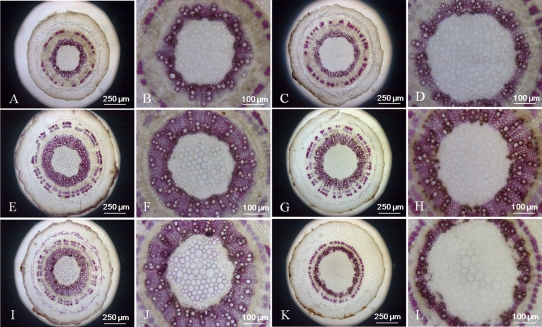
Histochemical analysis of lignin in stem cross-sections of control and V. dahliae-inoculated cotton plants. Hand-cut cross-sections of stem were stained with Wiesner reagents for detecting lignin. Pink staining with the Wiesner reagent indicates the presence of p-hydroxycinnamyl aldehyde end groups in lignin. (A, B, E, F, I ,J) Sections from control and V. dahliae-inoculated G. barbadense (resistant) stems. (C, D, G, H, K, L) Sections from control and V. dahliae-inoculated G. hirsutum (susceptible) stems. (A–D) Sections from 16-day-old plants before inoculation. (E–H) Sections from control plants 14 d after treatment. (I–K) Sections from inoculated plants 14 d after treatment. Adjustments to magnification and illumination were made to allow optimal viewing of individual sections.

References

    1. Ansorge WJ. Next-generation DNA sequencing techniques. Nature Biotechnology. 2009;25:195–203. - PubMed
    1. Audic S, Claverie JM. The significance of digital gene expression profiles. Genome Research. 1997;7:986–995. - PubMed
    1. Azaiez A, Boyle B, Levee V, Seguin A. Transcriptome profiling in hybrid poplar following interactions with Melampsora rust fungi. Molecular Plant-Microbe Interaction. 2009;22:190–200. - PubMed
    1. Bari R, Jones JD. Role of plant hormones in plant defence responses. Plant Molecular Biology. 2009;69:473–488. - PubMed
    1. Bethel G, Robertson AJ, Perkins AC, et al. Next is now: new technologies for sequencing of genomes, transcriptomes, and beyond. Current Opinion in Plant Biology. 2009;12:107–118. - PMC - PubMed

Publication types

MeSH terms