


Use of hundreds of electrocardiographic biomarkers for prediction of mortality in postmenopausal women: the Women's Health Initiative
- PMID: 21862719
- PMCID: PMC3893688
- DOI: 10.1161/CIRCOUTCOMES.110.959023
Use of hundreds of electrocardiographic biomarkers for prediction of mortality in postmenopausal women: the Women's Health Initiative
Abstract
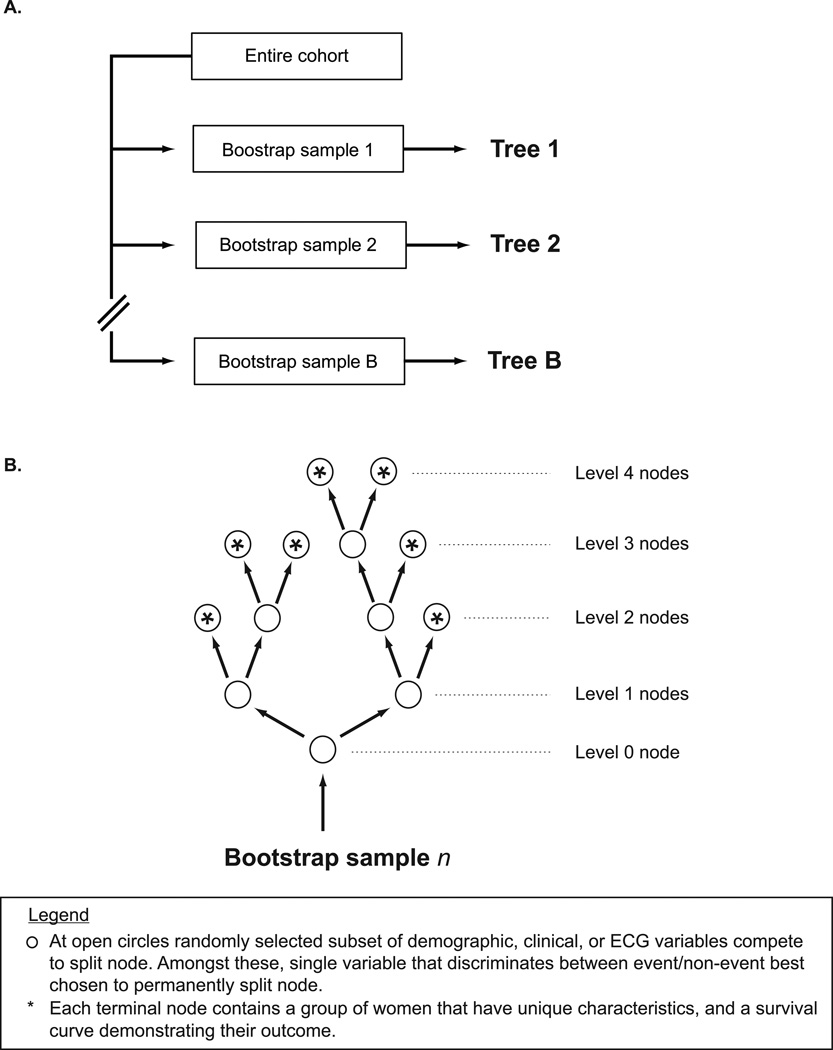
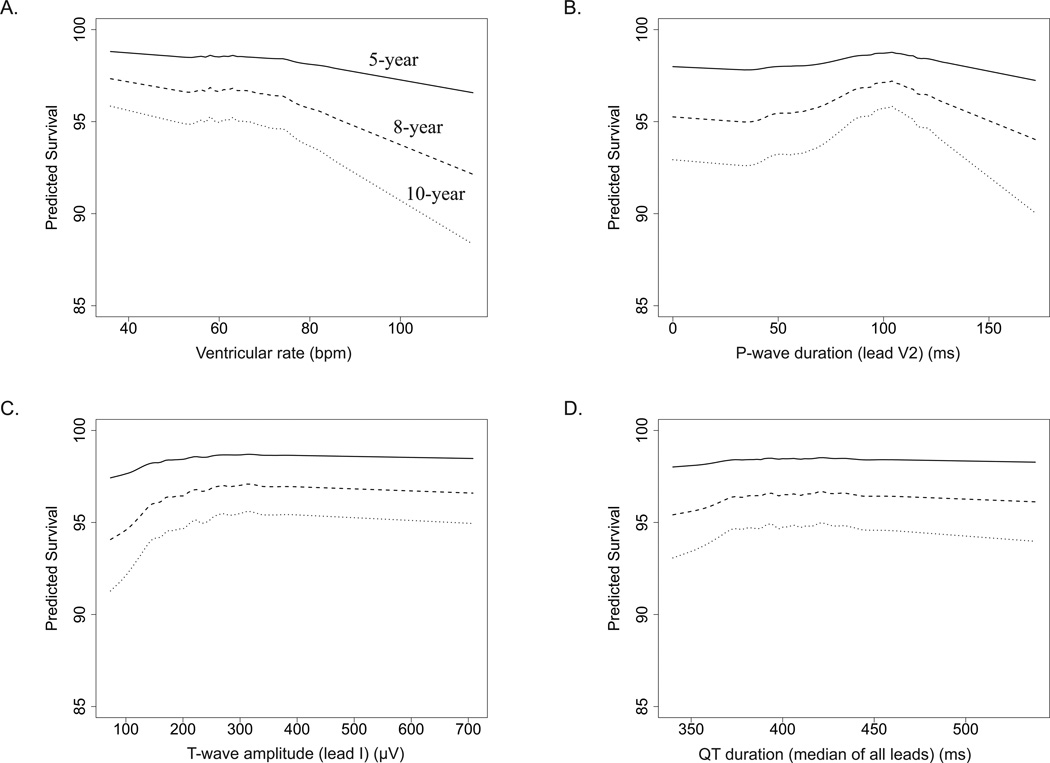
BACKGROUND- Simultaneous contribution of hundreds of electrocardiographic (ECG) biomarkers to prediction of long-term mortality in postmenopausal women with clinically normal resting ECGs is unknown. METHODS AND RESULTS- We analyzed ECGs and all-cause mortality in 33 144 women enrolled in the Women's Health Initiative trials who were without baseline cardiovascular disease or cancer and had normal ECGs by Minnesota and Novacode criteria. Four hundred and seventy-seven ECG biomarkers, encompassing global and individual ECG findings, were measured with computer algorithms. During a median follow-up of 8.1 years (range for survivors, 0.5 to 11.2 years), 1229 women died. For analyses, the cohort was randomly split into derivation (n=22 096; deaths, 819) and validation (n=11 048; deaths, 410) subsets. ECG biomarkers and demographic and clinical characteristics were simultaneously analyzed using both traditional Cox regression and random survival forest, a novel algorithmic machine-learning approach. Regression modeling failed to converge. Random survival forest variable selection yielded 20 variables that were independently predictive of long-term mortality, 14 of which were ECG biomarkers related to autonomic tone, atrial conduction, and ventricular depolarization and repolarization. CONCLUSIONS- We identified 14 ECG biomarkers from among hundreds that were associated with long-term prognosis using a novel random forest variable selection methodology. These biomarkers were related to autonomic tone, atrial conduction, ventricular depolarization, and ventricular repolarization. Quantitative ECG biomarkers have prognostic importance and may be markers of subclinical disease in apparently healthy postmenopausal women.
Conflict of interest statement
None.
Figures


References
-
- Rautaharju PM, Kooperberg C, Larson JC, LaCroix A. Electrocardiographic abnormalities that predict coronary heart disease events and mortality in postmenopausal women: the Women's Health Initiative. Circulation. 2006;113:473–480. - PubMed
-
- Rautaharju PM, Kooperberg C, Larson JC, LaCroix A. Electrocardiographic predictors of incident congestive heart failure and all-cause mortality in postmenopausal women: the Women's Health Initiative. Circulation. 2006;113:481–489. - PubMed
-
- Denes P, Larson JC, Lloyd-Jones DM, Prineas RJ, Greenland P. Major and minor ECG abnormalities in asymptomatic women and risk of cardiovascular events and mortality. Jama. 2007;297:978–985. - PubMed
-
- Zhang ZM, Prineas RJ, Eaton CB. Evaluation and comparison of the Minnesota Code and Novacode for electrocardiographic Q-ST wave abnormalities for the independent prediction of incident coronary heart disease and total mortality (from the Women's Health Initiative) The American journal of cardiology. 2010;106:18–25. e12. - PubMed
-
- Iuliano S, Fisher SG, Karasik PE, Fletcher RD, Singh SN. QRS duration and mortality in patients with congestive heart failure. American heart journal. 2002;143:1085–1091. - PubMed
Publication types
MeSH terms
Substances
Grants and funding
LinkOut - more resources
Full Text Sources
Other Literature Sources
