


Stabilisation of p53 enhances reovirus-induced apoptosis and virus spread through p53-dependent NF-κB activation
- PMID: 21863032
- PMCID: PMC3185941
- DOI: 10.1038/bjc.2011.325
Stabilisation of p53 enhances reovirus-induced apoptosis and virus spread through p53-dependent NF-κB activation
Abstract
Background: Naturally oncolytic reovirus preferentially kills cancer cells, making it a promising cancer therapeutic. Mutations in tumour suppressor p53 are prevalent in cancers, yet the role of p53 in reovirus oncolysis is relatively unexplored.
Methods: Human cancer cell lines were exposed to Nutlin-3a, reovirus or a combination of the two and cells were processed for reovirus titration, western blot, real-time PCR and apoptosis assay using Annexin V and 7-AAD staining. Confocal microscopy was used to determine translocation of the NF-κB p65 subunit.
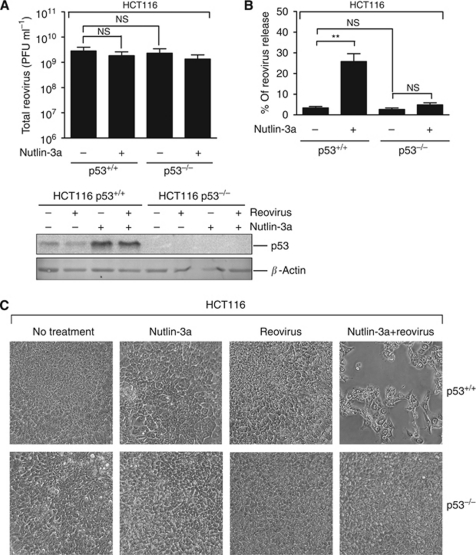
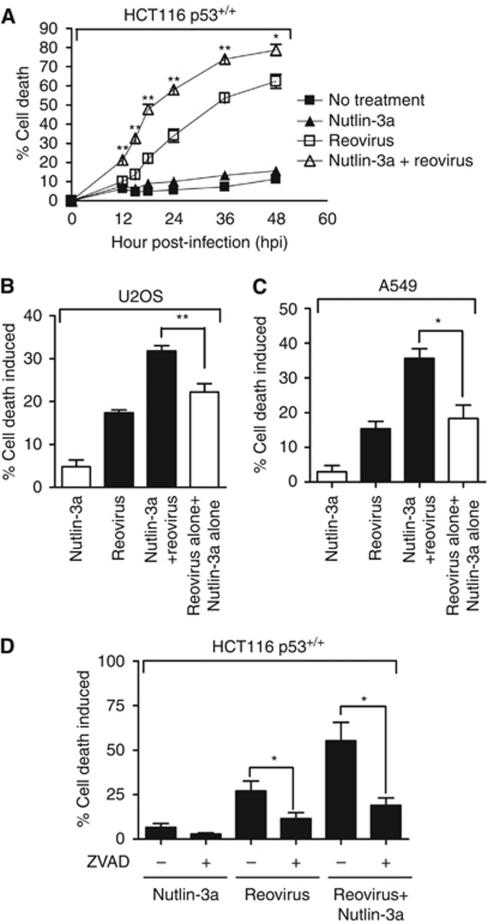
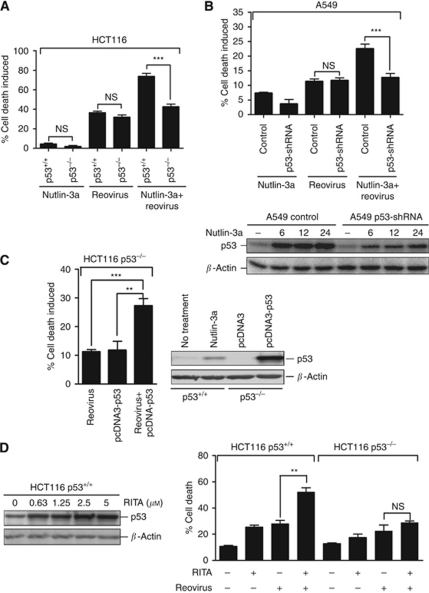
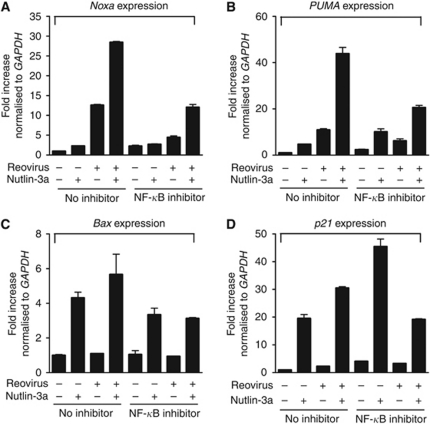
Results: We show that despite similar reovirus replication in p53(+/+) and p53(-/-) cells, stabilisation of p53 by Nutlin-3a significantly enhanced reovirus-induced apoptosis and hence virus release and dissemination while having no direct effect on virus replication. Enhanced apoptosis by Nutlin-3a was not observed in p53(-/-) or p53 knockdown cells; however, increased expression of Bax and p21 are required. Moreover, elevated NF-κB activation in reovirus-infected cells following Nutlin-3a treatment was necessary for enhanced reovirus-induced apoptosis, as synergistic cytotoxicity was overcome by specific NF-κB inhibitors.
Conclusion: Nutlin-3a treatment enhances reovirus-induced apoptosis and virus spread through p53-dependent NF-κB activation, and combination of reovirus and Nutlin-3a might represent an improved therapy against cancers harbouring wild-type p53.
Figures



References
-
- Alain T, Hirasawa K, Pon KJ, Nishikawa SG, Urbanski SJ, Auer Y, Luider J, Martin A, Johnston RN, Janowska-Wieczorek A, Lee PW, Kossakowska AE (2002) Reovirus therapy of lymphoid malignancies. Blood 100: 4146–4153 - PubMed
-
- Brown CJ, Lain S, Verma CS, Fersht AR, Lane DP (2009) Awakening guardian angels: drugging the p53 pathway. Nat Rev Cancer 9: 862–873 - PubMed
-
- Bunz F, Dutriaux A, Lengauer C, Waldman T, Zhou S, Brown JP, Sedivy JM, Kinzler KW, Vogelstein B (1998) Requirement for p53 and p21 to sustain G2 arrest after DNA damage. Science 282: 1497–1501 - PubMed
Publication types
MeSH terms
Substances
Grants and funding
LinkOut - more resources
Full Text Sources
Research Materials
Miscellaneous
