


Mortality reduction by heart rate characteristic monitoring in very low birth weight neonates: a randomized trial
- PMID: 21864846
- PMCID: PMC3215822
- DOI: 10.1016/j.jpeds.2011.06.044
Mortality reduction by heart rate characteristic monitoring in very low birth weight neonates: a randomized trial
Abstract
Objective: To test the hypothesis that heart rate characteristics (HRC) monitoring improves neonatal outcomes.
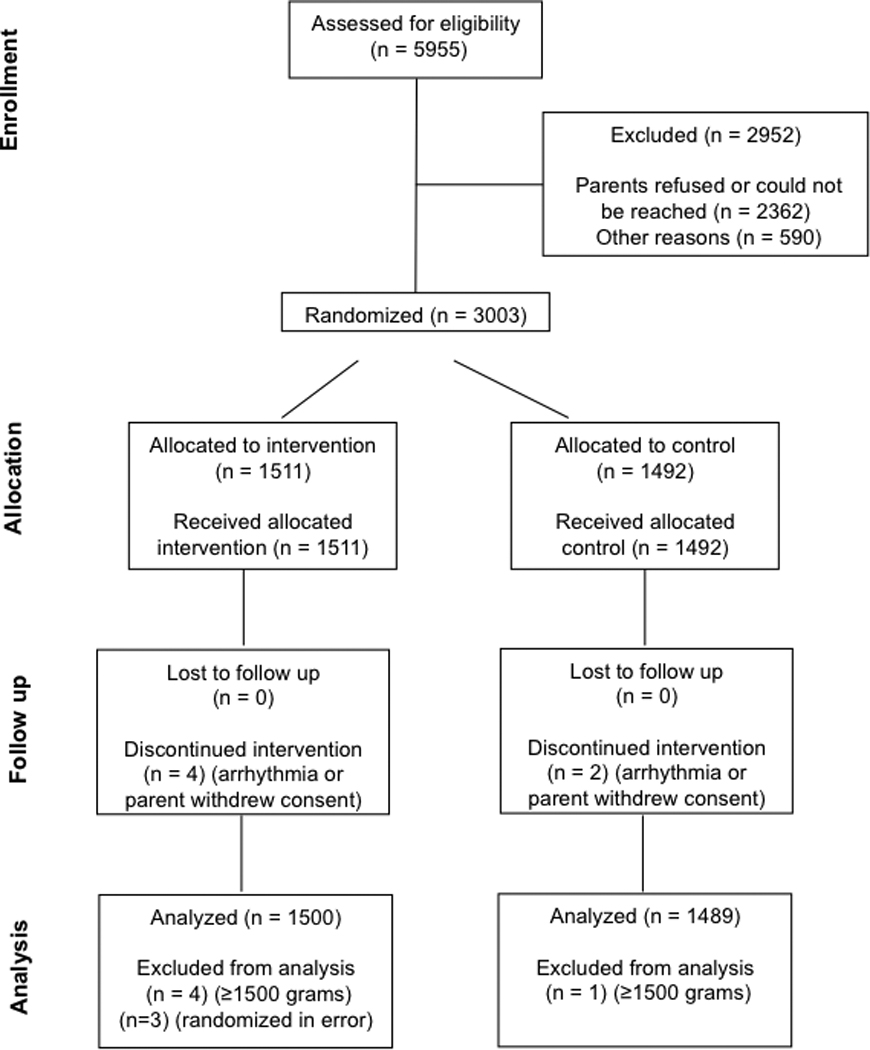
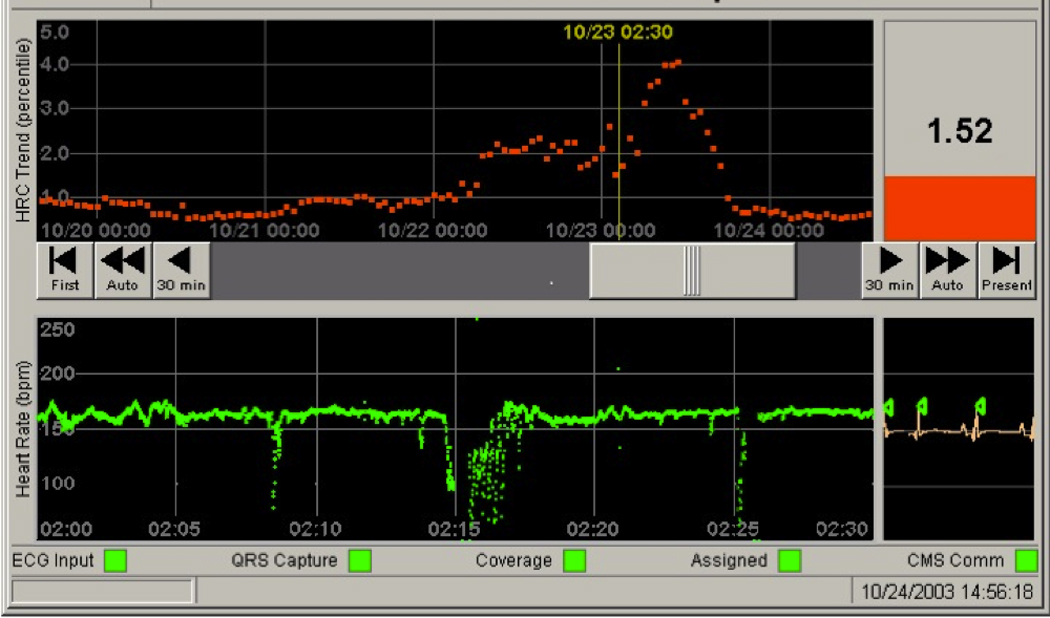
Study design: We conducted a two-group, parallel, individually randomized controlled clinical trial of 3003 very low birth weight infants in 9 neonatal intensive care units. In one group, HRC monitoring was displayed; in the other, it was masked. The primary outcome was number of days alive and ventilator-free in the 120 days after randomization. Secondary outcomes were mortality, number of ventilator days, neonatal intensive care unit stay, and antibiotic use.
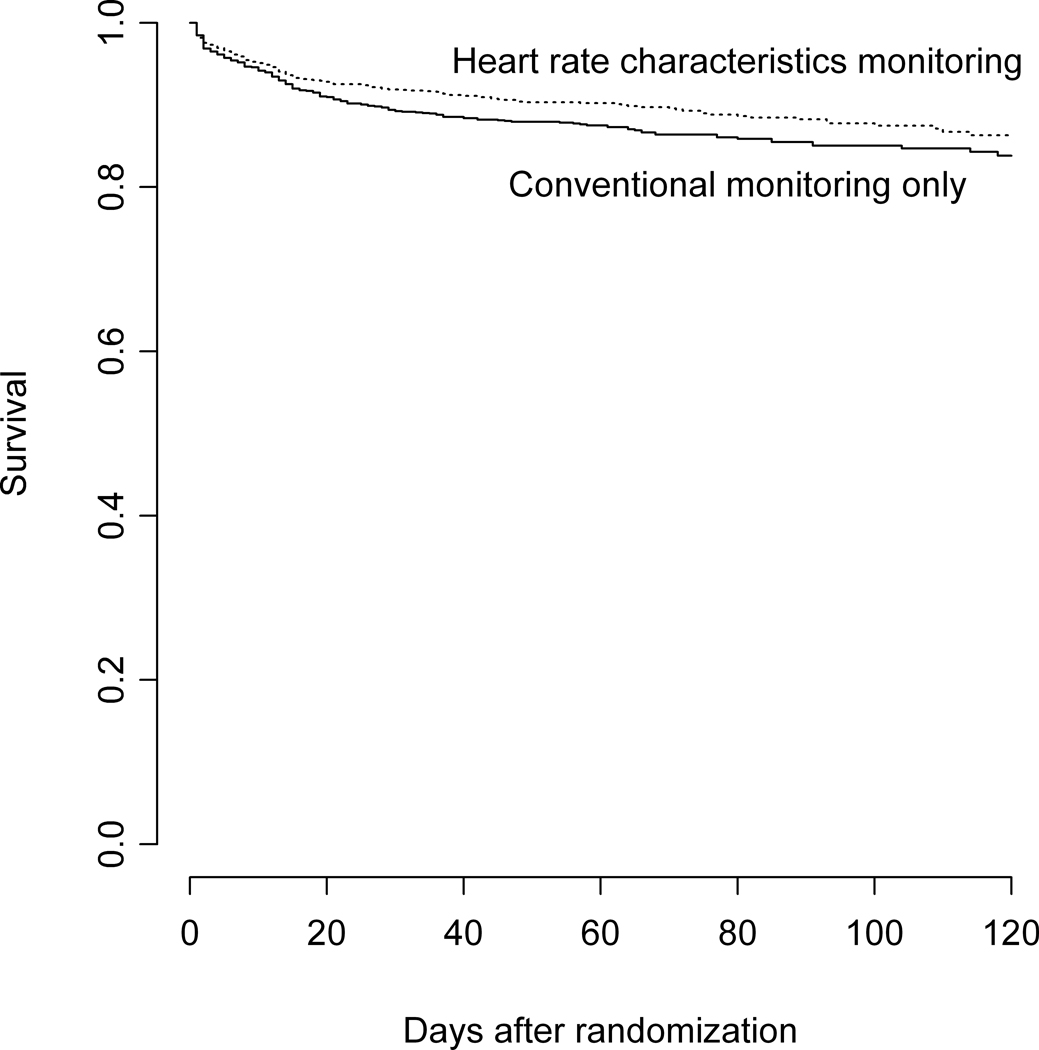
Results: The mortality rate was reduced in infants whose HRC monitoring was displayed, from 10.2% to 8.1% (hazard ratio, 0.78; 95% CI, 0.61-0.99; P = .04; number needed to monitor = 48), and there was a trend toward increased days alive and ventilator-free (95.9 of 120 days compared with 93.6 in control subjects, P = .08). The mortality benefit was concentrated in infants with a birth weight <1000 g (hazard ratio, 0.74; 95% CI, 0.57-0.95; P = .02; number needed to monitor = 23). There were no significant differences in the other outcomes.
Conclusion: HRC monitoring can reduce the mortality rate in very low birth weight infants.
Trial registration: ClinicalTrials.gov NCT00307333.
Copyright © 2011 Mosby, Inc. All rights reserved.
Figures
Comment in
-
Heart rate characteristic monitoring-HeRO or villain?J Pediatr. 2011 Dec;159(6):885-6. doi: 10.1016/j.jpeds.2011.08.049. Epub 2011 Oct 6. J Pediatr. 2011. PMID: 21982302 No abstract available.
-
Heart rate predicts sepsis.J Pediatr. 2012 Oct;161(4):770; author reply 770. doi: 10.1016/j.jpeds.2012.07.001. Epub 2012 Aug 15. J Pediatr. 2012. PMID: 22901737 No abstract available.
References
-
- Stoll BJ, Hansen N, Fanaroff AA, Wright LL, Carlo WA, Ehrenkranz RA, et al. Late-onset sepsis in very low birth weight neonates: the experience of the NICHD Neonatal Research Network. Pediatrics. 2002;110:285–291. - PubMed
-
- Fanaroff AA, Korones SB, Wright LL, Verter J, Poland RL, Bauer CR, et al. Incidence, presenting features, risk factors and significance of late onset septicemia in very low birth weight infants. The National Institute of Child Health and Human Development Neonatal Research Network. Pediatr.Infect.Dis.J. 1998;17:593–598. - PubMed
-
- Griffin MP, Moorman JR. Toward the early diagnosis of neonatal sepsis and sepsis-like illness using novel heart rate analysis. Pediatrics. 2001;107:97–104. - PubMed
Publication types
MeSH terms
Associated data
Grants and funding
LinkOut - more resources
Full Text Sources
Other Literature Sources
Medical
