. 2011 Aug 24;31(34):12297-306.
doi: 10.1523/JNEUROSCI.1568-11.2011.

Single synapse information coding in intraburst spike patterns of central pattern generator motor neurons

Affiliations

Single synapse information coding in intraburst spike patterns of central pattern generator motor neurons

Ludmila Brochini et al. J Neurosci. .

Abstract

Burst firing is ubiquitous in nervous systems and has been intensively studied in central pattern generators (CPGs). Previous works have described subtle intraburst spike patterns (IBSPs) that, despite being traditionally neglected for their lack of relation to CPG motor function, were shown to be cell-type specific and sensitive to CPG connectivity. Here we address this matter by investigating how a bursting motor neuron expresses information about other neurons in the network. We performed experiments on the crustacean stomatogastric pyloric CPG, both in control conditions and interacting in real-time with computer model neurons. The sensitivity of postsynaptic to presynaptic IBSPs was inferred by computing their average mutual information along each neuron burst. We found that details of input patterns are nonlinearly and inhomogeneously coded through a single synapse into the fine IBSPs structure of the postsynaptic neuron following burst. In this way, motor neurons are able to use different time scales to convey two types of information simultaneously: muscle contraction (related to bursting rhythm) and the behavior of other CPG neurons (at a much shorter timescale by using IBSPs as information carriers). Moreover, the analysis revealed that the coding mechanism described takes part in a previously unsuspected information pathway from a CPG motor neuron to a nerve that projects to sensory brain areas, thus providing evidence of the general physiological role of information coding through IBSPs in the regulation of neuronal firing patterns in remote circuits by the CNS.


Figures
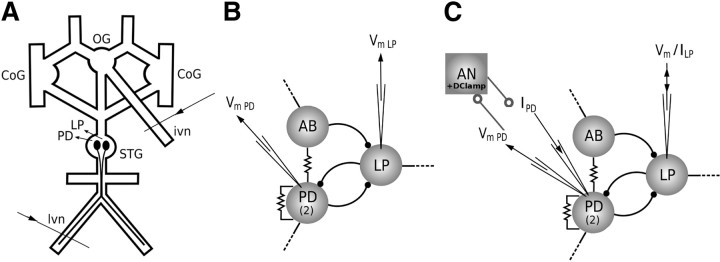
Figure 1.
Figure 1.
Experimental procedures. A, Representation of the whole stomatogastric nervous system in the Petri dish: the two commissural ganglia (CoGs) and the OG are kept in the preparation to provide neuromodulation to the STG. In a set of experiments, extracellular signals are recorded from the lvn, which contains LP spikes, and from the ivn, which connects the STNS to the brain. B, Simplified scheme of the intact pyloric CPG. The pacemaker group is composed of two PD motor neurons that are connected to the anterior burster interneuron (AB) and to each other through electrical synapses. The LP neuron receives inhibitory synapses from the pacemaker group neurons and is the only presynaptic motor neuron to the pacemaker group. C, An inhibitory current ILP is used to hyperpolarize LP while PD is connected to the AN, which mimics ISI variability, number of spikes per burst, and burst duration of the original LP. AN and PD real-time interaction is provided by a dynamic clamp protocol that injects IPSCs from the AN into PD according to a model of synaptic chemical inhibition. One PD neuron is impaled with two electrodes: one to record the membrane potential and the other to inject the artificial IPSCs.
Figure 2.
Figure 2.
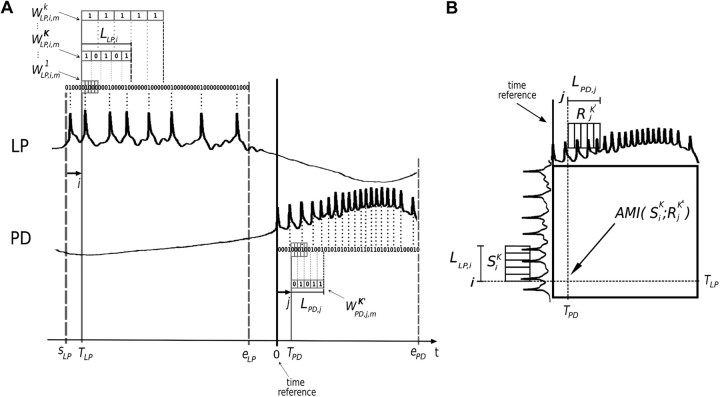
Entropy maximization and AMI representation. A, Illustration of the mth pair of stimulus (LP) burst followed by the response (PD) burst. Time series are resampled into two binary strings in which a bit is set to one or zero according to spike occurrence, depicted above LP or below PD neuron trace, respectively. The time reference (thick vertical line) is set at the first spike of the PD burst for each pair of bursts. The start and end of LP (sLP and eLP, respectively) and the end of PD (ePD) bursts are chosen according to statistics over the whole time series. Five bits words are formed beginning at the string bit pointed by i or j. The first stimulus word W1LP,i,m is composed of the sequence of five bits starting at the i pointer position. The resampling parameter k is used to select words of larger bins (W1LP,i,m, W2LP,i,m, … , WKLP,i,m,… ); this way, the words represent a larger portion of the burst. Note that for very small k, the words have almost all bits equal to zero and for very large k, the words have almost all bits equal to one, producing small entropy values. k = K provides the stimulus set SiK = (WKLP,i,1, WKLP,i,2, … , WKLP,i,m, .., WKLP,i,N) that maximizes entropy. LLP,i (LPD,j) is the word duration associated with the stimulus (response) set. It measures the portion of the burst that SiK (or RiK′) represents and can vary along the burst. B, Schematic representation of AMI graphs: AMI(SiK, RjK') is computed for all possible pairs of pointers (i, j) according to the procedure described in A.
Figure 3.
Figure 3.
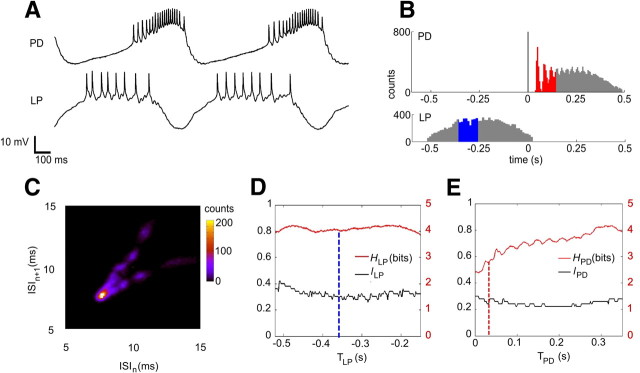
Time series, spike distributions, ISI signature, and entropies. A, Sample of LP and PD neurons time series presenting a typical antiphasic periodic bursting behavior. Spike rate of PD neuron is not uniform along the PD burst: from the beginning to the middle of the burst ISIs get progressively smaller and from the middle to the end of the burst, ISIs get progressively larger. B, Spike distributions of PD and LP using the first spike of each PD burst as time reference. The first spikes of PD occur in a well defined sequence that becomes less reliable along the burst. The distribution portion corresponding to the set of words of maximum local entropy for TPD = 0.03 s is shown in red. Because of the time reference chosen, the distribution of LP spikes is much less precise. The distribution portion corresponding to the set of words of maximum local entropy for TLP = −0.36 s is shown in blue. C, Intraburst ISI first return map showing clusters organized in a V-shape signature, characteristic of the PD. The clusters apparently present no inner structured pattern. D, Entropy HLP (in bits, right y-axis) and lLP (dimensionless, left y-axis); word duration is normalized by the LP burst duration. The blue dashed line is an example where TLP = −0.36 s corresponds to HLP = 4.0 bits and the set of words that maximizes entropy has a word duration lLP = 0.3 (30% of LP burst). E, Same as D but for PD bursts. The red dashed line indicates TPD = 0.03 s that corresponds to HPD = 2.8 bits and the set of words that maximized the entropy has a word duration lPD = 0.22 (22% of the PD burst). HLP is approximately four bits along all LP burst while HPD increases from 2.5 to four bits along the PD burst. The entropies are smooth but not homogeneously distributed along the bursts. l is also smooth for each neuron but there is no simple relation between H and l.
Figure 4.
Figure 4.
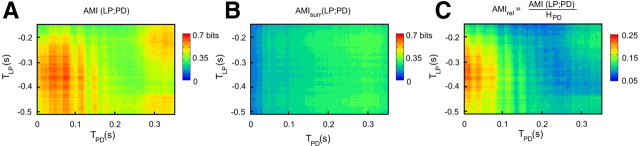
Average mutual information. A, Matrix of local AMI values calculated for LP and PD in bits. TLP and TPD (in seconds) are the time indexes that vary along the neurons bursts. As the first spike of PD is used as time reference, TPD is always positive and TLP has negative values. There is a strong peak of 0.66 bits at (0.03, −0.36) s. B, AMI from LP to PD using surrogate sets where LP bursts order was scrambled. The surrogate matrix has a much lower amplitude, meaning that the peak observed in A is due to the causality relation between LP and PD: the PD neuron changes its IBSPs according to the input previously received from LP. C, AMIrel = AMI/HPD, which gives how much of the PD informational capacity is dedicated to encode LP stimuli.
Figure 5.
Figure 5.
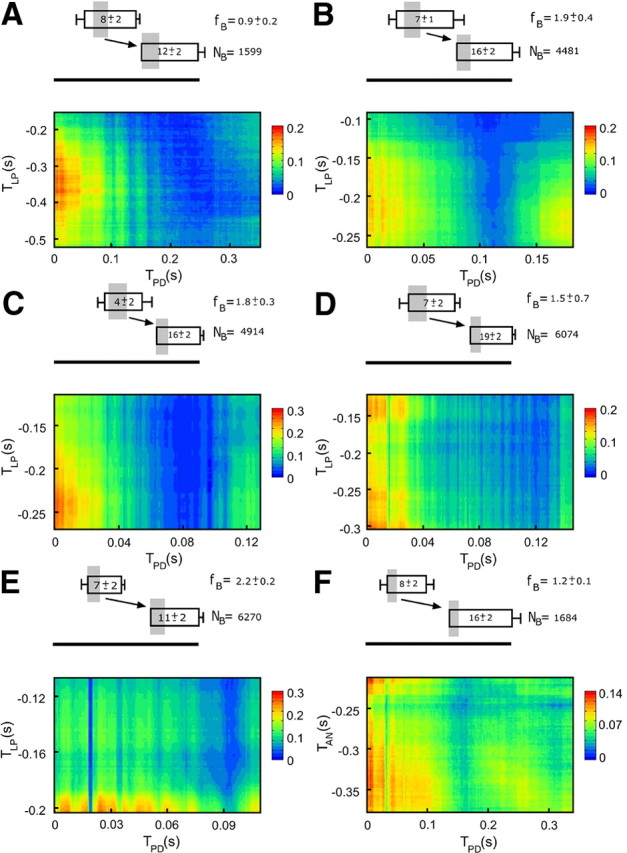
AMIrel results in different preparations for experiments with LP and PD neurons. A–D, Preparations with the intact circuit of Callinectes sapidus. E, Preparations with the intact circuit of Panullirus interruptus. F, A hybrid circuit in which the LP neuron was replaced by an AN (prepared to mimic the original LP) and connected to PD through an artificial inhibitory synapse. Above each graph is a representation of the LP (upper box) and PD (lower box) average bursting duration and phases (time reference in the first spike of the PD bursts). The lateral bars represent SDs. The size of rectangles were normalized to the bursting period (horizontal bar with the same length for all maps). Bursting frequency (fB in Hertz) and the number of pairs of bursts (NB) used in the analysis are also indicated in each case. The average number of spikes/burst of each neuron is indicated inside each rectangle. Gray shading represents the portions of the bursts that correspond to the maximum peak of AMIrel, and the arrow points the direction of information flow from LP to PD. AMIrel peaks correspond to the beginning of both LP and PD bursts in all cases. Results are similar for different animals (with different LP and PD bursting phases, average spike numbers, and pyloric frequencies) and even among different species and are reproduced in hybrid circuit experiments.
Figure 6.
Figure 6.
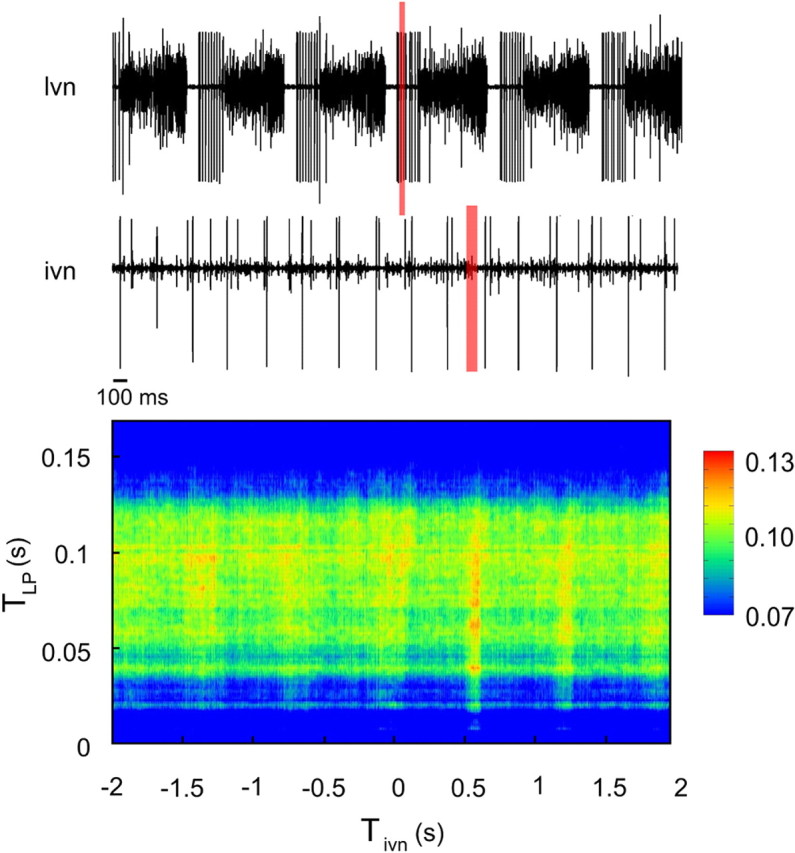
AMIrel between LP neuron and ivn as a function of TLP and Tivn. The upper trace is the extracellular signal obtained from the lvn; we can clearly see and detect the LP spikes (big units). The lower trace is the extracellular signal recorded from the ivn. The peak of AMIrel lies at Tivn ∼0.6 s. The red shaded rectangles represent portions of the LP and ivn signals that correspond to the AMIrel peak.

References

    1. Ayers J, Selverston AI. Synaptic perturbation and entrainment of gastric mill rhythm of the spiny lobster. J Neurophysiol. 1984;51:113–125. - PubMed
    1. Bair W, Koch C. Temporal precision of spike trains in extrastriate cortex of the behaving macaque monkey. Neural Comput. 1996;8:1185–1202. - PubMed
    1. Böhm H, Dybek E, Heizel HG. Anatomy and in vivo activity of neurons connecting the crustacean stomatogastric nervous system to the brain. J Comp Physiol A. 2001;187:392–403. - PubMed
    1. Borst A, Theunissen FE. Information theory and neural coding. Nat Neurosci. 1999;2:947–957. - PubMed
    1. Brocard F, Tazerart S, Vinay L. Do pacemakers drive the central pattern generator for locomotion in mammals? Neuroscientist. 2010;16:139–155. - PubMed

Publication types

MeSH terms

LinkOut - more resources