Comparative Study
. 2011 Nov;301(5):R1440-52.
doi: 10.1152/ajpregu.00298.2011. Epub 2011 Aug 24.

Skeletal muscle proteomics: carbohydrate metabolism oscillates with seasonal and torpor-arousal physiology of hibernation

Affiliations
Comparative Study

Skeletal muscle proteomics: carbohydrate metabolism oscillates with seasonal and torpor-arousal physiology of hibernation

Allyson G Hindle et al. Am J Physiol Regul Integr Comp Physiol. 2011 Nov.

Abstract

The physiology of small mammalian hibernators shifts profoundly over a year, from summer homeothermy to winter heterothermy. Torpor-arousal cycles define high-amplitude tissue activity fluctuations in winter, particularly for skeletal muscle, which contributes to the energetically demanding rewarming process via shivering. To better understand the biochemistry underlying summer-winter and torpor-arousal transitions, we applied two-dimensional gel electrophoresis coupled with liquid chromatography/mass spectrometry/mas spectrometry to the soluble proteins from hindlimb muscle of 13-lined ground squirrels (Ictidomys tridecemlineatus) in two summer and six winter states. Two hundred sixteen protein spots differed by sampled state. Significantly, intrawinter protein adjustment was a minor component of the dataset despite large discrepancies in muscle activity level among winter states; rather, the bulk of differences (127/138 unequivocally identified proteins spots) occurred between summer and winter. We did not detect any proteomic signatures of skeletal muscle atrophy in this hibernator nor any differential seasonal regulation of protein metabolism. Instead, adjustments to metabolic substrate preferences dominated the detected proteomic differences. Pathways of carbohydrate metabolism (glycolysis and gluconeogenesis) were summer enriched, whereas the winter proteome was enriched for fatty acid β-oxidation. Nevertheless, our data suggest that some reliance on carbohydrate reserves is maintained during winter. Phosphoglucomutase (PGM1), which reversibly prepares glucose subunits for either glycolysis or glycogenesis, showed apparent winter state-specific phosphorylation. PGM1 was phosphorylated during rewarming and dephosphorylated by interbout arousal, implying that glucose supplements lipid fuels during rewarming. This, along with winter elevation of TCA cycle enzymes, suggests that hindlimb muscles are primed for rapid energy production and that carbohydrates are an important fuel for shivering thermogenesis.


Figures
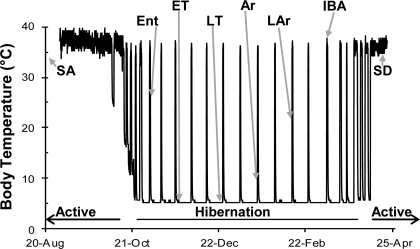
Fig. 1.
Fig. 1.
Body temperature (Tb) of a laboratory-housed 13-lined ground squirrel (Ictidomys tridecemlineatus) over ∼8 mo. The hibernation label identifies the winter heterothermic period and the annual cycle of this species is completed by a spring-fall active period. The physiological state at sampling (n = 8) over the year are indicated by the abbreviations. SA, summer active; Ent, entering torpor; ET, early torpor; LT, late torpor; Ar, early arousing; LAr, late arousing; IBA, interbout aroused, SD, spring dark.
Fig. 2.
Fig. 2.
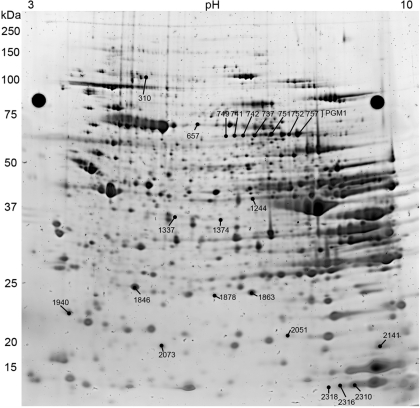
Proteins from a hindlimb muscle sample fractionated by two-dimensional (2D) gel electrophoresis and stained with SYPRO ruby. Reference markers for spot picking are the black circles on the upper portion of the gel on either side. Left: molecular mass ruler (kDa). Top: isoelectric point (pH). All known protein strong contributors to the Random Forests clustering (listed in Table 3) are identified by spot number. Also note the elements of the phosphoglucomutase (PGM1) spot train, which differed significantly among sampling states.
Fig. 3.
Fig. 3.
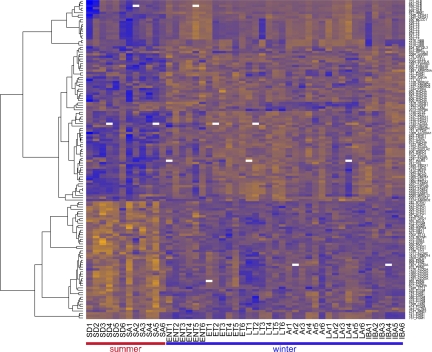
Proteins that differed significantly by ANOVA after multiple test correction and were confidently identified with liquid chromatography/mass spectrometry/mas spectrometry were clustered hierarchically and visualized by heat map. Orange represents higher relative protein abundance, while blue denotes lower. Shown on the x-axis: each sampled animal (see materials and methods for sampled state definitions); y-axis: identified proteins. This heat map reveals a marked switch from a summer to winter skeletal muscle proteome in 13-lined ground squirrels and that the majority of protein abundance increases occur in the winter season.
Fig. 4.
Fig. 4.
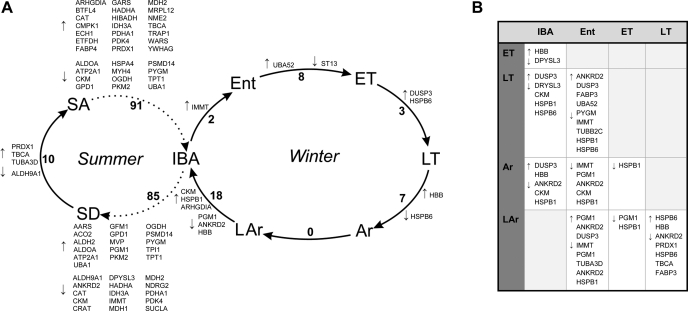
Significant (P < 0.05) state-by-state Tukey post hoc tests demonstrate that the majority of pairwise differences occurred between summer (SA or SD) and winter (IBA) samples from the skeletal muscle of 13-lined ground squirrels. A: consecutive states in which the number of significant pairwise comparisons are indicated along each connecting arrow, as are the unique protein identities, denoted by gene symbol, which increased (↑) or decreased (↓). A broken arrow connects SA and SD to IBA to indicate their similarity as euthermic states but that animals transition indirectly between them. The number of significant Tukey comparisons is greater than the number of listed proteins because pairwise comparisons could reflect multiple protein spots representing isoforms of the same protein as well as ambiguous or missing protein identifications. As adjustments to winter cellular protein content were often too gradual to elicit significant pairwise significance between consecutive states, proteins with significant abundance change between nonconsecutive states are displayed in B (state comparisons are top row vs. left column in order through the cycle as depicted in A). Sampling states are described fully in materials and methods.
Fig. 5.
Fig. 5.
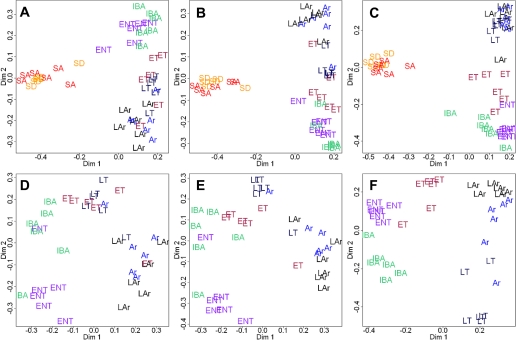
Unsupervised classification by Random Forests (50,000 trees) reveals a distinct summer (SA, SD) vs. winter (Ent, ET, LT, Ar, LAr, IBA) switch (A–C) as well as intrawinter cycling (D–F) in the skeletal muscle proteome of hibernating 13-lined ground squirrels (n = 6 per state, see materials and methods). Patterns of clustering were maintained or improved by limiting the data inputs (left to right), ultimately revealing the minimum number of proteins required to define the states. A (all states) and D (winter only) show Random Forests outputs from all completely matched spots (i.e., present on all analytical gels), while B (all) and E (winter) reflect all 133 of those that were identified. C and D: minimum number of known proteins required for equivalent or improved clustering compared with the expanded data inputs. This was accomplished with 10 protein spots for all states, and 12 proteins for winter states only (listed in Table 3).
Fig. 6.
Fig. 6.
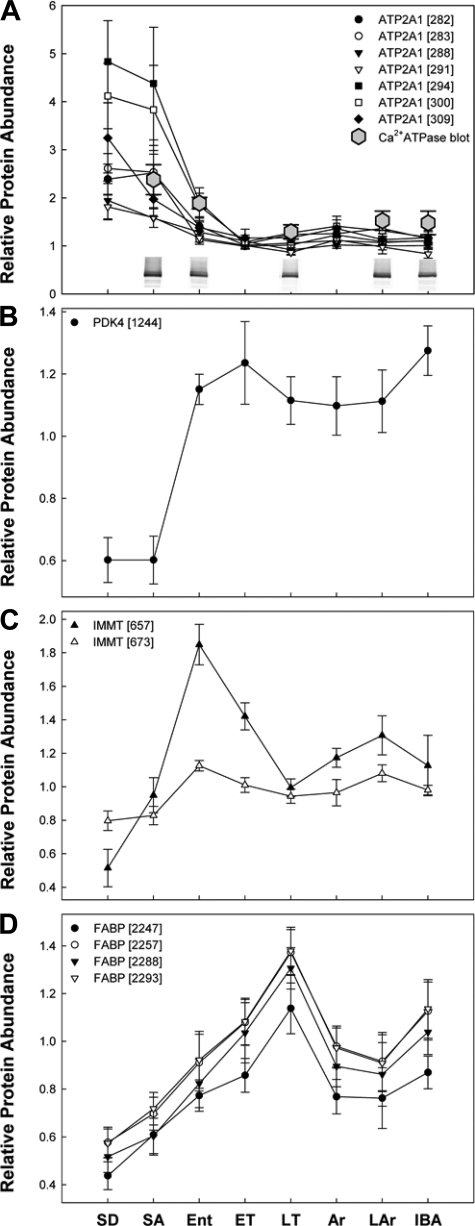
Several patterns of protein abundance among sampling states (x-axis: defined in materials and methods) were observed in the skeletal muscle proteome of 13-lined ground squirrels (n = 6 per state). Ca2+ATPase, (ATP2A1; A) and pyruvate dehydrogenase kinase 4, (PDK4; B) displayed summer to winter reprogramming, a pattern that was the major feature of the dataset. A more limited suite of proteins had altered abundance within the winter hibernation season, being significantly elevated in warm (C; IMMT, mitofilin) or cold-Tb states (D; FABP3, fatty acid binding protein). Relevant spot numbers appear with protein IDs. Western blot analysis quantification of Ca2+ATPase can be found in A (n = 3 per state). Inset: representative lanes from anti-Ca2+ATPase Western blot: lanes from a single blot have been reordered to align with the progression of physiological states and images have not otherwise been retouched. All data are presented means ± SE.
Fig. 7.
Fig. 7.
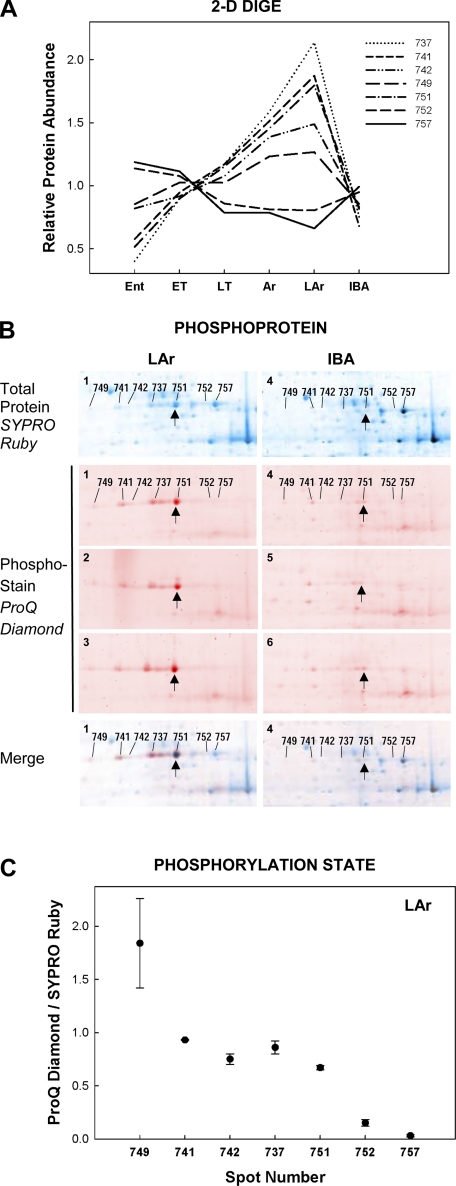
Patterns of relative protein abundance across winter hibernation states, defined in materials and methods, elucidates a mechanism of protein regulation during heterothermy. A: reciprocal Cy2-normalized abundance patterns of 7 protein spots all identified as PGM1 imply that this protein undergoes hibernation state-specific posttranslational modification. Phosphoprotein staining (ProQ Diamond) of 2D gels from n = 3 squirrels in each of 2 winter states [LAr vs. IBA (B)] supports a specific posttranslational modification, phosphorylation, of the more acidic spots (749, 741, 742, 737, 751) in the PGM1 train. B: false-color overlay to compare the SYPRO Ruby total protein stain (blue) with ProQ Diamond phosphoprotein stain (red) and merged images for LAr and IBA. A representative gel from each state poststained for total protein with SYPRO Ruby is labeled for each PGM1 spot. The PGM1 spot train region of each ProQ Diamond-stained gel (LAr 1–3, IBA 4–6) is also shown, along with 1 ProQ Diamond-SYPRO Ruby merged image from each state. Spot 751 is indicated (↑) in each image for comparison. The phospho-forms comprised a larger proportion of the overall PGM1 signature in LAr, while the dephosphorylated forms (752 and 757) were more prevalent in IBA. Quantification of phosphorylation state (ProQ Diamond/SYPRO Ruby staining intensity) is presented for each LAr gel (n = 3 gels stained in sequence, means ± SE; C). Staining intensity for both variables was normalized to the lowest-staining spot on each gel. The general increase in phosphorylation state moving left along the spot train (i.e., toward increasingly acidic protein spots) is expected if the posttranslational modification is indeed phosphorylation.

References

    1. Agostini B, Martino LD, Hasselbach W. On the problem of season and cold dependence of calcium transport by skeletal muscle sarcoplasmic reticulum. Z Naturforsch C 45: 671–675, 1990 - PubMed
    1. Agostini B, Martino LD, Soltau B, Hasselbach W. The modulation of the calcium transport by skeletal muscle sarcoplasmic reticulum in the hibernating European hamster. Z Naturforsch C 46: 1109–1126, 1991 - PubMed
    1. Agrawal GK, Thelen JJ. Development of a simplified, economical polyacrylamide gel staining protocol for phosphoproteins. Proteomics 5: 4684–4688, 2005 - PubMed
    1. Andrews MT. Advances in molecular biology of hibernation in mammals. Bioessays 29: 431–440, 2007 - PubMed
    1. Andrews MT, Russeth KP, Drewes LR, Henry PG. Adaptive mechanisms regulate preferred utilization of ketones in the heart and brain of a hibernating mammal during arousal from torpor. Am J Physiol Regul Integr Comp Physiol 296: R383–R393, 2009 - PMC - PubMed

Publication types

Substances

LinkOut - more resources