


Thirty-day mortality after bariatric surgery: independently adjudicated causes of death in the longitudinal assessment of bariatric surgery
- PMID: 21866378
- PMCID: PMC3249614
- DOI: 10.1007/s11695-011-0497-8
Thirty-day mortality after bariatric surgery: independently adjudicated causes of death in the longitudinal assessment of bariatric surgery
Abstract
Background: Mortality following bariatric surgery is a rare event in contemporary series, making it difficult for any single center to draw meaningful conclusions as to cause of death. Nevertheless, much of the published mortality data come from single-center case series and reviews of administrative databases. These sources tend to produce lower mortality estimates than those obtained from controlled clinical trials. Furthermore, information about the causes of death and how they were determined is not always available. The aim of the present report is to describe in detail all deaths occurring within 30 days of surgery in the Longitudinal Assessment of Bariatric Surgery (LABS).
Methods: LABS is a ten-center observational cohort study of bariatric surgical outcomes. Data were collected prospectively for bariatric surgeries performed between March 2005 and April 2009. All deaths occurring within 30-days of surgery were identified, and cause of death assigned by an independent Adjudication Subcommittee, blinded to operating surgeon and site.
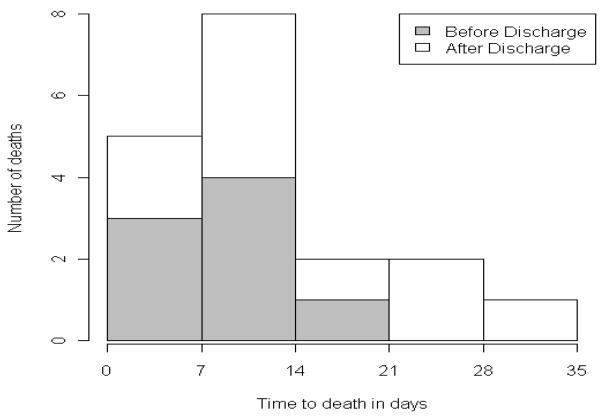
Results: Six thousand one hundred eighteen patients underwent primary bariatric surgery. Eighteen deaths (0.3%) occurred within 30-days of surgery. The most common cause of death was sepsis (33% of deaths), followed by cardiac causes (28%), and pulmonary embolism (17%). For one patient cause of death could not be determined despite examination of all available information.
Conclusions: This study confirms the low 30-day mortality rate following bariatric surgery. The recognized complications of anastomotic leak, cardiac events, and pulmonary emboli accounted for the majority of 30-day deaths.
Figures
References
-
- Flegal KM, Carroll MD, Kuczmarski RJ, Johnson CL. Overweight and obesity in the United States: prevalence and trends, 1960-1994. Int J Obes Relat Metab Disord. 1998;22:39–47. - PubMed
-
- Kuczmarski RJ, Flegal KM, Campbell SM, Johnson CL. Increasing prevalence of overweight among US adults. The National Health and Nutrition Examination Surveys, 1960 to 1991. JAMA. 1994;272:205–211. - PubMed
-
- Ford ES, Mokdad AH. Epidemiology of obesity in the Western Hemisphere. J Clin Endocrinol Metab. 2008;93:S1–8. - PubMed
-
- Low S, Chin MC, Deurenberg-Yap M. Review on epidemic of obesity. Ann Acad Med Singapore. 2009;38:57–59. - PubMed
-
- Misra A, Khurana L. Obesity and the metabolic syndrome in developing countries. J Clin Endocrinol Metab. 2008;93:S9–30. - PubMed
Publication types
MeSH terms
Grants and funding
- U01 DK066555/DK/NIDDK NIH HHS/United States
- UL1-RR024153/RR/NCRR NIH HHS/United States
- UL1 RR024153/RR/NCRR NIH HHS/United States
- U01-DK66526/DK/NIDDK NIH HHS/United States
- U01 DK066585/DK/NIDDK NIH HHS/United States
- U01 DK066526/DK/NIDDK NIH HHS/United States
- M01 RR000037/RR/NCRR NIH HHS/United States
- UL1 RR025014/RR/NCRR NIH HHS/United States
- UL1-RR024996/RR/NCRR NIH HHS/United States
- U01 DK066471/DK/NIDDK NIH HHS/United States
- M01RR-00037/RR/NCRR NIH HHS/United States
- UL1 RR024996/RR/NCRR NIH HHS/United States
- U01 DK066557/DK/NIDDK NIH HHS/United States
- U01 DK066568/DK/NIDDK NIH HHS/United States
- U01 DK66568/DK/NIDDK NIH HHS/United States
- U01 DK66667/DK/NIDDK NIH HHS/United States
- U01-DK66471/DK/NIDDK NIH HHS/United States
- U01-DK66585/DK/NIDDK NIH HHS/United States
- U01-DK66555/DK/NIDDK NIH HHS/United States
- WT_/Wellcome Trust/United Kingdom
- U01 DK066667/DK/NIDDK NIH HHS/United States
LinkOut - more resources
Full Text Sources
Medical
Miscellaneous
