. 2011 Aug 25:6:62.
doi: 10.1186/1750-1326-6-62.

Evaluation of the global association between cholesterol-associated polymorphisms and Alzheimer's disease suggests a role for rs3846662 and HMGCR splicing in disease risk

Affiliations

Evaluation of the global association between cholesterol-associated polymorphisms and Alzheimer's disease suggests a role for rs3846662 and HMGCR splicing in disease risk

Christopher R Simmons et al. Mol Neurodegener. .

Abstract

Background: Recent genome-wide association studies (GWAS) have identified single nucleotide polymorphisms (SNP)s that are essentially unequivocally associated with peripheral cholesterol. Since the alleles of the APOE gene, which modulate peripheral cholesterol metabolism, and midlife plasma cholesterol are both associated with Alzheimer's disease (AD) risk, we have evaluated the hypothesis that SNPs associated with plasma cholesterol are also associated with AD.

Results: Seventeen non-APOE SNPs reproducibly associated with cholesterol per GWAS were tested for association with AD in ~2,000 AD and ~4,000 non-AD subjects. As a group, these SNPs are associated with AD. Two SNPs in particular, rs3846662 and rs1532085, are associated with AD risk and age-of-onset. Additionally, rs3846662 was associated with HMGCR exon 13 splicing in human liver but not brain, possibly obscured by CNS cell-type heterogeneity. However, rs3846662 was associated with HMGCR exon 13 splicing in liver- and brain-derived cell lines.

Conclusions: Cholesterol-associated SNPs outside of APOE confer a global risk for AD. Rs3846662 and rs1532085 are associated with both AD risk and age-of-onset. Rs3846662 is associated with HMGCR exon 13 inclusion. Since rs3846662 affects AD risk and age-of-onset as well as statin responsiveness, this SNP may confound clinical trials evaluating the protective effects of statins on AD.


Figures
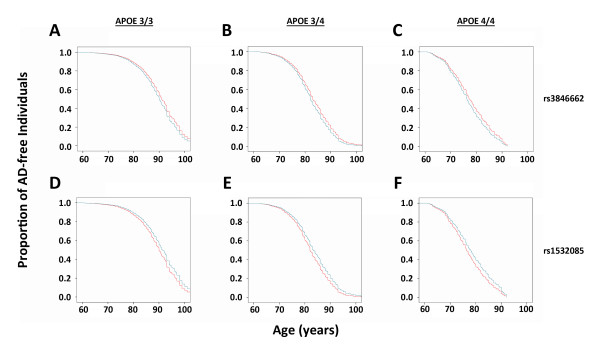
Figure 1
Figure 1
Both rs3846662 and rs1532085 are significantly associated with AD age-of-onset. (A-C) Carriers of the rs3846662_G allele exhibit a significantly earlier onset of AD than AA homozygotes, stratified by the number of APOE-ε4 alleles present. (D-F) Individuals homozygous for the A allele of rs1532085 exhibit a significantly later onset of AD than carriers of the G allele, again stratified by the number of APOE-ε4 alleles present. (A/D - no APOE-ε4, B/E - 1 copy of APOE-ε4, C/F - 2 copies of APOE-ε4)
Figure 2
Figure 2
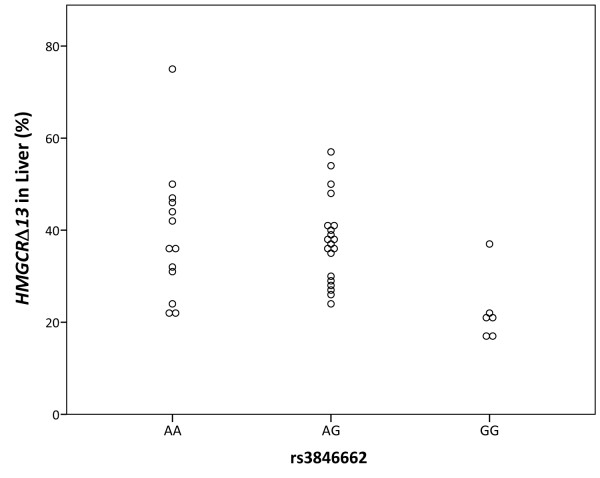
Rs3846662 is significantly associated with percent HMGCRΔ13 in human liver. Individuals homozygous for the G allele of rs3846662 exhibit the most efficient splicing of HMGCR exon 13 (p = 0.026, ANOVA. We note that GG homozygotes also exhibit an increased risk of AD and exhibit increased total and LDL cholesterol.
Figure 3
Figure 3
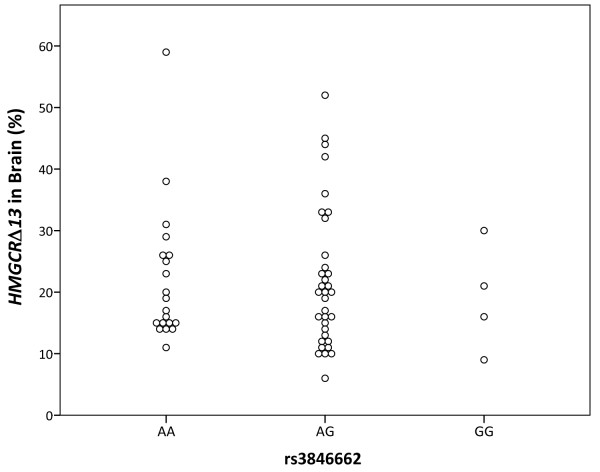
Rs3846662 is not associated with percent HMGCRΔ13 in human brain. However, we are underpowered to observe a significant difference (p ≤ 0.05) in percent HMGCRΔ13 between rs3846662 genotypes given the overall high level of exon 13 inclusion in brain cDNA and the possibility that rs3846662 may affect HMGCR exon 13 in a cell-type dependent manner.
Figure 4
Figure 4
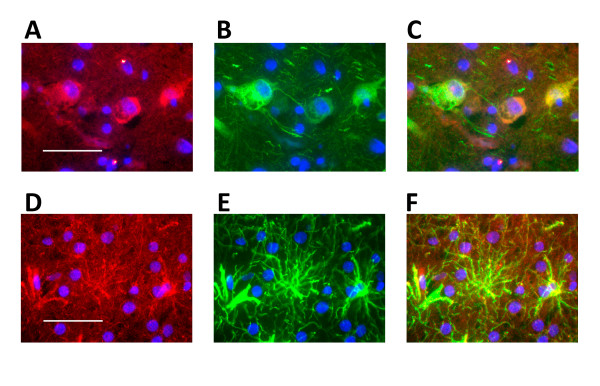
Immunostaining reveals that HMGCR is present in both neurons and glia. (A-C) HMGCR (A) is expressed within MAP2 labeled neurons (B) per merging of the two images (C). (D-F) Likewise, HMGCR (D) is also expressed in GFAP positive glia (E) per merging of the two images (F). Size bars in A and D represent 50 μm.
Figure 5
Figure 5
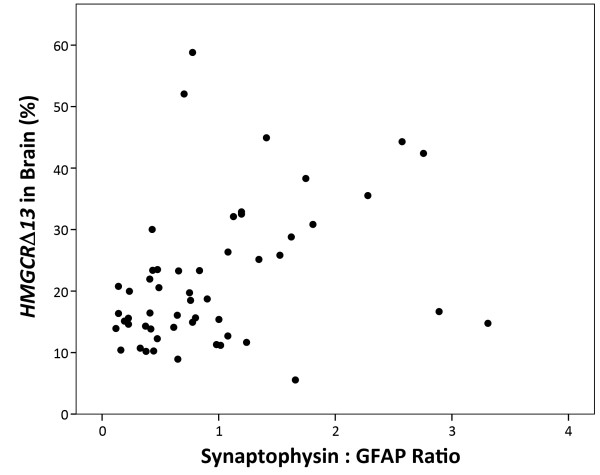
HMGCR exon 13 splicing efficiency is associated with the ratio of neuronal to glial markers. The percentage of HMGCRΔ13 in brain is significantly correlated with neuronal versus astrocyte enrichment in brain samples as determined by the ratio of synaptophysin: GFAP expression (p = 0.026, Pearson correlation = 0.339).
Figure 6
Figure 6
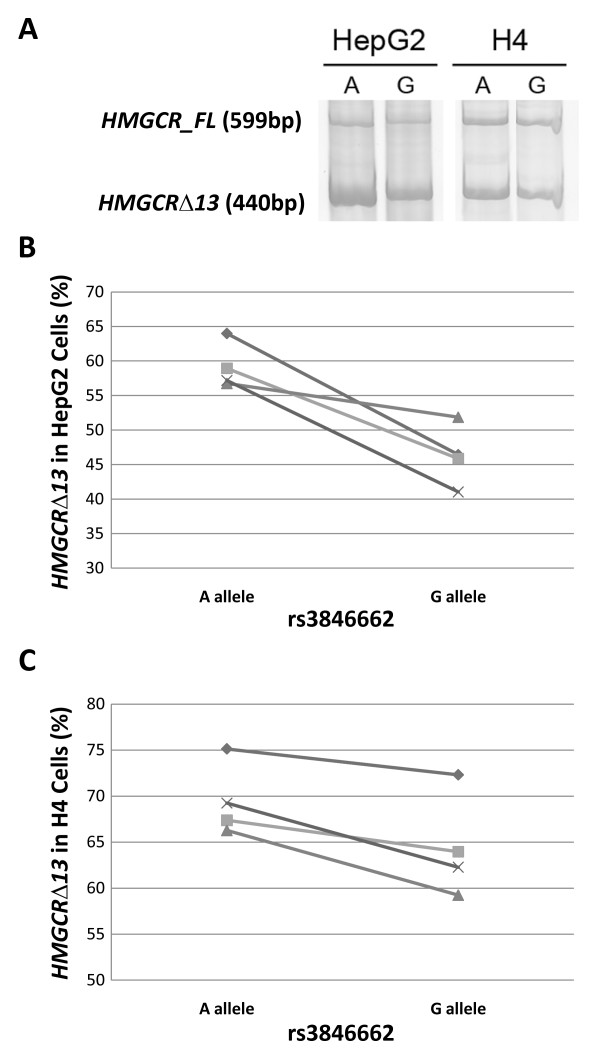
Rs3846662 functionally modulates percent HMGCRΔ13 in vitro in HepG2 and H4 cells. Cells were transfected with HMGCR exon 12-14 mini-genes that contained either the A or G allele of rs3846662. Vector-derived HMGCR isoforms were separated by PAGE and visualized by using SYGR-gold fluorescence (A). The G allele of rs3846662 was consistently associated with increased retention of HMGCR exon 13 in both HepG2 (B) and H4 (C) cell lines relative to the A allele (p = 0.02, Student's paired t-test).
Figure 7
Figure 7
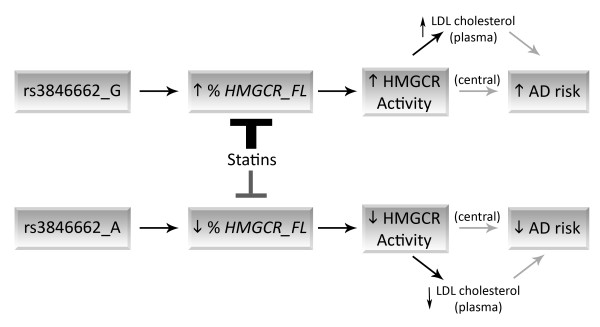
The alleles of rs3846662 differentially affect HMGCR exon 13 splicing, statin responsiveness, LDL cholesterol and potentially AD risk. Individuals carrying the rs3846662_G allele are prone to retain HMGCR exon 13, resulting in a greater proportion full-length HMGCR mRNA (% HMGCR_FL) and thus higher LDL cholesterol as a result of increased cellular HMGCR activity. Consequently, AD risk may be increased in these individuals due to a peripheral effect on plasma LDL and/or a central effect on HMGCR. Individuals carrying rs3846662_G, who are prone to both increased LDL and AD risk, are also predicted to be more responsive to stain therapy than individuals homozygous for the rs3846662_A allele (who tend to inefficiently splice HMGCR exon 13). Thus, rs3846662 genotype may not only increase AD risk but may also help separate potential responders from non-responders in statin trials to prevent AD.

References

    1. Gatz M, Pedersen NL, Berg S, Johansson B, Johansson K, Mortimer JA, Posner SF, Viitanen M, Winblad B, Ahlbom A. Heritability for Alzheimer's disease: the study of dementia in Swedish twins. J Gerontol A Biol Sci Med Sci. 1997;52:M117–125. - PubMed
    1. Gatz M, Reynolds CA, Fratiglioni L, Johansson B, Mortimer JA, Berg S, Fiske A, Pedersen NL. Role of genes and environments for explaining Alzheimer disease. Archives of general psychiatry. 2006;63:168–174. doi: 10.1001/archpsyc.63.2.168. - DOI - PubMed
    1. Corder EH, Saunders AM, Risch NJ, Strittmatter WJ, Schmechel DE, Gaskell PC Jr, Rimmler JB, Locke PA, Conneally PM, Schmader KE. et al. Protective effect of apolipoprotein E type 2 allele for late onset Alzheimer disease. Nature genetics. 1994;7:180–184. doi: 10.1038/ng0694-180. - DOI - PubMed
    1. Strittmatter WJ, Roses AD. Apolipoprotein E and Alzheimer disease. Proceedings of the National Academy of Sciences of the United States of America. 1995;92:4725–4727. doi: 10.1073/pnas.92.11.4725. - DOI - PMC - PubMed
    1. Davidson Y, Gibbons L, Pritchard A, Hardicre J, Wren J, Stopford C, Julien C, Thompson J, Payton A, Pickering-Brown SM. et al. Apolipoprotein E epsilon4 allele frequency and age at onset of Alzheimer's disease. Dementia and geriatric cognitive disorders. 2007;23:60–66. doi: 10.1159/000097038. - DOI - PubMed